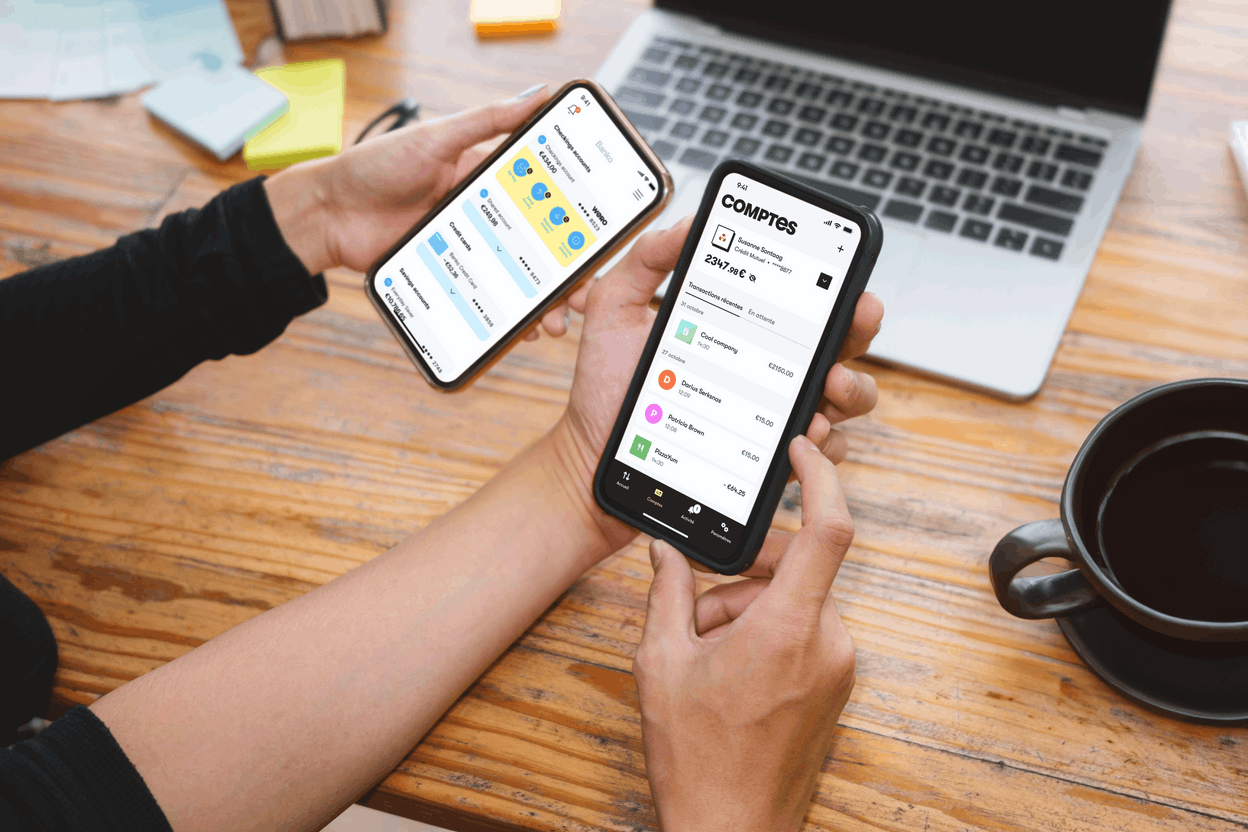
To pay back a friend, a Luxembourg client could use Wero with their phone number. A few years later, their bank might offer them a digital euro wallet to carry out virtually the same transaction. Behind these two almost identical experiences, however, lie two different conceptions of European money.
Wero represents the banking channel. The solution developed by the European Payments Initiative triggers an instant transfer between the payer’s account and the payee’s account. The money remains a claim on a commercial bank. The user does not need to provide or enter an IBAN.
In Luxembourg, Wero is set to replace Payconiq on a bank-by-bank basis. BGL BNP Paribas, BIL, Raiffeisen Bank, Spuerkeess and Post Finance have announced that it will be rolled out from summer 2026. Banque de Luxembourg is due to follow in spring 2027. The Payconiq app will remain available until 30 September 2026, according to the timetable provided to customers.
This migration gives Wero a decisive advantage: the solution isn’t starting from scratch. It takes over the users and some of the functionality already set up by Payconiq. Once their business is connected, customers will need to download the Wero app and link it to their account, unless the feature is directly integrated into their banking app.
Wero already enables peer-to-peer transfers in Belgium, France and Germany. In February 2026, EPI reported having around 47 million users across these three countries. Online payments are being rolled out gradually, ahead of in-shop payments and additional services such as subscriptions, loyalty schemes, shared expense management and deferred payment.
A new direction for Satispay and Worldline
The digital euro takes a different approach. It will not involve transferring a deposit between two banks: it will give individuals access to a currency issued by the European Central Bank and the national central banks. A digital euro will always be worth one euro, just like a banknote, but can be held in a digital wallet.
Luxembourg is directly involved in its preparation. Satispay Europe and Worldline Financial Services (Europe), two non-bank service providers based in the country and members of the ABBL, are among the 36 organisations selected by the ECB. The pilot is due to begin in the second half of 2027 and will last 12 months.
Participants will be asked to test a pilot version in situations similar to those encountered in everyday life. The programme must cover the opening of wallets, funding them from a bank account, payments, the management of holding limits and the user experience. This experimental currency will not be legal tender and will not yet constitute the definitive digital euro.
Luxembourg is thus having it both ways. Its banks are supporting the immediate roll-out of a private European solution. Two payment companies based in Luxembourg will contribute to the design of a public infrastructure, with an initial issuance still planned for 2029, subject to the adoption of the European regulation and a final decision by the ECB.
A distinction that is probably abstract
For consumers, the distinction is likely to remain an abstract concept. Both Wero and the digital euro promise to enable payments to be made to friends and family, shops or websites without relying on US card networks. Both aim to operate across national borders and make payments as instant as sending a text message from a mobile phone.
The digital euro would nevertheless retain several unique features. It is expected to be accessible even without a bank account, to be widely accepted across the eurozone, and to enable offline payments between two devices in close physical proximity. Basic services would be free of charge for individuals. Balances held would not earn any interest and would be subject to a limit, the exact amount of which has yet to be determined.
Wero, on the other hand, is several years ahead of the game. It uses existing bank accounts, relies on the banks that consumers already use, and will be able to offer commercial services that the public currency is not intended to develop itself.
The ECB refuses to portray these projects as competitors. It believes that the standards and components of the digital euro could help European private-sector solutions to expand across the euro area. The two wallets could even be offered via a shared interface.
From 4… to 18 billion in costs
The Eurosystem does, however, recognise the risk of inefficient investment if private and public infrastructure is developed separately. This issue takes on particular significance in Luxembourg: banks must prepare for the introduction of the digital euro whilst also funding the replacement of Payconiq with Wero. The ABBL does not have consolidated statistics on the budgets already committed by its members. It also points out that many banks in Luxembourg belong to international groups and that the main investments will be managed at that level.
A study published by the European Banking Federation, based on a survey of 19 banks, estimated their initial costs associated with the digital euro at over €2bn, or around €110m per institution. When extrapolated to the euro area, this figure reached €18bn, of which around 75% would be spent on technical adaptations. The ECB has since presented a lower estimate, ranging from €4 to €5.8bn, largely thanks to the pooling and reuse of existing infrastructure. These estimates are not based on the same scope, and none of them constitutes a final figure.
The challenge goes beyond cost. Only 45% of consumers surveyed in 2024 across 11 eurozone countries said they were likely to use the digital euro. This figure had, however, risen from the 28% recorded in 2022. Information plays an important role: a video explaining the project’s features had boosted interest in offline payments by 13 percentage points. The digital euro will therefore need to demonstrate its usefulness to Europeans who already have cards, banking apps and instant transfers at their disposal. In Luxembourg, the comparison will be even more direct, as Wero will have already begun to establish itself in the market.
The difference between the two solutions becomes crucial in times of crisis: money held in a digital euro wallet will be a claim on the Eurosystem, rather than on a commercial bank. But when standing at a till, the customer will simply see two buttons allowing them to pay the same bill. The success of the public scheme will depend on its ability to highlight what Wero cannot offer: universality, offline functionality and direct access to a central bank currency.