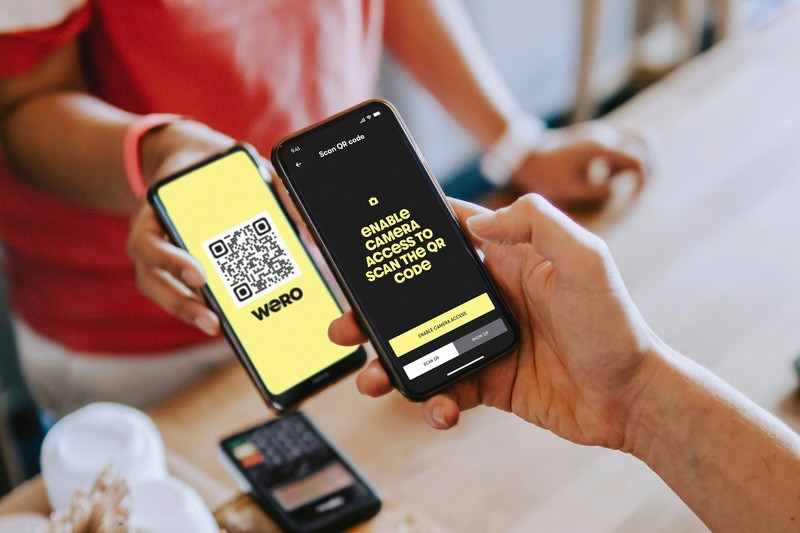
Wero’s offensive in European payments comes in a rapidly expanding market. In the first half of 2025, the eurozone recorded 77.7 billion non-cash payments, up 7.7% year-on-year, with a total value of €116,000bn, according to the European Central Bank (ECB). This growth reflects a rapid transformation in usage, driven by digitisation and the widespread use of contactless payments.
Cards dominate in terms of volume. They account for 57% of transactions, or around 44 billion payments over six months, with a total value of €1,700bn. The average amount per transaction was €38, confirming their central role in everyday spending. Contactless, with 29.6 billion transactions (+12.8%), is now the standard, supported by a network of 24.7 million terminals, 93% of which are compatible.
Credit transfers, 92% of value
This dominance in terms of volume does not, however, translate into value. Credit transfers, which represent only 22% of transactions, alone account for €107,300bn, or 92% of the total value of non-monetary payments in the eurozone. This dissociation between volume and value structures the market profoundly: cards capture everyday payments, while credit transfers dominate major economic flows.
This is precisely the space in which Wero fits. Based on Sepa instant transfers, which already account for 23% of transfer volumes in the eurozone, the European solution capitalises on an existing and fast-growing infrastructure. With commissions estimated at around 0.7%, it is positioned directly against the card networks on low-value payments, where sensitivity to fees is highest.
Cross-border, the goose that lays the golden eggs
But this competition only affects part of Visa and Mastercard’s business model. Their profitability is largely based on cross-border transactions. These flows, identified as “international transaction revenues” at Visa and “cross-border volume fees” at Mastercard, represent around 25 to 30% of their turnover, with an even higher contribution to margins. In terms of volume, they represent only a fraction of payments, around 10 to 15%, but concentrate a disproportionate share of the economic value.
This outperformance is explained by the complexity of international payments. Each transaction involves currency conversion, risk management, compliance with multiple regulatory frameworks and the orchestration of flows between jurisdictions. Mastercard operates in over 220 countries and territories and processes payments in more than 150 currencies, while its network handles the bulk of cross-border card transactions. Visa, for its part, points out that cross-border growth remains higher than the levels seen before the pandemic, driven in particular by international e-commerce, which accounts for almost 40% of these flows.
The limits of Wero
With this global infrastructure, the limits of Wero become clear. Built on Sepa rails, the system operates in euros and within a uniform regulatory framework. It has no native currency conversion capabilities, no global acceptance network, and no multi-jurisdictional clearing infrastructure. Its scope remains essentially intra-European.
At the same time, Visa and Mastercard are adapting their strategy to incorporate the new technologies likely to transform cross-border. Visa has facilitated more than $140bn in flows linked to crypto-assets and stablecoins since 2020, with more than 130 associated card programmes in more than 40 countries. The group is developing stablecoin settlement solutions and integrating them into its transfer infrastructures, particularly for international payments.
These technologies reduce the friction associated with cross-border payments, by making transfers almost instantaneous and continuously available. But they do not eliminate the need for orchestration, compliance or risk management. By positioning itself as an intermediary between banks, fintechs and these new rails, Visa is transforming a potential disruption into a growth lever.
In parallel, both groups are investing in real-time transfer solutions, such as Visa Direct or Mastercard Move, in order to capture a growing share of international off-card flows. This strategy illustrates a broader repositioning: the networks are no longer defined solely as card operators, but as global infrastructures for the circulation of value, capable of integrating different types of payment rails.
Real but targeted pressure
In this context, the pressure exerted by Wero on domestic fees appears real, but targeted. It is affecting low-margin segments, without calling into question the core of the business model. The real challenge remains the control of cross-border flows, where the barriers to entry—technical, regulatory and economic—remain considerable.
Europe now has an efficient infrastructure for domestic payments, with growing adoption of instant transfers. But the economic value of payments continues to be concentrated on a global scale, in flows that regional initiatives do not yet capture. So while Wero is redrawing the balance of payments in Europe, the rent of US networks remains, for the time being, firmly entrenched in the international financial system.