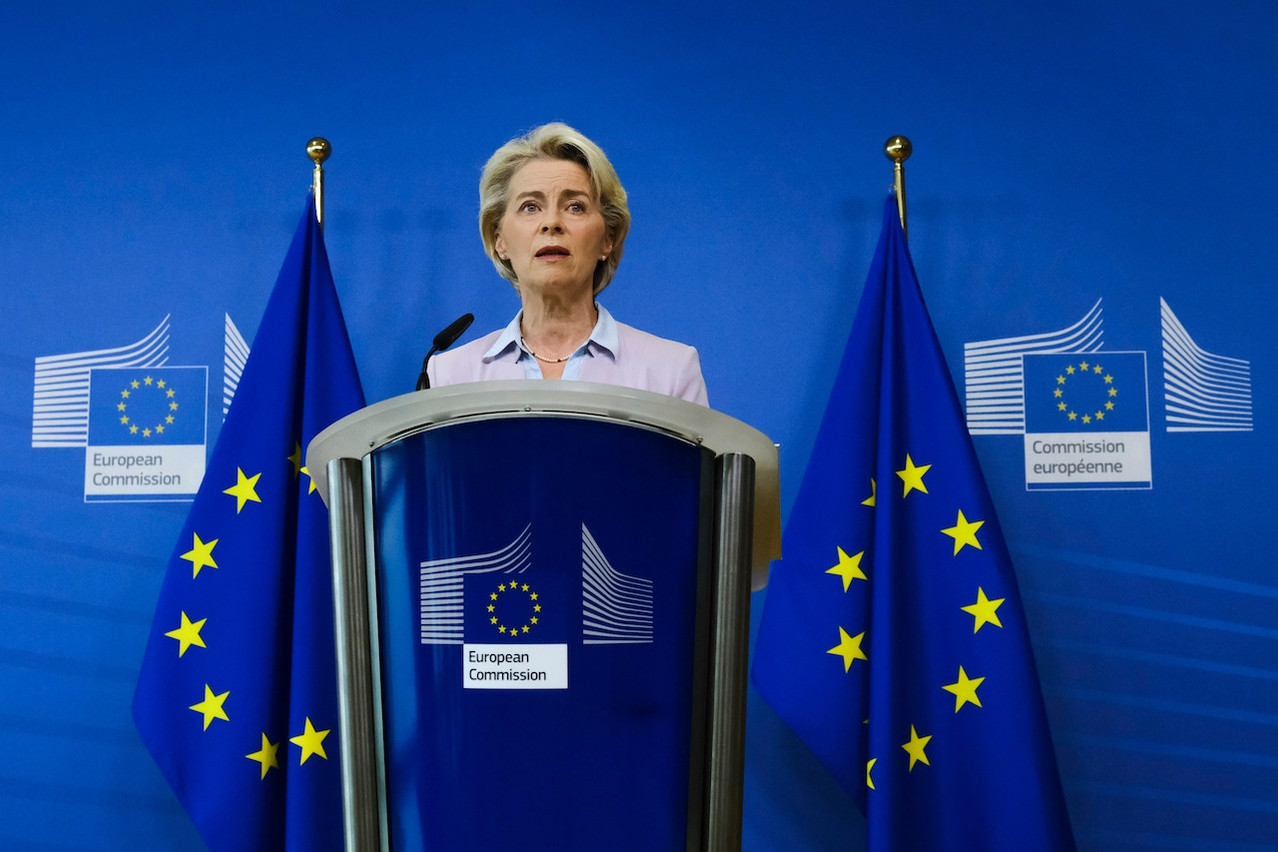
Ursula von der Leyen’s candidacy for a second term at the head of the European Commission was approved by 401 votes to 282 on Thursday. Even though votes were cast by secret ballot, 401 votes represents exactly the number of MEPs in her majority--188 EPP, 136 S&D and 77 Renew. The support von der Leyen had hoped for from Green MEPs and members of the populist CRE group did not materialise. Nor did the feared defections, particularly within the EPP.
282 MEPs voted against, while 15 abstained. 7 ballots were blank. This week’s EU court ruling on the commission’s contracts with the pharmaceutical industry during the covid crisis apparently had no impact on the election.
Roadmap
Re-elected. But on what programme?
Von der Leyen presented her vision of a stronger, more prosperous Europe to MEPs. This vision was accompanied by proposals designed to broaden her electoral base, made up of the EPP, S&D and Renew, the Greens and Giorgia Melloni's European Conservatives and Reformists (ECR). The main proposals include a new pact on clean industry "to encourage decarbonisation and industrial growth", a plan for agriculture "that adapts to climate change", a European competitiveness fund to support innovation, a European plan for affordable housing, a roadmap for women's rights, doubling the staff of Europol and tripling the number of European border and coast guard officers to 30,000.
The outgoing president also proposed a European shield for democracy to combat the manipulation of information and foreign interference. In terms of foreign policy, she reaffirmed the EU's unwavering support for Kiev, reiterating that "Europe will stand by Ukraine for as long as it takes". She also called for an end to hostilities in the Gaza Strip.
Four new areas of competence
The von der Leyen II commission will have four new areas of responsibility, like so many new political priorities to be shared out between the 27 European commissioners who will make it up.
Firstly, there will be a commissioner responsible for housing "with a view to remedying the housing crisis affecting all member states". Such a post was a demand of the European Socialists during the campaign. A request echoed by the Luxembourg Socialists.
A commissioner will be responsible for the Mediterranean "in order to promote regional stability and cooperation" in a region of the globe that has been pivotal in the migratory crisis that the EU has been experiencing in recent years. This is a sensitive issue, with NGOs criticising a willingness to enter into political agreements with regimes that have little regard for democracy and human rights.
A commissioner assigned to intergenerational equity will be responsible for defining policies that take account of the needs of future generations. This may be seen as a sign of the political will to define minimum pension thresholds along the lines of what is being done for a European minimum wage.
Finally, a new post of commissioner for defence, whose role will be to lead the European Defence Union. The aim here is not to conduct military operations, but to accelerate the growth of European defence equipment production capacities. In the shorter term, their first task will be to set up a comprehensive air defence system to protect European airspace. According to von der Leyen, this would be "a powerful symbol of European unity in defence matters".
On 19 July, the first plenary session of the tenth legislature of the European Parliament will conclude with the setting up of the parliamentary committees.
Read the original French language version of this report here