Trade union unity in the banking sector? This was not a foregone conclusion, if we recall the union psychodrama that led to the loss of Aleba’s sectoral representativeness. A sectoral representativeness that the union was unable to regain at the ballot box during the last social elections.
A past forgotten in the name of trade union unity in the face of an Luxembourg Bankers’ Association (ABBL) accused of knowingly degrading employees’ working conditions :in the name of hypothetical threats to competitiveness despite stratospheric profits”.
An ABBL on whose back a trade union front is being rebuilt. With the exception of the renewal of the collective agreement for banks in 2019, the ABBL has always been able to manoeuvre between the country’s three representative unions--national representativeness for the OGBL and the LCGB and sectoral representativeness for the Aleba--to reach agreements in which its members--and above all the parent companies of the major groups present in the marketplace--could find common ground. With the loss of Aleba’s sectoral representation--although its influence in the field remains very real--the situation has changed.
Read also

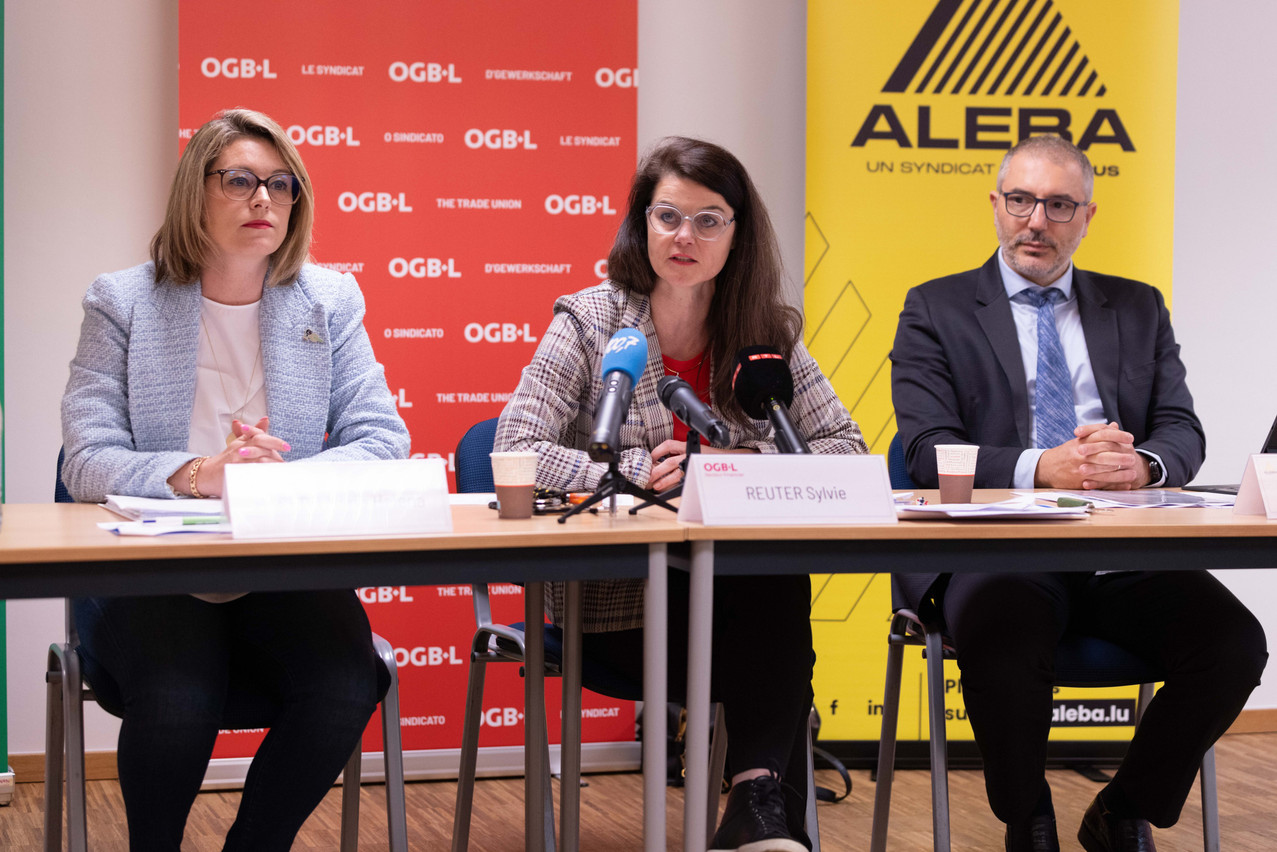
For Reuter, “if we all pull in the same direction, there’s no reason why it can’t work.” This three-way marriage can be seen as a renewal. We’re giving ourselves this chance. Negotiations began before the social election campaign. A campaign that was clean. We’re going to continue in that spirit.” The spirit? “To defend employees and negotiate a better collective agreement for everyone,” stated Macedo.
This spirit is reflected in a common set of demands. “We drew up this joint list of demands by taking the best ideas from the three unions. It is not the demands of this or that union for this or that share. It is the demands of the trade union front,” said Mendolia.
Ambitious catalogue of demands
What does it include?
Firstly, an increase in the starting salary--“a salary close to the social minimum wage”--a revision of the salary scale, an upward revision of the loyalty bonus and the introduction of a new management group. This new group may be outside the scale, but not outside the agreement. The unions see this as a way of resolving the problem of bogus executives.
The unions are united on the guarantee of the individual right to training and on the creation of an individual training savings account, as well as on the strengthening of individual and collective rights in the event of redundancy. They are also calling for stronger rights for employees in terms of work-life balance and mental health.
They are also calling for an agreement on the use and employment consequences of artificial intelligence.
Originally published in French by Paperjam and translated for Delano