In July, the unemployment rate in the eurozone fell to a record low of 6.4%, compared with 6.5% in June. This is a surprising development, given the sluggish growth, weak demand and restrictive monetary policy aimed at slowing inflation. While demographics are leading to structural tightening, the low unemployment rate is partly attributable to companies retaining workers in the hope that demand will soon pick up again.
European Central Bank officials have repeatedly warned that a “surprisingly strong” labour market could accelerate wage inflation. However, divergences within the eurozone member states are complicating the ECB’s task. As the graph below shows, the unemployment rate has fallen in some countries over the past two years, while it has risen in others, notably Luxembourg.
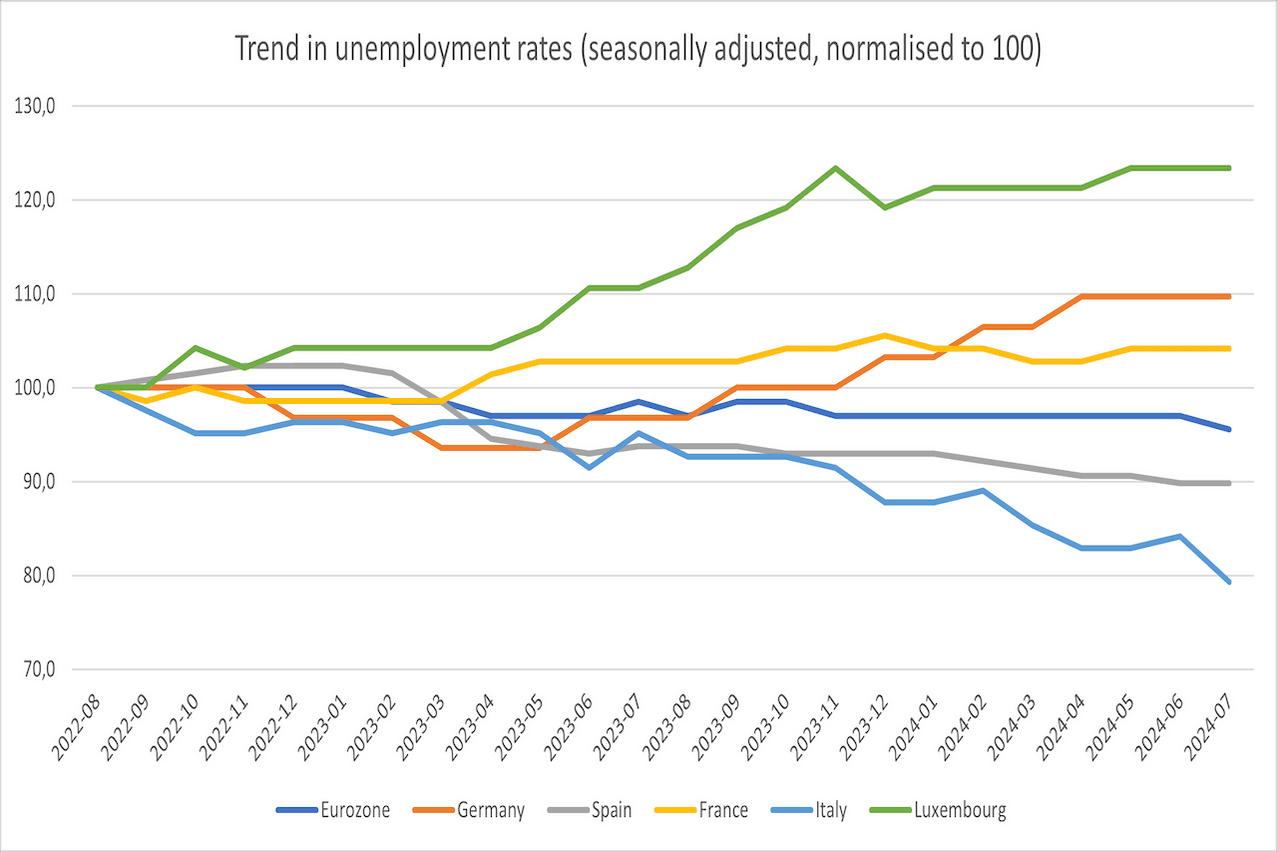
Trends in certain unemployment rates (monthly data, seasonally adjusted, normalised to 100). Source: Eurostat, Bloomberg, BIL
It should be noted that the unemployment rate in Luxembourg, while tending to rise, remains lower than in other countries.
Brief analysis of eurozone data
Unemployment is moving in the right direction in the more service-oriented economies (particularly those with a booming tourism sector). In Italy and Spain, for example, unemployment rates have fallen to levels not seen since 2008. Germany, on the other hand, has seen its unemployment rate rise as a result of the continuing malaise in industry. However, the rate remains low overall, and German trade unions are continuing to call for higher wages. This year, real incomes in the country are expected to grow at one of the fastest rates since 2000, as workers attempt to regain the purchasing power lost as a result of the pandemic. In France, the unemployment rate currently stands at 7.4%, compared with 7.2% in August 2022. The labour reforms introduced by Emmanuel Macron, which aim to achieve full employment by 2027, have made it easier for companies to negotiate wages directly with their employees, without the need for unions and collective agreements, impacting entire sectors. The government has also attempted to simplify recruitment and dismissal procedures.
The situation in Luxembourg
The number of resident jobseekers registered with Adem stood at 17,901 at the end of July, an increase of 11.1% compared with July 2023, which mainly affected the most highly qualified profiles. Over the same period, job vacancies fell by 20.8%, bringing the total to 7,539. Many positions remain unfilled due to skills mismatches, particularly in terms of language and technical skills. From a sectoral point of view, “professional, scientific and technical services” are the most affected by labour shortages. In this respect, efforts are currently being made to attract more non-EU experts in “highly qualified professions considered to be in short supply.”
When analysing the data, it is clear that the fall in job vacancies and the increase in jobseekers are, to a large extent, attributable to the current slowdown in real estate and the restructuring of financial services. The Luxembourg property sector was one of the first victims of the rise in interest rates. To illustrate the scale of the slowdown, at the end of last year transactions for flats reached their lowest quarterly level since the creation of the land registry in 2007. This development has had a clear impact on a whole range of professions, from brokerage to property development, construction and installation.
Read also
The financial sector accounts for 25% of the country’s GDP. In recent years, given the more difficult macroeconomic context, several banks and financial institutions have restructured or refocused their activities. Digitalisation has also spread throughout the sector. A reduction in the workforce in Luxembourg automatically has a greater impact on the country’s overall unemployment rate because of its size. If 200 workers were suddenly made redundant tomorrow in the grand duchy, the total number of jobseekers would rise by 1.12% to 18,101. On the other hand, if a German bank made the same number of people redundant, the impact on the unemployment rate would be negligible, given that the country has 2.6m unemployed.
Outlook for the Luxembourg labour market
The Chamber of Commerce’s latest economic barometer, published in June 2024, revealed that 65% of companies plan to maintain their workforce over the next six months, despite the difficult economic climate. 17% of businesses plan to make redundancies, while 18% expect to increase staff numbers, suggesting a slowdown in job creation. The outlook varies considerably from one sector to another. Companies in manufacturing, construction and trade are more likely to anticipate a decline in staff numbers than an increase. The financial and non-financial services sectors, on the other hand, are more optimistic: 23% and 22% of companies respectively expect their workforce to increase, while only 8% and 12% anticipate a reduction.
Overall, the European Commission expects Luxembourg’s unemployment rate to stabilise at 5.8% this year, before falling slightly to 5.7% in 2025. Lower interest rates will certainly contribute to this. Given the interest rate differential, the Fed’s willingness to initiate rate cuts bodes well, with the ECB now freer to pursue its own interest rate cuts to support the eurozone economy. If the Fed had maintained the status quo, further easing by the ECB would probably have weakened the euro, which could have pushed up inflation in the currency bloc.
This article was originally published in French.