
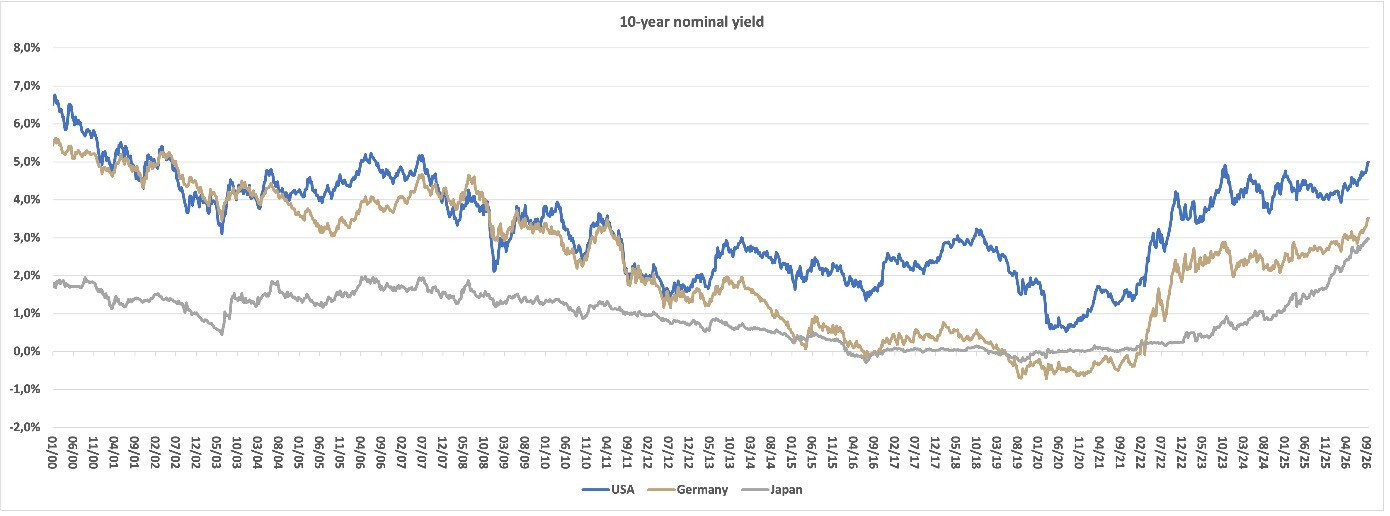
Long-term (10-year) rates have risen by more than 70 basis points since the start of the year and have returned to the levels seen before the 2008 financial crisis. The sharp rise in short-term rates – reflecting the tightening of monetary policy – and the restoration of the term premium account for most of the upward movement in long-term yields. The component relating to inflation expectations has risen only very slightly.
(Source: Bloomberg, Banque de Luxembourg)
Tightening of monetary policy and a rise in short-term interest rates
Inflation, largely fuelled by the fallout from the conflict in the Middle East, is currently running at over 3% in both the eurozone and the United States. Fearing that soaring energy prices might spread to the wider economy, particularly via wages, central banks have embarked on a cycle of monetary tightening, leading, on the one hand, a complete reversal of the expectations that prevailed at the start of the year and, on the other hand, a sharp rise in short-term interest rates driven by the real component. The resilience of growth, confirmed by the recent improvement in leading indicators, is also making the monetary authorities’ task easier.
In the eurozone, the European Central Bank (ECB) has raised interest rates twice this year, once in June and again in September. Markets are anticipating a third rise by the end of the year. Across the Atlantic, the Federal Reserve also implemented its first interest rate rise since 2023 in September, and the markets are expecting a further rise by the end of December.
Funding requirements of governments and the technology sector
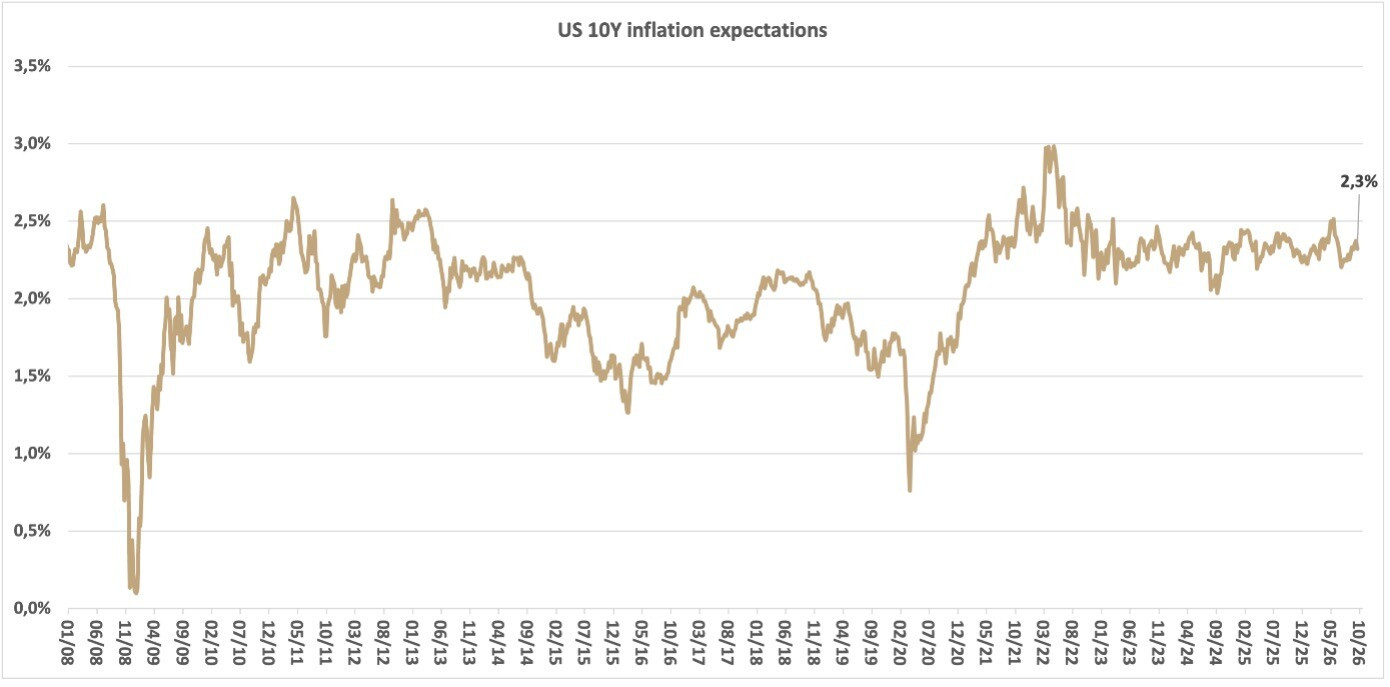
Whilst price growth has accelerated significantly in recent months, longer-term inflation expectations as reflected in the bond markets have risen only very slightly since the start of the year. In other words: the markets do not currently anticipate inflation becoming “unanchored” over the long term and remain confident in the ability of central banks to eventually bring rising prices back towards their target. These relatively stable inflation expectations cannot, therefore, justify the sharp rise in long-term yields.
(Source: Bloomberg, Banque de Luxembourg)
The rise in long-term interest rates appears to be largely attributable to a recovery in the term premium: investors are demanding an additional risk premium in order to raise capital over long maturities. We identify several factors that explain this:
– The resurgence of concerns about the sustainability of public finances. The challenges facing developed countries are indeed colossal, with structural upward pressure on expenditure linked, in particular, to ageing populations, defence and the rising interest burden (the financial cost of debt). The case of the United States is particularly illustrative. Public debt has quadrupled since 2008 and, at the end of August, just passed the symbolic milestone of $40trn. The highly expansionary fiscal policy is keeping the deficit at a far too high level, close to 6% of GDP. Interest payments now exceed $1trn, or more than 3% of GDP, an amount greater than the US defence budget. In the absence of credible measures to curb the deficit’s trajectory, investors are logically demanding a higher risk premium on long-term maturities, contributing to a rise in yields.
– The massive funding requirements of major technology firms. Capital expenditure by hyperscalers (Amazon.com, Alphabet, Microsoft, Meta Platforms and Oracle) is expected to exceed $4trn between 2026 and 2029. However, these colossal investments in artificial intelligence (data centres, etc.) are, on the whole, no longer covered by these companies’ cash flow generation. They are therefore forced to turn to the bond markets. The emergence of these new players is generating greater competition amongst issuers, which is also contributing to the upward trend in interest rates. Furthermore, the major central banks have scaled back their bond purchases, meaning that private investors are increasingly called upon. Private investors, who are sensitive to price-to-yield ratios, demand a higher return on their investments.
Concerned about the impact of tensions at the long end of the yield curve on the US economy and public finances, the US Treasury Secretary, Scott Bessent, announced in mid-September that the maximum size of long-term debt buybacks carried out by the US Treasury for liquidity purposes would be tripled (from $2bn to $6bn). However, the Secretary’s objective here is far removed from improving liquidity at the longest maturities; rather, it stems from a desire to curb the rise in yields.
Debt buybacks remain limited
These buybacks are very limited in relation to the total volume of US debt. They are, moreover, financed from the Treasury’s current account and, ultimately, through the issuance of short-term debt (T-bills). The Treasury is therefore becoming increasingly dependent on short-term securities and, indirectly, on the Federal Reserve’s monetary policy decisions.
In order to address market concerns, the development of a credible, multi-year plan aimed at reducing the deficit to 3% of GDP – a target clearly set out by Scott Bessent upon his appointment – would go some way towards reassuring investors.
An increased risk of market volatility
In conclusion, we are likely entering a period of structurally higher nominal interest rates, with yields returning to the levels seen before the 2008 financial crisis.
Despite this rise in the cost of capital, we are maintaining a slight overweight position in equities within our managed portfolios. Risky assets continue to be underpinned by solid earnings momentum. The main risk facing equities is that of an excessive tightening of monetary policy, which would weaken the investment cycle and economic growth. Leading indicators, both in the eurozone and in the US, currently rule out such a scenario.
On the bond front, we are maintaining our structural underweight position. We do not yet consider real sovereign yields in the eurozone to be sufficiently attractive. Within this asset class, we favour exposure to corporate bonds with relatively short maturities. In this new market environment, caution remains the order of the day and we remain fully vigilant.