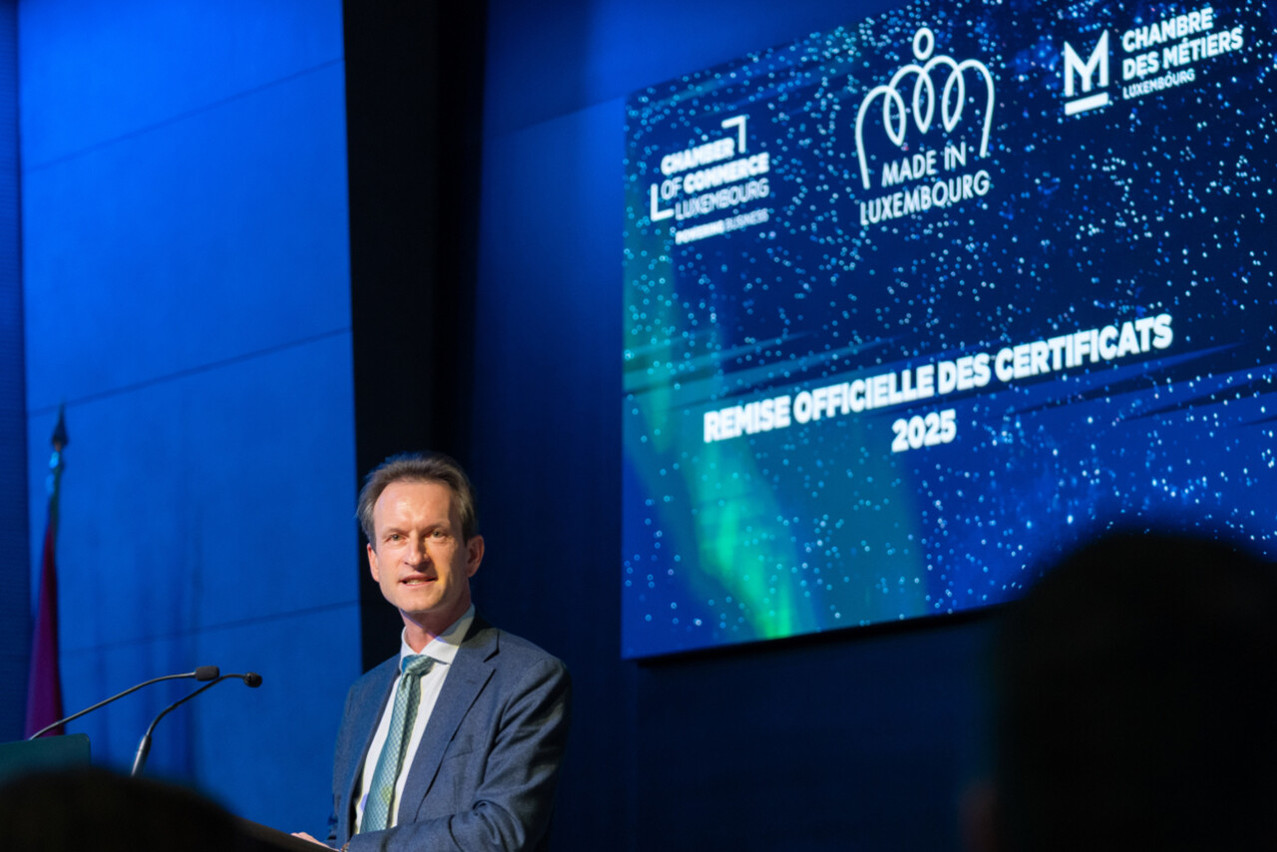
The scheme is attracting more businesses but losing some sectors. Having certified 172 companies for the year 2025, its administrators are closing the door to the catering, accommodation and subcontracted services sectors.
The new regulations governing the “Made in Luxembourg” collective mark set out the conditions that will apply to new applications and renewals. Certificates granted previously remain valid until their expiry date. The label is issued for five years by the Chamber of Commerce or the Chamber of Skilled Trades and Crafts, depending on the company’s membership.
The main change concerns services. These must be offered and provided directly by the company, without subcontracting. For digital services, the design, development and maintenance must be carried out in Luxembourg. A consultancy firm must demonstrate specific expertise or the application of professional standards specific to the country and essential to the provision of its services.
The catering and accommodation sectors join finance and property among the services explicitly excluded. Foreign franchises, businesses whose main activity is directly linked to a foreign brand, and those limited to purchase and resale without processing or substantial value-add in Luxembourg are not eligible.
More than 2,000 businesses have been awarded the label
Companies must also provide evidence that they have been established in Luxembourg for at least 12 months. The regulations allow the chambers to examine, amongst other things, obligations regarding filing with the Trade and Companies Register, statutory notices, online presence and vehicle registration, in order to assess the authenticity of this establishment.
As regards products, the principle remains that they must be manufactured locally or undergo their final substantial processing in Luxembourg. Simply preserving, cutting up or freezing a foodstuff is not sufficient to confer a Luxembourgish origin upon it.
The granting and renewal of licences are now subject to the payment of a non-refundable licence fee. The regulations set the maximum fee at €500 excluding tax for five years. However, the application form viewed shows a fee of €200 excluding tax.
The tightening of the criteria comes at a time when the number of awards remains high: 172 companies had been awarded the label for 2025. This latest round of awards has brought the announced total to over 2,000 certified companies.
A sticker that influences purchasing decisions
Quantitative success does not reveal what the label brings to businesses. The main public study found dates back to 2015. Students from the School of Business and Management (ECG) surveyed 834 consumers across the country. 54.8% were aware of the label. Of those who were familiar with it, 87% could name a company or product covered by the scheme. More than half stated that the label influenced their purchasing decisions.
Another survey, carried out in 2016 amongst certified companies, had yielded positive feedback. Luxlait, Salaisons Meyer, Majerus-Parmentier and Etix Group associated the label with responsible production in the eyes of their customers and as a guarantee of quality overseas.
Since then, the chambers have emphasised commercial differentiation, transparency regarding origin and credibility in export markets. Several companies have attested to the label’s usefulness in foreign markets. However, these accounts do not allow us to isolate its effect on their commercial performance.