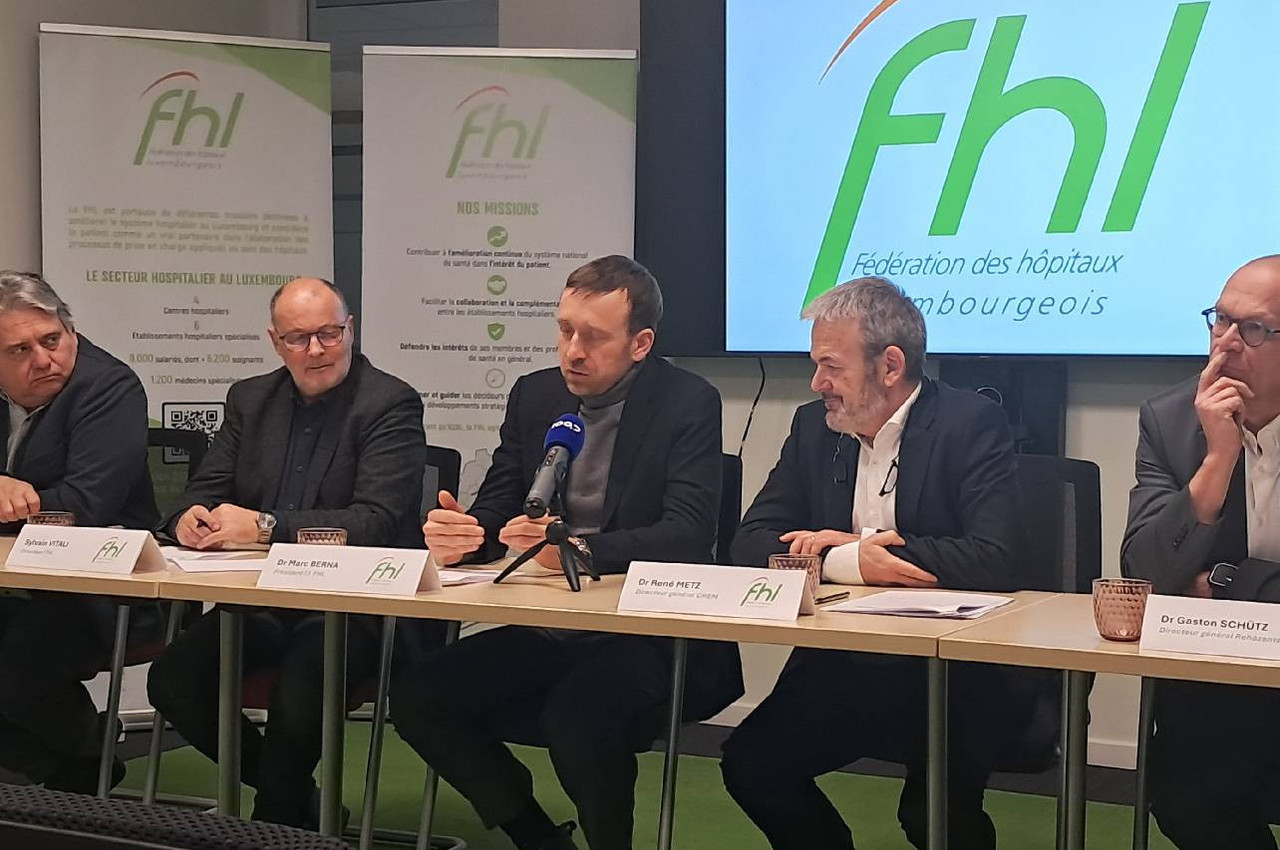
The Luxembourg Hospital Federation (FHL) presented its proposals for the next government programme on Monday 24 November. In front of an audience of decision-makers and journalists, Dr Marc Berna (director of Robert Schuman Hospitals), Sylvain Vitali (director of the FHL), Dr Guy Berchem (CHL), 
“The Luxembourg system, which is public, supportive and universal, has proved its worth,” Dr Berna pointed out. “But the cohesion and safety of care are evolving in a changing environment.” An ageing population, growing care needs, weak economic growth, pressure on talent: the diagnosis is clear, and for the FHL, the country can, and must, do better.
Growing pressure on medical resources
This fragility can already be measured in terms of medical staffing levels. In 2019 (the latest figure in the report), the country had just 2.98 doctors per 1,000 inhabitants, a ratio well below that of its neighbours (4.2 in Germany, 3.3 in Belgium, 3.2 in France). This is compounded by unfavourable medical demographics: the proportion of doctors under the age of 55 has fallen from 75% in 2005 to 57% in 2017, while that of the over-65s is rising.
This demographic weakness is compounded by another imbalance that weighs heavily on the organisation of healthcare. The country has few specialists in private practice, simply because many disciplines require heavy technical equipment that is difficult to set up outside hospitals. Setting up a private practice is therefore limited, if not impossible, in the majority of specialties.
This lack of out-of-hospital provision prevents a balanced distribution of activity between towns and hospitals. As a result, hospital establishments not only take on almost all specialist medicine, but also have to provide part of the primary care in certain complex areas (rheumatological, chronic inflammatory, cardiovascular or renal diseases, etc.). This overload is made all the more difficult to absorb by the fact that many essential tasks are still not highly valued, which makes the profession even less attractive.
Faced with this observation, the FHL wants to change the current model, which is considered to be too binary between private practice and salaried employment. It is proposing a hybrid model, retaining direct billing for procedures while adding fixed remuneration for essential tasks within the hospital, such as continuity of care and presence in emergencies.
Strengthening training
The issue of talent also highlights a major challenge for the country, that of training its healthcare professionals. Luxembourg currently relies on a massive influx of talent from outside the country. Almost two thirds of hospital teams come from the Greater Region,” said Dr Marc Berna. The FHL is calling for a drastic strengthening of the national training offer.
Today, out of 24 regulated healthcare professions, only ten can be studied in the territory, in particular by following a full course of medical studies including a master’s degree in Luxembourg. “As part of postgraduate training, Diplomas of Specialised Studies (DES) are to be drawn up as soon as possible for the most common medical disciplines,” the study also stresses.
Patient-centred care
In addition to the attractiveness of the professions, the FHL stresses the need to rethink the place of the patient. In its vision for 2030, the patient becomes a fully fledged player, involved in his or her own care, associated with decision-making and integrated into quality processes. To achieve this, better coordination between primary, secondary and tertiary care is essential. “We need increasingly integrated medicine, as opposed to fragmentation,” explains the director of Robert Schuman Hospitals.
And this integration cannot be achieved without a solid digital foundation. Because the link between players today is digital. While data capture is progressing in establishments, standardisation and interoperability remain limited. “However, various research factors clearly indicate that the structured and intelligent management of quality data, artificial intelligence, as well as the extension of telehealth networks, will improve the management of resources and the sustainability of the healthcare system,” the white paper qualifies.
However, this rise in digital power is accompanied by another major challenge: system security. Cybersecurity issues are intensifying as data volumes explode. According to RBC Capital Markets, a third of the global data produced in 2025 will be medical, with an annual growth of 36%. According to Checkpoint, the healthcare sector suffered an average of 830 cyber attacks per week in 2021 (+71%), making it a prime target for hackers.
In an ideal world, the FHL would like to see the emergence of solid, shared digital governance, harmonised infrastructures and a truly operational Shared Care Record (SCR) fed with structured, usable data, not mostly PDFs.
The entire white paper can be found here.