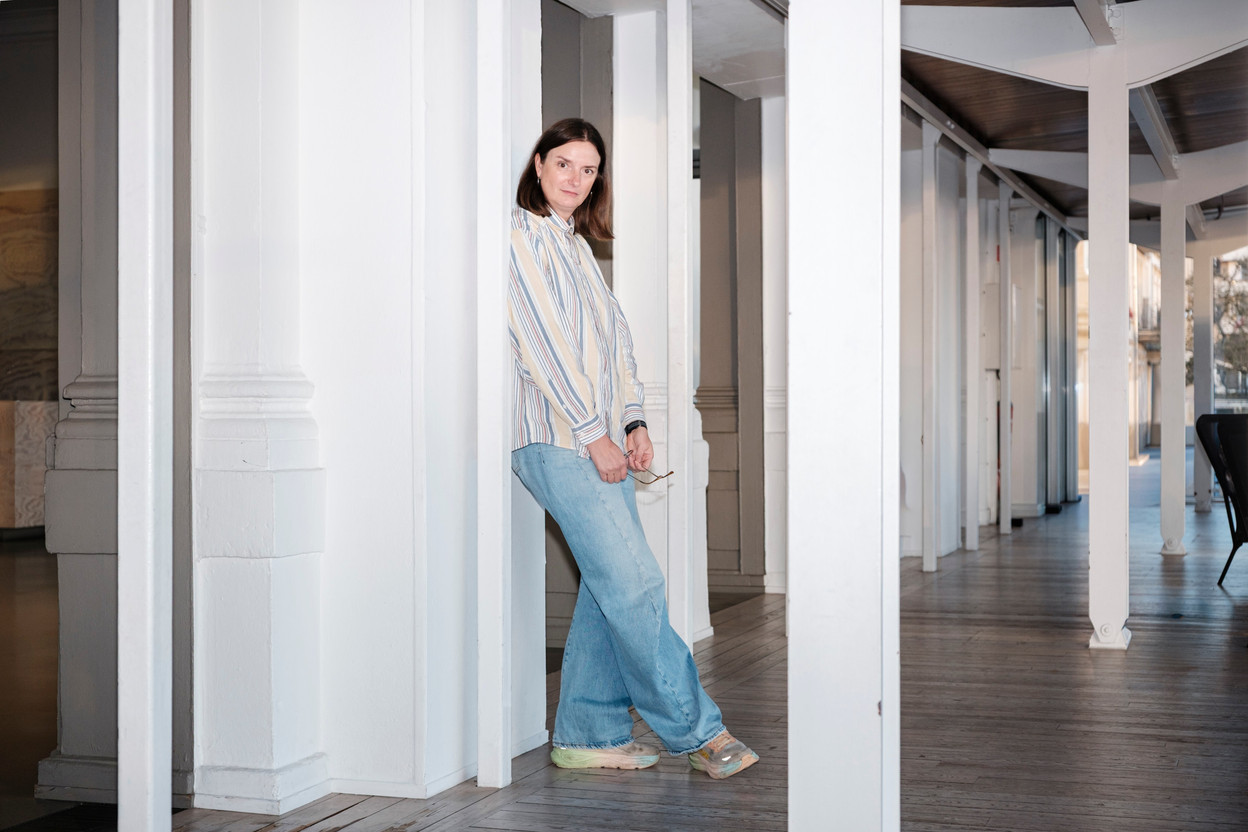
It often takes a few minutes to understand what the National Museum of Archaeology, History and Art (MNAHA) really stands for. A state cultural institution founded in 1946, it brings together several museums and heritage sites—including the most visible building in the old town, the Nationalmusée um Fëschmaart—as well as research and conservation centres. It’s a dense and scattered collection, whose wealth is not immediately apparent to the public. It was at the head of this multi-faceted house that 
An outlook shaped by the field
Trained in art history and conservation-restoration, Tania Brugnoni is well versed in the heritage requirements of a national museum. She also knows the workings of the MNAHA from the inside: she worked there during her student years and at the start of her career. She then moved on to management positions. In particular, she spent more than ten years at the head of the 1535° Creative Hub in Differdange, a place where the question of audiences and mediation is central.
When a place is perceived as ‘cool’ […], it is more easily recognised and experienced. For our part, we sometimes just need to dust things off.

It was in this context that the discussion about the museum’s visibility emerged. The observation is external: the MNAHA does not always spontaneously appear in the list of cultural places that are mentioned, unlike other cultural institutions that are more immediately identified. Faced with this observation, Tania Brugnoni chooses her words carefully. She refers to the “coolness factor”, emphasising from the outset the need to be diplomatic. Not to compare or rank, but to put words into a reality: “Certain places are more easily recognised and experienced by certain audiences. For our part, we sometimes just need to dust things off.”
Museums, she says, can be impressive. Their architecture, their codes, their way of targeting the visitor can create a distance. She speaks of a form of fortress, as an image, not as a reproach. To describe this phenomenon, she uses the German term “Hemmschwelle”, that hesitation, that fear of entering a museum. An invisible but decisive threshold that she wants to reduce without denying the identity or fundamental missions of the institution.
Concrete gestures, structural challenges
In practice, Tania Brugnoni explains that this reflection is reflected in the increased attention paid to public mediation. For a long time, the museum’s approach to outreach has been very qualitative, and has mainly been based on printed materials, in line with the museum’s historical priorities of conservation and research. “Mediation has always existed, and it has sometimes been innovative, but it was mainly through print, and very little through digital. This was consistent with our priorities at the time, centred on conservation and research, but it’s no longer totally contemporary for a museum today,” she sums up.
[Staying relevant:] this is a challenge in a context where the cultural offer is very dense and attention is saturated, particularly in a small country.

From now on, other formats will complement this approach. On the social networks of the Nationalmusée um Fëschmaart, for example, the “Meet the Masterpiece” series invites visitors to discover a work from the national collections in a short, dynamic and accessible format. An initiative that illustrates this desire to shift the point of entry, arouse curiosity and reach out to the public where they already are.
On the financial front, the director of the MNAHA is delighted with the budget increase: “We have a 4.5% budget increase for our museum, which is a great privilege, it must be said.” But the challenges lie elsewhere. Heavy infrastructure to maintain, conservation spaces that are sometimes unsuitable, collections estimated at between half a million and a million items, a lack of space, digitisation that is still incomplete, and human skills that need strengthening. Added to this is a central question: how to remain relevant in a country where the cultural offering is dense and attention is fragmenting.
Reducing the “Hemmschwelle” then appears less like a slogan than a guideline: making the institution more legible, more accessible, more open; without denying what it is or what it preserves.