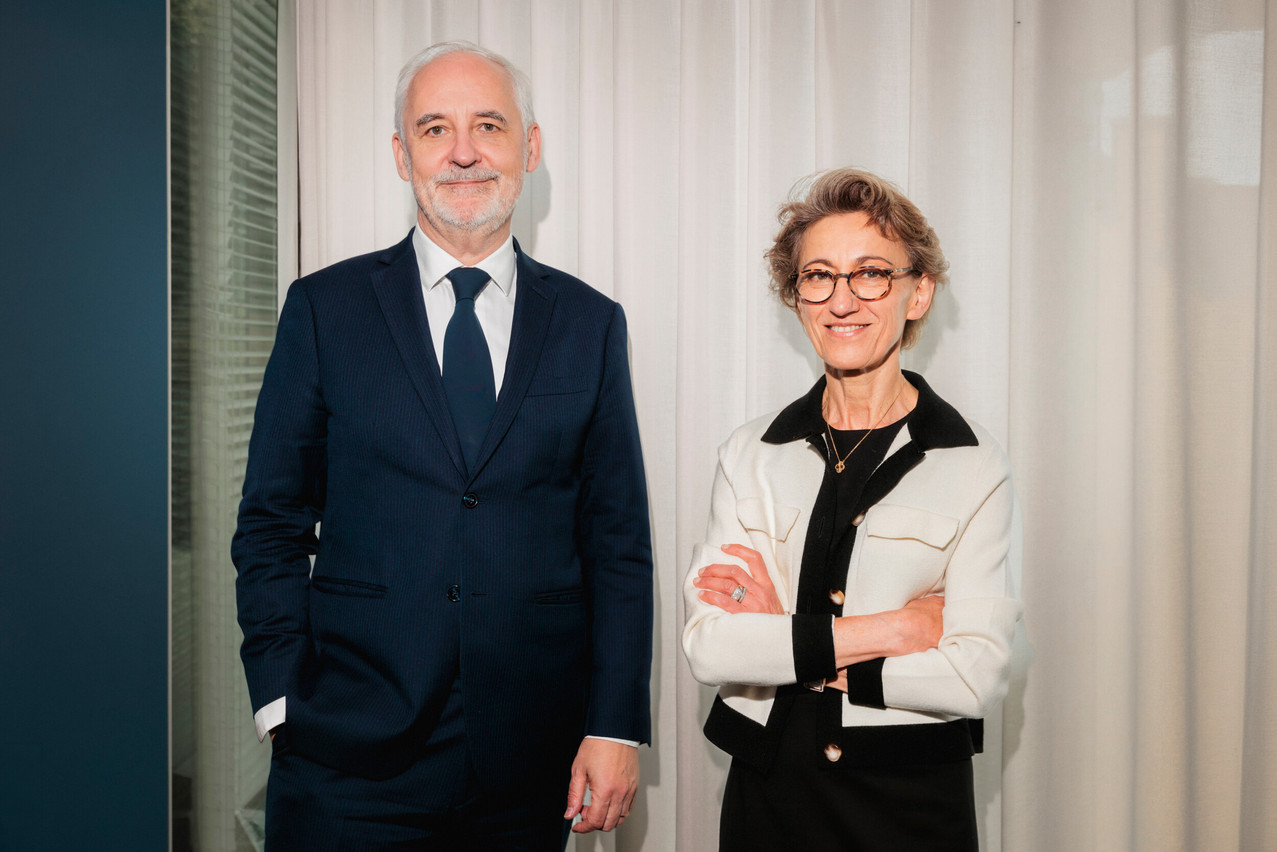
“Extremely positive!” François Pérol, managing partner and co-chair of the Group Partners Committee at Rothschild & Co, has just two words to sum up the bank’s first year of operations in the Grand Duchy. “Our assets under management have risen from nearly €500m to over €1.7bn,” says the executive enthusiastically. With such a promising start, the bank has expanded its workforce from 13 to 18 staff, a figure set to rise further to 21 by the end of the summer. A move is also planned for September to 23 Rue de Hollerich, in the Unicity building, hopes Marie-José Vackier, CEO of Rothschild & Co Luxembourg.
The bank has been operating in the Grand Duchy since late 2020, but initially as a mere asset management company following the acquisition of the Swiss bank Banque Pâris Bertrand. “We then transformed this business by equipping it with banking capabilities,” explains François Pérol. The announcement regarding 2025 therefore does not mark a start from scratch, but rather a new phase.
Thanks to the European banking passport, the Luxembourg-based firm enjoys full banking status. “Our clients can deposit their financial assets and cash with us, obtain financing, whilst entrusting us with the management of their portfolio. In particular, we offer discretionary and advisory management for both listed and unlisted assets,” he explains. Middle and back-office functions remain largely shared across the group.
Going beyond the boundaries of investment banking
Historically focused on financial advisory, mergers and acquisitions, restructuring and capital markets, Rothschild & Co has been seeking to develop less cyclical activities for several years. “Investment banking has certain limitations from the perspective of both shareholders and the company. Its business is volatile: when the economy is doing well, its performance is excellent; conversely, during a downturn, it tends to be affected more severely than the economy as a whole,” observes François Pérol.
“It’s a business driven by fluctuations. Every year, you start from scratch, as you have to find new mandates with very little visibility. We felt it was necessary to develop, alongside investment banking, other areas of business within financial services that might be related and would be less cyclical. It was quite natural for us to turn to private banking and asset management,” the executive continued.
It was actually rather unusual not to be in Luxembourg.

Following France, the United Kingdom and Switzerland, the Private Bank established a presence in Belgium, Germany, Italy, Spain and Monaco, then in Israel in 2022 and in Dubai in 2024. It now operates in 13 countries. “It is in this sector that our expansion is most recent. We began, quite naturally, with the European market, where we already had the strongest presence. It is also in Europe that our investment banking arm holds its strongest positions and where our networks are most developed. It made sense to focus our efforts on this region initially,” says François Pérol.
Nevertheless, the United States remains the most important market for private banking and asset management, whilst Asia is currently the fastest-growing region; however, for the executive, these two regions are primarily part of a medium to long-term strategy.
For François Pérol, “it was actually rather unusual not to be in Luxembourg. If you’re developing a private banking business, Luxembourg is a must”. Contrary to popular belief, it is not so much the arrival of Rothschild & Co in Luxembourg that is surprising as its prolonged absence until recently. “If you operate a private banking business in Europe, you need to have a presence in the major European economies and in the major European financial centres, which do not entirely overlap.”
Beyond its role as a fund domicile, Luxembourg ranks among the world’s wealthiest countries. According to the Global Wealth Report 2025 published by UBS, the Grand Duchy ranks first in the world in terms of median wealth per adult, at $395,340, ahead of Australia and Belgium.
Assets in funds domiciled in Luxembourg reached €8.2trn in 2025, an increase of more than 50% since the end of 2020. This growth was driven by more than 58 new entities being authorised or licensed during the year, including Rothschild & Co Wealth Management, according to the study “Luxembourg financial centre records strong growth across sectors in 2025”, published by the Financial Centre Development Agency.
European uncertainty is benefiting the Grand Duchy
For François Pérol, the success achieved during this first year is also down to the political and economic climate in Europe. Without giving precise figures on the origin of new clients, He notes that the uncertainties affecting certain major European countries, such as France and the United Kingdom, are prompting some clients to seek greater stability. In a European environment characterised by political upheaval, successive tax reforms and geopolitical tensions, stability has emerged as a key priority – which seems almost paradoxical at a time when uncertainty appears to be the only constant.
We have no desire to set up a private banking business in a financial centre that is not financially sound.
“Luxembourg offers a stable legal and tax framework, as well as rigorous supervision,” adds Marie-José Vackier. This is an argument regularly put forward by international institutions based in the Grand Duchy, although some observers believe that competition amongst European financial centres remains fierce, particularly with Switzerland and Ireland, or even outside the EU with Singapore.
For François Pérol, this combination of factors was decisive in the decision to establish and develop this business in the Grand Duchy: “We don’t want to develop a private banking business in a financial centre that isn’t financially sound, because you’re putting your reputation on the line.”
According to the 2026 UBS Global Family Office Report, which surveyed 307 family offices across more than 30 markets, these organisations are now prioritising the resilience of their portfolios. Faced with persistent geopolitical and economic uncertainty, they are focusing on diversifying their assets, currencies and regions, rather than making radical changes to their asset allocations.
According to Marie-José Vackier, “the international dimension is ever-present. We work with international clients, entrepreneurs, single-family offices and multi-family offices. The cross-border aspect is very strong”. “There is also a growing number of French clients placing assets in Luxembourg, sometimes with a view to eventually settling in Italy or elsewhere, or simply because their children are studying abroad. In this context, Luxembourg’s situation is rather unique,” observes the CEO.
When asked about competition from other European jurisdictions such as Ireland, the Netherlands and France, Marie-José Vackier highlights the way Luxembourg’s institutions operate. “The authorities are extremely pragmatic. There is a determination to be at least as competitive as other European countries. And we can see the financial centre’s progress. Communication between the financial centre’s stakeholders and the government authorities is very smooth.”
Artificial intelligence: opportunity or bubble?
On the subject of artificial intelligence (AI) – a topic on which Rothschild & Co regularly comments – François Pérol takes a more cautious stance than is generally seen in the financial sector. “There is a major debate about the success or profitability of the huge investments currently being channelled into AI, particularly generative AI, and the question is whether now is still the right time to get involved or whether it is perhaps a little too late.” He continues: “It is likely that some of these investments will not be profitable and never will be.” Here again, his views stand in stark contrast to the sometimes overwhelming enthusiasm seen in the financial markets. For whilst the technological revolution seems undeniable, the economic profitability of certain investments remains a matter of debate.
The group is already trialling certain applications internally, particularly to support analysts, portfolio managers and wealth management specialists, as well as in areas such as IT development and cyber security. However, there are no plans as yet for a large-scale roll-out to clients.
We currently manage just over €100bn, of which nearly €8bn are private assets.
In addition to traditional portfolios, Rothschild & Co is also continuing to expand its range of services in the private assets sector. “We can manage all types of assets. We manage diversified portfolios, bond portfolios, equity portfolios, liquid portfolios, listed portfolios, as well as private assets.”
The Five Arrows platform, which specialises in alternative assets and currently manages more than €30bn in assets, is one of the key drivers of this strategy. “We offer our retail and institutional clients exclusive access to a whole range of private funds, which we develop ourselves. We are developing a range of private equity and private debt funds under the Five Arrows brand,” explains the CEO.
Today, alternative assets still account for a minority but growing share of private banking’s assets under management. “We currently manage just over €100bn, of which nearly €8bn are private assets. That represents around 10% of the assets we manage on behalf of our clients,” says François Pérol.
It remains to be seen whether the growth of private banking in Luxembourg will prove sustainable or whether it primarily reflects a European context characterised by political, fiscal and economic uncertainties.