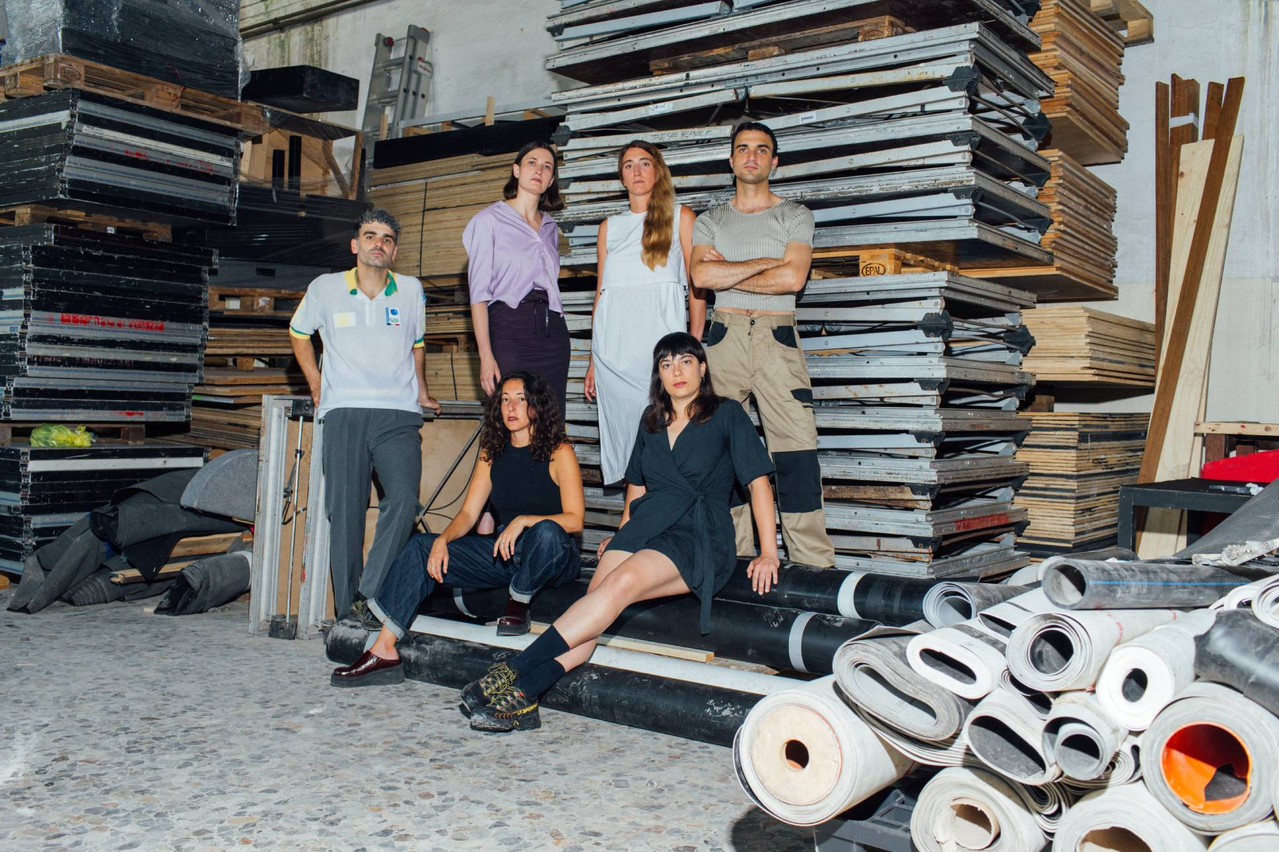
The exhibition “A Comparative Dialogue Act,” by Andrea Mancini and the Every Island collective, will open on 18 April 2024 at the 60th Biennale di Venezia (Venice Biennale). “The jury’s selection is a perfect response to the call for tolerance and hospitality made by general curator Adriano Pedrosa, who chose ‘Foreigners Everywhere’ as the theme for this 60th edition--even if they (the jury) didn’t even know it, since the theme was not revealed until after the final choice had been made,” said 
Says the Mudam website about “A Comparative Dialogue Act”: “[It] challenges the entrenched notion of individual artistic authorship by presenting a collection of works where artists relinquish ego in favour of a profound exploration of collective creativity through the medium of sound.”
For this 2024 edition of the art festival, the Luxembourg pavilion will be both an exhibition venue and a research space: four international artists will take up residencies in the pavilion to help create a shared body of sound: Spanish musician and performer Bella Báguena, Turkish artist Selin Davasse, Swedish artist Stina Fors and French transdisciplinary artist Célin Jiang.
“The process is as important as the result,” explains 
For the first time…
This year’s Luxembourg pavilion will see several firsts: Thill’s first biennale as minister; the first time that sound will have such a prominent place at the pavilion; the first time that in situ research and experimentation will accompany exhibition space at the pavilion; the first time a collective is involved; the first time that Kultur | lx will curate the Luxembourg pavilion; and the first curation for the Mudam’s Joel Valabrega, who is part of “A Comparative Dialogue Act.”
These firsts, at least some of them, underline the emergent nature of this pavilion: an experiment exploring a variety of acoustic languages, reflecting on dialogue and the use of sound as a tool, an object of negotiation that enables exchange.
“The artists will create a sound library representative of their artistic approach,” explains Mancini. “During their residency, each artist will be able to appropriate the work of the others and add to it, in order to create a soundscape. The sound samples will enable co-creativity and move beyond the individual approach in favour of a collective creation.”
Each of the artists will also be putting on performances that will be moments of exchange with the audience. “The whole thing will operate in the form of a cycle, which will be repeated throughout the six months of the biennial,” says Mancini.
Although the approaches of the four artists vary, each walks among identity, performance and sound. Báguena tends towards gender identity; Jian, decolonial cyberfeminism and identity in the context of transcultural aesthetics; Davasse, the blending of literary and performative techniques; and Fors, how choreography, percussion and voice can plunge into the depths of the “sonic body.” At the end of the exhibition, a vinyl record will be pressed, featuring all the pieces produced.
A sensitive space
The space itself will also be a voice: the artists will be able to change its configuration during their respective residencies.
The pavilion has been designed as an infrastructure for transmitting sound. Its walls--glass panels whose vibrations are converted to sound via a transducer--are mounted on wheels to facilitate different arrangements. The floor reacts to the sound of the walls and vibrates to transmit low frequencies. The suspended ceiling, for its part, supports a light installation, while a curtain acts as an acoustic screen with the rest of the room.
The space was devised by the Every Island collective, whose research focuses on the role of performativity in architecture.
The Biennale di Venezia runs from 20 April to 24 November 2024. The Luxembourg pavilion is in the Arsenale, on the first floor of Sale d’Armi.
This article was originally published in Paperjam. It has been translated and edited for Delano.


