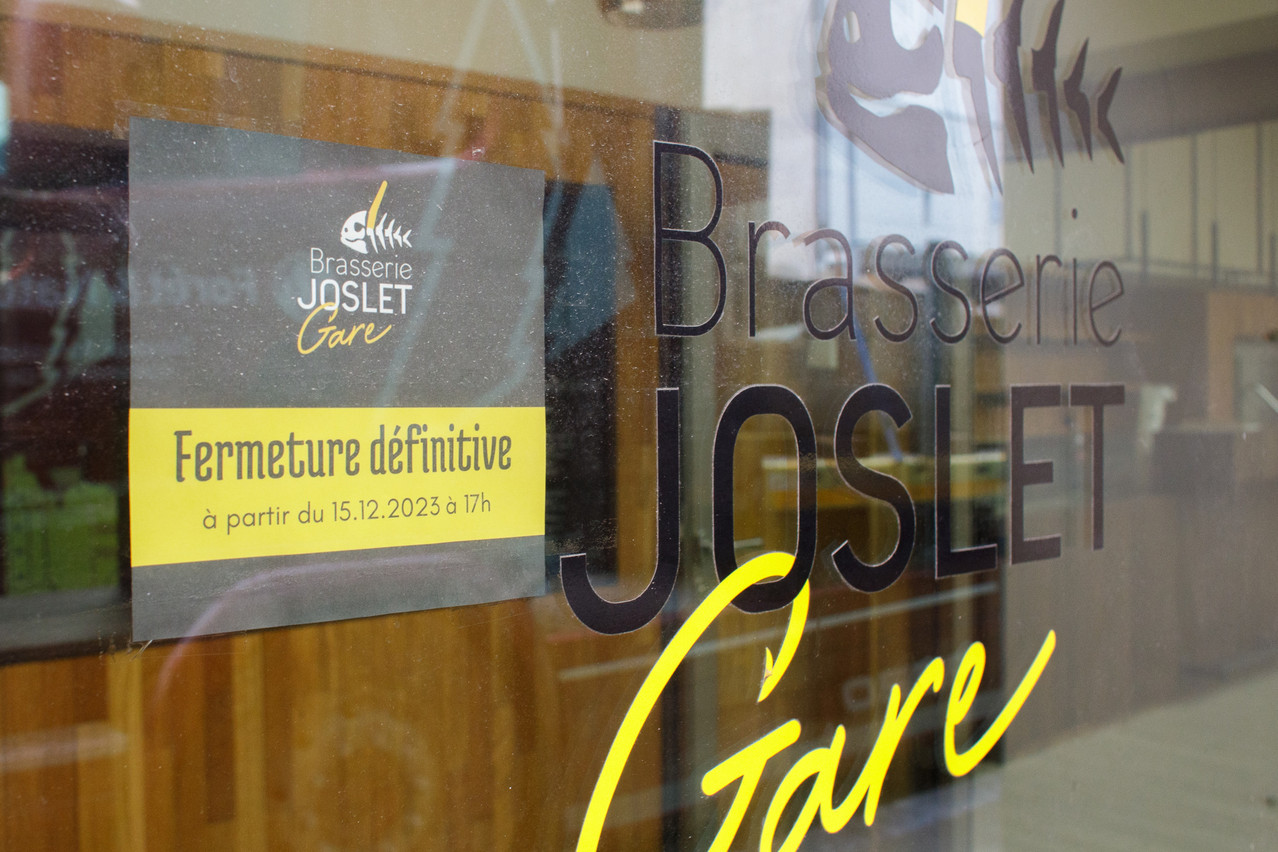
No sooner closed, no sooner reopened? At least, that’s what Luxembourg’s city council wants. As part of its scheme to set up pop-up stores in disused premises, it has just issued a call for applications to take over the premises of the former Brasserie Joslet, which closed shop in December, less than ten months after its inauguration.
This was the first attempt by Friture Joslet, which specialised in fairs and funfairs (and fried fish at the Schueberfouer), to establish itself more permanently. The closure came “with a heavy heart,” as the store’s managers wrote on social networks on the day of the announcement. The 70 square metre space is located on rue du Fort Neipperg, on the ground floor of the car park.
“Establishing a long-term presence”
Eight pop-up stores leased by the commune are currently dotted around the city centre, with leases running until the end of January for the oldest (Maison Hagada, rue Philippe II) or until next summer for those signed more recently (located on rue des Capucins, Boutique du Monde will remain there until 30 September). From the Grand-Rue to the avenue de la Gare, a total of 78 retailers have at some time occupied one of these cells, which are offered at preferential rates. This reletting operation was launched in November 2019.
“The aim is to encourage young entrepreneurs, startups or creators to set up permanently in business and to establish themselves in the capital over the long term,” say the departments concerned. First alderman at the time (and now minister of the environment and civil service), 

The importance of availability
From fashion to beauty or decorative accessories, not forgetting the (very seasonal) sale of Péckvillercher or pet supplies, all areas of activity are eligible, provided you have the right idea. “The criteria include the quality of the concept, its innovative nature and how it complements the existing commercial offer,” the city explained, in response to a request from Delano’s sister publication Paperjam.
Another overriding criterion is the almost immediate availability of the retailer, as local councillors want to “avoid vacancies remaining unoccupied between two lease contracts.” The City of Luxembourg’s Economic and Commercial Development Unit (DEC) is responsible for sorting through the applications before making a proposal to the college of aldermen, who have the final say.
From €650 to €1,250 per month
In terms of rates, three scenarios are on the table. For entrepreneurs without commercial premises, a monthly rent of €650 is charged. This sum is supplemented by €280 in charges. For those who already have a first address elsewhere, they will have to pay €1,250 per month, again with €280 in charges. The last possible configuration is if the retailer already has several premises (in the country or abroad), in which case the rent will be decided “on a case-by-case basis, after consultation with the college of aldermen.”
In any event, it is the city that collects the rent, before paying “the ‘real’ rent to the landlord,” with the city contributing was was missing. Since 2019, 14 addresses have been proposed in the capital. 43 rue du Fort Neipperg, where Brasserie Joslet was located, will be the fifteenth. This time, it will be in a building owned by the city, according to data on the Geoportail website.
A restaurant for 11 months
By definition, pop-up stores are temporary. Luxembourg City itself specifies that it is not seeking “to achieve a given number of short-lived shops.” The minimum occupancy period is one month; the maximum is six months. A three-month extension is optional, subject, of course, to the availability of the rented space.
In this respect, the future restaurant on Rue du Fort Neipperg is an exception. An 11-month lease has been agreed from the outset, “as it has proved more complicated in the past to find a tenant.” Interested restaurant owners have until 5 February to submit their applications, with business expected to resume in March. The restaurant will be able to seat up to 50 diners.
It’s a brand new concept for temporary restaurants.
This article was first published in French on Paperjam. It has been translated and edited for Delano.