Luxembourg’s residential property market finally appears to be emerging from the exceptional period it has been experiencing for nearly three years. Following the sharp correction of 2023, and the subsequent rebound artificially boosted by temporary tax measures in 2025, the first quarter of 2026 marks a return to a market driven more by economic fundamentals than by windfall effects. A return to normality, certainly, but a normality that reveals an increasingly clear divide between the property market and the rental market.
The key finding of the report published by the Observatoire de l’habitat on Thursday 25 June is that buyers are back. Transaction volumes remain well above the levels seen at the height of the 2023 property crisis and in early 2024. In the second-hand market, flat sales have risen by 9% year-on-year, with 965 transactions – a figure almost identical to the pre-crisis average. House sales are also continuing to recover, with 650 sales (+11.5%), although they remain slightly below the levels seen between 2017 and 2021.
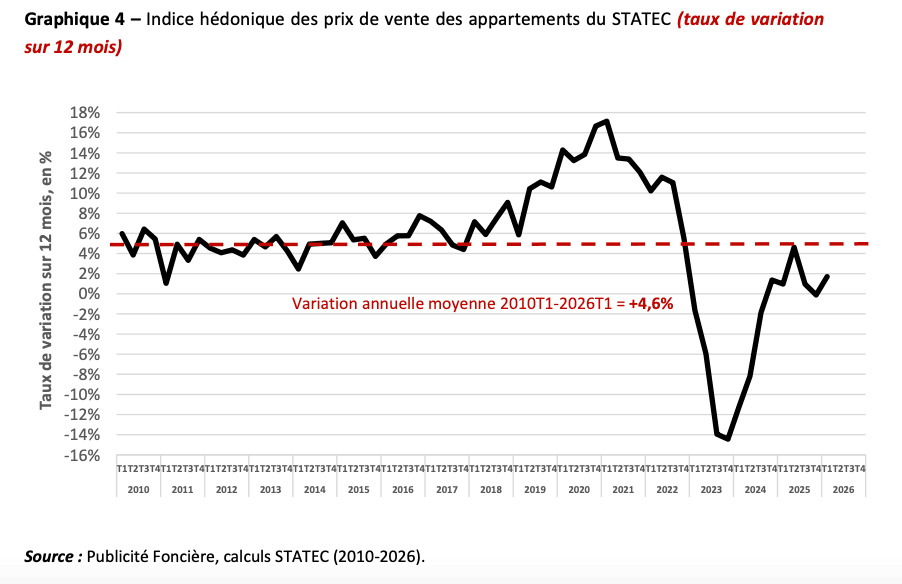
STATEC’s hedonic index of flat sale prices. (Source: Publicité Foncière, calculs Statec, 2010-2016)
The picture is less encouraging for new-build properties. Off-plan sales continue to be the weak link. With just 207 transactions in the first quarter, they have fallen by a further 18.2% year-on-year and remain a long way off the average of around 650 sales recorded before the market downturn. Developers are therefore still not reaping the full benefits of the upturn in activity, a sign that buyers remain cautious about prices, financing costs and the uncertainty surrounding new projects. The total value of flat sales – including both existing and new-build properties – reached around €720m in the first quarter, down 9.3% year-on-year, despite an increase in the number of transactions.
No more ups and downs
The Observatory points out, however, that some new-build homes may now be sold through conventional sales channels, which partly obscures the interpretation of the statistics. Another sign of stabilisation is that prices are no longer on a rollercoaster ride. Statec’s hedonic index has risen by 0.7% over the past quarter and by 1.7% year-on-year. In practice, property prices are now rising at almost the same rate as inflation, which stands at 1.6%. This situation would have been unimaginable just a few years ago, when property prices in Luxembourg were rising at a rate several times higher than the cost of living.
However, this average masks differing trends. Older houses have shown a genuine rebound, with a 3% rise over twelve months, having experienced a steeper correction during the crisis. Flats, on the other hand, remain virtually stagnant. Both existing homes and off-plan properties have recorded growth of just 0.9% year-on-year. Even more telling is the fact that prices for new flats have actually fallen by 2.2% over the quarter, illustrating the persistent volatility of a segment where the number of transactions remains limited.
The figures from property adverts paint a slightly different picture. Whilst advertised prices for houses are rising again (+1.4% year-on-year), those for flats continue to fall (-2.9%). This discrepancy suggests that the market is still far from finding a new equilibrium and that flat sellers are still struggling to regain their bargaining power.
Fewer changes for existing tenancies
However, it is in the rental market that the report highlights the greatest pressures. Rents being asked for new flat tenancies have risen by 4.4% year-on-year, which is nearly three times faster than inflation and significantly faster than house prices. Furnished rooms, which now account for nearly 18% of the rental stock, are rising even faster (+4.7%). The gap between the property market and the rental market is therefore widening once again.
This trend reflects an increasingly pronounced economic reality. Whilst house prices are no longer soaring, getting on the property ladder remains difficult for some households. Prospective buyers who abandon or postpone their plans automatically fuel demand for rental accommodation, against a backdrop of continued insufficient supply. The result is paradoxical: the property sales market is gradually returning to equilibrium, whilst the rental market is heating up.
However, the Observatoire de l’habitat qualifies this interpretation by pointing out that these figures relate solely to new tenancies. Tenants already in place are seeing their rents rise much more slowly. According to Statec, the rent index has risen by just 1.4% year-on-year, a rate close to that of inflation. The gap between existing and new tenants is therefore continuing to widen, making it even harder for new entrants to the market to find accommodation.