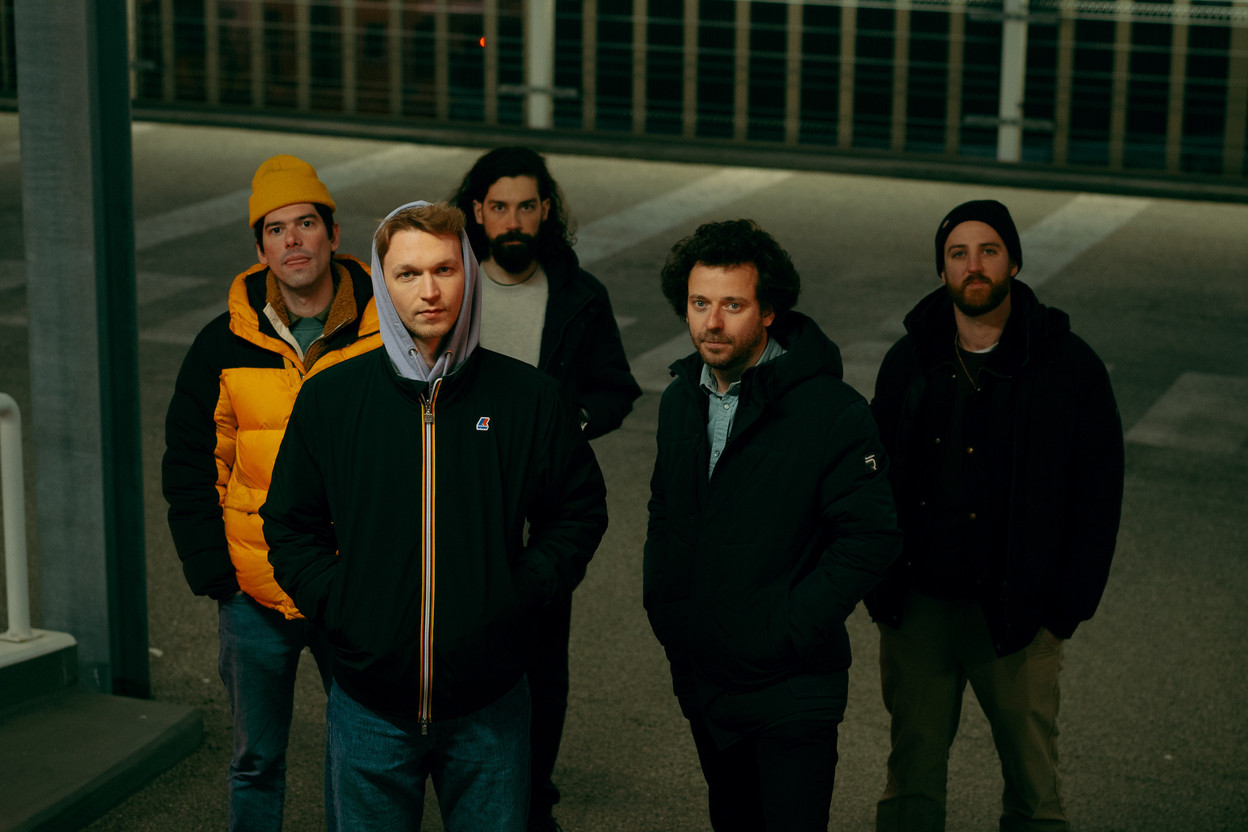
“Well… if you hear it, you’ll get it.” Michel Reis, leaning back in his chair in a coffee shop in Luxembourg City, laughs.
His comment is in response to a question about why his new album--an hourlong musical conversation between himself, Pit Dahm, Benoît Martiny and the late Michel Pilz--is called Mayhem.
Still, while “mayhem” connotes chaos and the absence of structure, the album doesn’t quite hit that extremity. Or else, all things are relative: the tracks are undoubtedly loose-feeling, the album comprising four compositions held in place by a generous halo of improvised interludes and thought-as-music, but they aren’t without structure and sense.
“There’s free jazz and then there’s free jazz,” says Reis. “I think Mayhem is very approachable… it has lots of structures, pieces, forms… as Michel Pilz would have said, if the free jazz police come, they would say it’s not free at all.” He laughs again. “It’s too melodic. There’s too much structure!”
As this discussion about the title devolves into one about labels, Reis says what a lot of jazz musicians--a lot of musicians, period--tend to say: that labels are limiting and possibly irrelevant. Stepping back from quibbles over sub-classifications (the “freeness” of the jazz in this case), one can also observe that “jazz”--meaning the ur-genre itself--is also nothing but a label. And, for Reis, a loaded one.
“It’s not supposed to be elitist music, but that’s what it has become, kind of--almost worse than classical music,” he says of jazz. “It’s almost like this secret club.”
“Many people say to me: ‘You’re a jazz guy? Oh, that’s interesting. I might come and check you out. But I don’t really understand anything about it.’ And I’ll say: ‘Well, you don’t need to understand anything, you don’t need to know the theory, you don’t have to be an expert. I’m not an expert. You just enjoy it or you don’t.”
Besides being an acclaimed pianist and composer, Reis teaches at the Conservatory of Music in Luxembourg City, so he knows his theory inside and out; even strict adjudicators would struggle to argue that he isn’t an expert. But this, then, is the tension that underpins Mayhem: the reconciliation of an academic, theoretical and historical understanding of music with an in-the-now performance, each player a voice among voices, sometimes heated, sometimes conciliatory, always interested.
Geography in sound
Theory and performance on the album can also be respectively assigned (albeit reductively) their own geographies, as Reis describes the two methodologies of education that have informed his current style. After studying in the conservatory in which he now teaches, here in his hometown of Luxembourg City, he moved to Boston to continue his education at the Berklee College of Music and the New England Conservatory of Music. In simple terms, he explains, European schools emphasise the academic context of music (harmony, arranging, theory), while their counterparts across the Atlantic don’t (and in that void emphasise play and practice).
“In the first semester [in the US] you had to do placement tests,” says Reis. “And in the theory placement tests, all the Europeans in general placed much higher… the Americans are less theoretical, you know? Which has lots of good sides, too. But that’s the difference in approach: they’re more practical, more intuitive, and we are more brainy, because we have all that baggage from the classes we took here.”
Whatever these differences, in Mayhem you can hear plenty, firstly, of intuition: the jams grow organically, such as in “Essaouira,” whose intro sounds almost like a warm up. A sort of chanting on the piano is pulled into a second dimension by soft drum-taps--then the saxophone speaks in what becomes a kind of melody--and from there the tune grows eventually into a groove that begets another groove that begets another. But it isn’t just a torrent of riffing: you can also hear restraint, habits, suggestions. The pleasure is in hearing, as it were, good speakers speak off the cuff.
Geography in sound (part two)
The geography of Mayhem is also notable in that its quartet are all Luxembourgers and that the project grew from a single evening in Dudelange, a retirement party for Danielle Igniti, then-director of the Opderschmelz cultural centre. Two duos were set to perform: Reis/Dahm and Martiny/Pilz, but they overlapped during the transition, which generated the spark (as well as the accident of having two drummers in the band). The four musicians decided to apply for a residency at Opderschmelz where, after some rehearsals, they recorded Mayhem in one hourlong take. They did a second take as well, and then a live take at the Like A Jazz Machine festival--which, Reis hints, they might be saving for a rainy day--but opted for that first one.