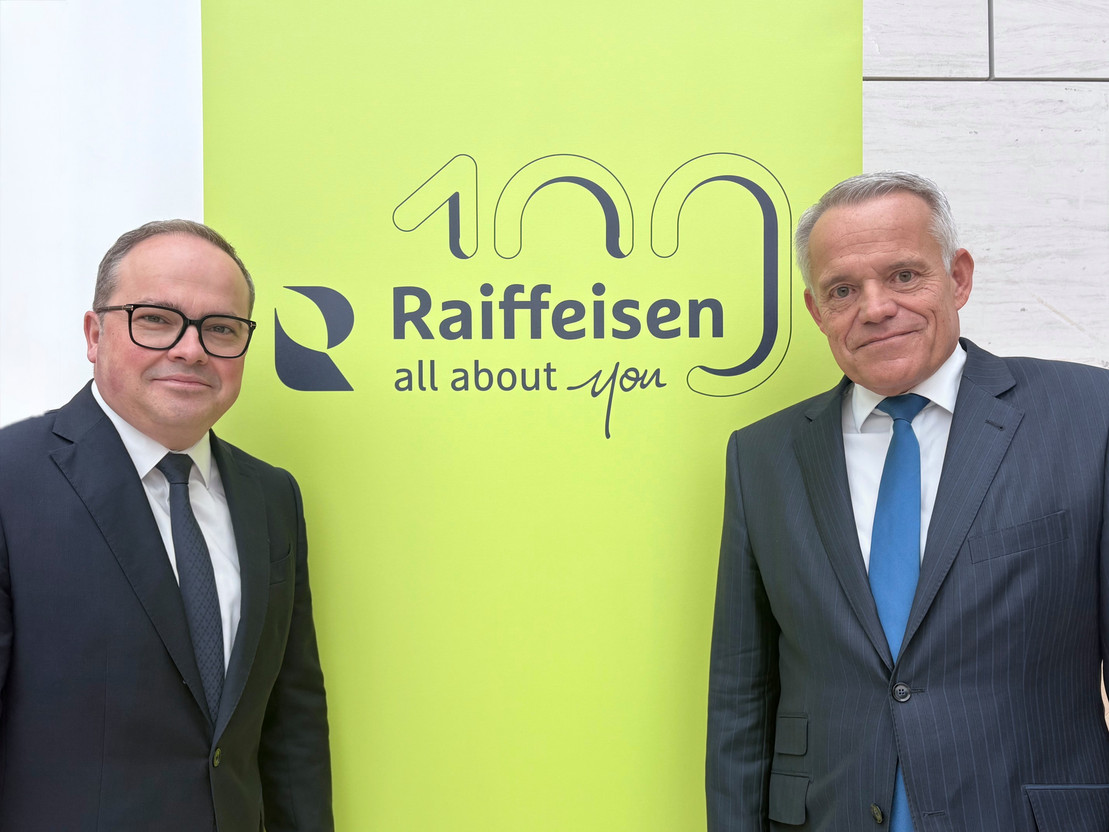
Raiffeisen Bank closed the 2025 financial year with a net profit of €31.1m, up 11% on 2024, marking a recovery following a year affected by an exceptional provision to the fund for general banking risks. This improvement comes against a backdrop of continued economic uncertainty, characterised by falling interest rates and persistent geopolitical tensions.
“We continue to navigate periods marked by significant geopolitical and economic uncertainty,” said the chairman of the board of directors, 
Net banking income reached €251m, a modest increase of 2.1%, confirming a marked slowdown following the strong growth seen in 2023. The net interest margin, the main component of income, stabilised at €205.9m, whilst fee income rose sharply (+14.8% to €39.4m), driven in particular by private banking and property financing.
Growth in the business client base
Total assets continued to grow, reaching €11.9bn (+3.7%), in a trend described by management as “under control”. Customer deposits reached €10.7bn (+3.7%), driven mainly by household savings, whilst customer loans rose by 3.4% to €8.1bn, driven by the recovery in mortgage lending.
“We have once again delivered solid results whilst maintaining our traditionally cautious approach,” said the CEO, 
More specifically, credit growth is driven mainly by mortgage lending to households, which is picking up after two years of slowdown, whilst new construction projects remain subdued. On the corporate side, activity is growing at a more moderate pace, against a backdrop of persistent cash flow pressures and economic uncertainty.
The balance sheet structure highlights a gradual diversification of the business model, with a growing focus on corporate and private banking, whilst maintaining a strong presence in retail banking. Around a third of outstanding loans and deposits now come from businesses, illustrating the evolution of the bank’s positioning.
136,000 customers, representing an 11% market share
This transformation has been accompanied by strong business growth. The bank has around 136,000 customers, including more than 57,000 cooperative members. Its market share stands at nearly 11% as a primary bank, with an even stronger position in the mortgage lending segment.
At an operational level, operating costs rose by 9.1% to €145.6m, driven by a combination of an increase in staff numbers (+3% to 733 employees, an increase of 25 employees), wage indexation, and investment in IT systems, cybersecurity and regulatory compliance.
At the same time, the bank maintains a prudent risk management policy, with €46.5m set aside for impairment charges and the general banking risk fund. This approach aims to anticipate potential downturns in certain economic sectors, particularly given the still fragile property market.
Prudent strengthening of capital
One of the most notable developments during the financial year was the strengthening of regulatory capital, which reached €915.6m (+9.4%). This level reflects a deliberate policy of retaining all profits and building up reserves. “We are now one of the few banks to have made a clear choice: to retain all our profits within the institution,” emphasised Guy Hoffmann. “This is a strong commitment to our economy and our customers.”
Beyond financial indicators, the management highlights the quality of customer relations as a strategic driver. The bank ranks among the top performers in terms of customer satisfaction, with an increase in its recommendation rates among both private and business customers.
“Our aim is to provide a service offering that combines both physical and digital channels, allowing every customer to choose the one that suits them best,” emphasised Guy Hoffmann. “But never to replace human interaction.”
In line with this approach, Raiffeisen is continuing to develop its network of 28 branches, with several refurbishments planned between 2025 and 2026, as well as launching new initiatives, including an “Agri Hub” dedicated to the agricultural and wine-growing sectors and a “Customer Care” service launched three weeks ago with a single contact number, available during office hours and in four languages. “Customer Care strengthens our ability to support our customers quickly, particularly in cases of fraud. It is fully in line with our ‘All About You’ commitment, offering an accessible, personalised and efficient service,” emphasises 
The bank also highlights its commitment to the sustainable transition, with €280m in ESG loans (+43%) and €285.5m in ESG investments. It has also been recognised for its initiatives in sustainable banking and innovation in retail banking.
In an environment where interest rates are set to remain on a downward trend, pressure on the net interest margin is likely to continue. The bank’s ability to grow its commission income and wealth management business will therefore be key to sustaining its profitability. “In an automated world, human presence and trust are once again becoming a competitive advantage,” said Guy Hoffmann. “That trust cannot be digitised.”