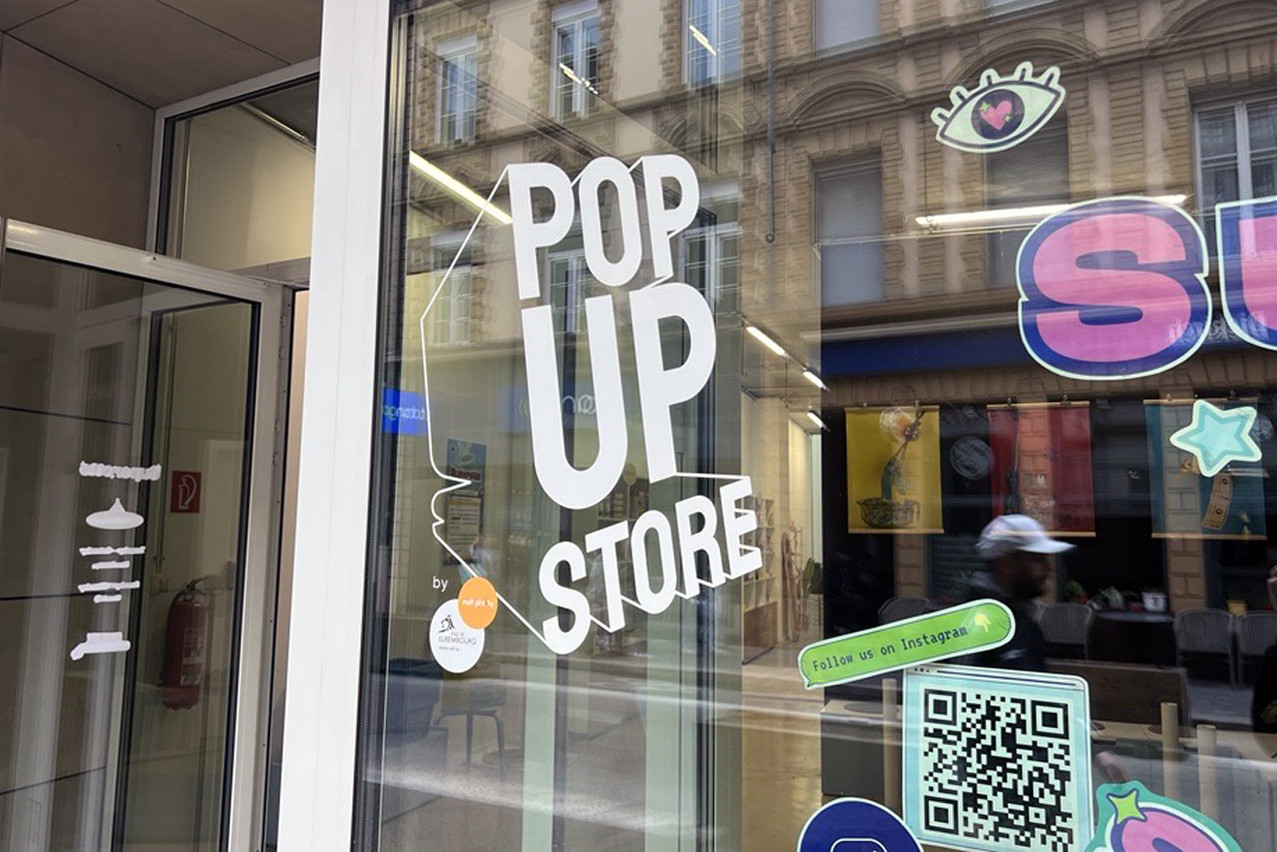
Faced with the vacancy rate affecting several strategic thoroughfares in the capital (12% in the Ville-Haute district and 13% at the Gare), the City of Luxembourg has developed a system of short-term leases, allowing young brands or independent retailers to temporarily occupy vacant cells. Three pop-up stores have set up shop in the city this spring and will soon be joined by a fourth. “The aim of pop-up stores is first and foremost to give budding entrepreneurs a chance to try out their concept, whilst creating life and excitement,” Luxembourg City alderman 
“It livens up shop windows and avoids the commercial desert effect,” notes Dimitri Collignon, head of retail Luxembourg at the real estate services company JLL. “In my opinion, the results of this scheme are positive, but measured.”
CBRE’s director of retail Luxembourg Marine Fetique agrees. “This allows some independents to test their concept in less dynamic streets, where the big names don’t go. It’s a way of occupying space and keeping the streets alive."
And Luxembourg City’s concept works. Since its creation in 2019, 88 entrepreneurs have been able to benefit from a pop-up store. And of these, 30% have succeeded in opening a business in a sustainable way. “It’s a real success story,” say Bauer and the city’s economic and commercial development officer, Francine Lies. “Some have set up in the middle of the city, others in neighbourhoods like Bonnevoie (like Bricks 4 Kidz), which also contributes to local development.” Other success stories include the restaurant Delikoreana, the Bonne Nouvelle bar, the clothing shops Devï and Kyo, the jeweller Banjjak and the shoe shop New Fresh Kicks.
“Examples such as Orta or Romantico Romantico exist, but remain the exception,” notes Fetique. “The pop-up is not designed to enhance a premises. It is transitory in essence.”
But behind the dressed-up shop windows lies a more complex mechanism. Leases are often signed by Luxembourg City with the owners for periods of up to six years. The city then sublets the space to retailers on more affordable terms. “This prevents landlords from having a vacancy, but it also artificially maintains rent levels,” explains Collignon. “Rent is signed and paid, so on paper everything looks rented--except that the real market would probably not follow at that price level.”
“Every rent is negotiated downwards,” says Bauer. “We don’t want to create unfair competition.” A rent below the market price is an essential give-and-take condition if the landlord’s unit is not to remain empty for a long time. Sometimes a private agreement can be reached between the tenant and the landlord, in which case it’s all over. The city plays the role of facilitator, but if the pop-up store can go ahead without its intervention, it withdraws.
High rents, unsuitable premises and work
The core of the problem remains structural: an imbalance between asking prices and economic reality. In the Ville-Haute district and at the station, some units have been vacant for several months--or even years. “In some cases, rents are simply too high in relation to potential sales,” says Audrey Chantereau, associate director retail Luxembourg at CBRE. “Landlords are clinging on to pre-crisis levels, but retailers are no longer keeping up."
The situation is particularly tense in the Gare, held back by a series of major urban works. “We’ve got one construction project after another, façade renovations, pavement changes... to the point where some shops are struggling to tell people they’re still open,” explains Fetique. Added to this are security issues (although some foreign brands often perceive Luxembourg as a safe country) and the virtual absence of access by car, which complicate the attractiveness of the area for retailers and customers alike.
Besides the price, the format of the premises poses a problem. “Most of the buildings are old, family-run, with surface areas spread over several floors. For a retailer, renting 400 square metres divided between the ground floor, a basement and two upper floors is not optimal,” says Collignon. “The big brands are looking for ground-level space, with no pillars, that can be easily converted. Here, they have to make concessions.”
And the issue of renovation is crucial. “After long-term occupation, some cells would require a minimum of work to accompany a new retailer who wants to take up residence there, but owners are not always inclined to do this,” explains Chantereau.
However, the city is sparing no expense in attracting new retailers to the Gare. “The establishment of the Action store is a good example of this: faced with the logistical constraints associated with delivery, the municipal services have adapted the facilities to facilitate the arrival of the retailer,” explains Lies.
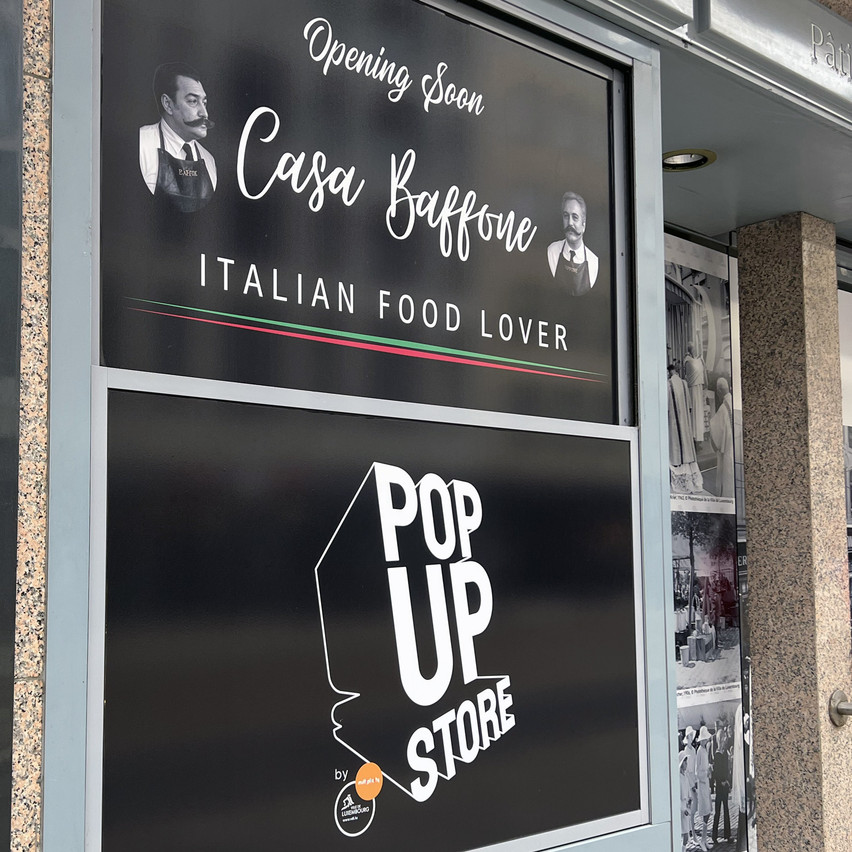
A new pop-up store will open this June on Avenue de la Liberté thanks to the capital city’s scheme. Photo: Emilio Naud/Maison Moderne
A small, coveted... but demanding market
Luxembourg still has its advantages: stability, security and high purchasing power. But this does not compensate for the narrowness of the market. “The country is attractive, but it’s still too small for many international retailers looking to open several outlets,” says Chantereau. “Investing in a single shop--with all the logistics that entails--is often too expensive.”
Collignon adds: “Luxembourg is the only non-millionaire city ranked among the 30 most expensive in the world in terms of prime rent. It’s a real paradox. The rent per square metre is high, but there is no mass tourism or constant flow to compensate.”
The proof of persistent interest can be found in a very specific street. On Rue Philippe II, experts agree that there are real waiting lists for certain locations. The sector remains highly coveted by premium retailers, who are targeting a few hundred square metres in ultra-precise areas.
Some international retailers now prefer shopping centres, where vacancy rates are low and the infrastructure is more suitable. “City centres and shopping centres are not in competition, they complement each other. Most retailers prefer to start out in town, with a flagship store, before considering a presence in a shopping centre that is consistent with their image,” explains Fetique.
“The rare exception is Nike, whose presence in Luxembourg will probably be confined to the Cloche d’Or,” concludes Collignon.
This article was originally published in French.