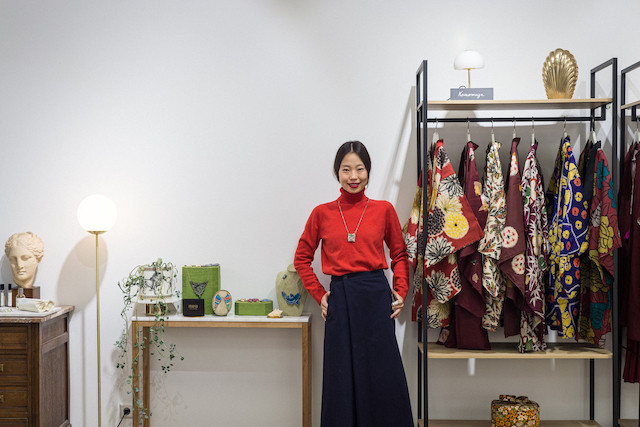
In addition to selling hand-selected, vintage clothing, including kimono jackets, similar to what was previously available at Botari, the shop will stock other design objects, stationery, ceramics and more from cities as wide ranging as Tokyo and Helsinki.
Jung says she selected “Kyō” for its name because, depending on how it is pronounced in Japanese, the term can mean either “cities” or “today”, and it’s these two axes she wants to be the focus of the concept store.
“Cities always fascinated me when I was young,” says Jung, who grew up in Seoul, South Korea. “When you go to Seoul, you see so much energy, so many things going on, 24 hours a day.” She also compares cities to museums, adding: “nostalgic memories of the past and visions of the future live side by side.”
Collectors' items
Growing up, she didn’t have legal access to Japanese media until the 1990s, when South Korea loosened its censorship rules. But she still found ways to seek out what she loved and moved to Tokyo later to study Japanese language and literature, in part because of her love of Haruki Murakami’s work. It was there that her love for vintage clothing really expanded.
Jung had already been collecting vintage items in Seoul (trying on her mother’s pieces was how she got her start), but in Japan she started to greatly appreciate the level of detail and craftsmanship behind kimonos.
It was on a trip to the Izu Islands “which used to be really famous for their onsens [hot springs]” that she got a new idea. “I found a shop where the old ladies, my grandmother’s generation, are selling vintage kimonos and [there were] beautiful kimono jackets in the shop. I thought maybe it could be a good idea to wear it in daily life because the fabric is beautiful silk, you can see how they weave them, they’re like [pieces of] art.”
Kimonos can sell for tens of thousands of euros, Jung explains, and families will often start saving for one after the birth of a child so they can purchase the kimono for graduation or other ceremonies.
Jung was already selling her pieces online while she lived in Japan, and her work involving fashion photography in Paris, France, thereafter only solidified this appreciation for clothing and design. Jung, who moved to Luxembourg three years ago, says before opening her first shop she “thought that people here in Luxembourg are a bit conservative in fashion,” but nevertheless “there are a lot of people who really enjoyed my kimonos and even collectors who bought more than three pieces, so I was happy to introduce something new here in Luxembourg.” There are also Scandinavian elements in her store--perhaps no surprise, given she literally wrote a book titled "Come By My Scandinavian Salon" (놀러와요 북유럽 살롱 in Korean) which was published by JoongAng Books in 2014.
Jung says a “made in Japan” label can be synonymous with quality and that her customers so far have noticed the same. Eventually she hopes that alongside designs from Tokyo, Seoul and Helsinki objects from Luxembourg will be included in her store.
“Joy with little objects”
Prior to covid-19, Jung says she would visit the far east two to four times per year, normally to Japan by way of South Korea, and would “come back with three to four really big suitcases.” Of course, the pandemic impacted her travels, but there was more. “My parents were really worried about the situation here and were asking me several times, are you sure you want to open at this moment? You never know what will happen in Luxembourg, even though the situation was well controlled from the beginning.”
But the health crisis seems to have actually fuelled Jung. “This is the moment where I really want to bring some more joyful things in our life,” she says. “We all experienced what it was like in the lockdown situation and [I want] to bring joy with the little objects… that can maybe, I hope, change your daily life.”
Inside the shop, Jung wants customers to enjoy moments and experiences and so will “create spaces to serve as a ‘mind garden’ for customers”. And, although she cannot currently sell drinks, she’s already anticipating an area showcasing things like slow coffee, for example. “You have to really take time to make coffee because it’s hand drip, heavier, stainless filter and you grind the coffee beans, or can buy the ground coffee. You pour the water slowly and enjoy the time and moments where you drink the coffee.”
Jung is the first to admit that covid also led to some introspection, but she thinks creating joyful moments within the shop will allow others to switch off. “With the situation that is going on with covid, the surrounding we are living in is becoming more important: what we are drinking, eating, wearing, all the choices are giving us more responsibility, and I think we become more aware.”
Kyō is situated next to the Modu shop at 5, Côte d'Eich. Visit kyojournal.com for more information.