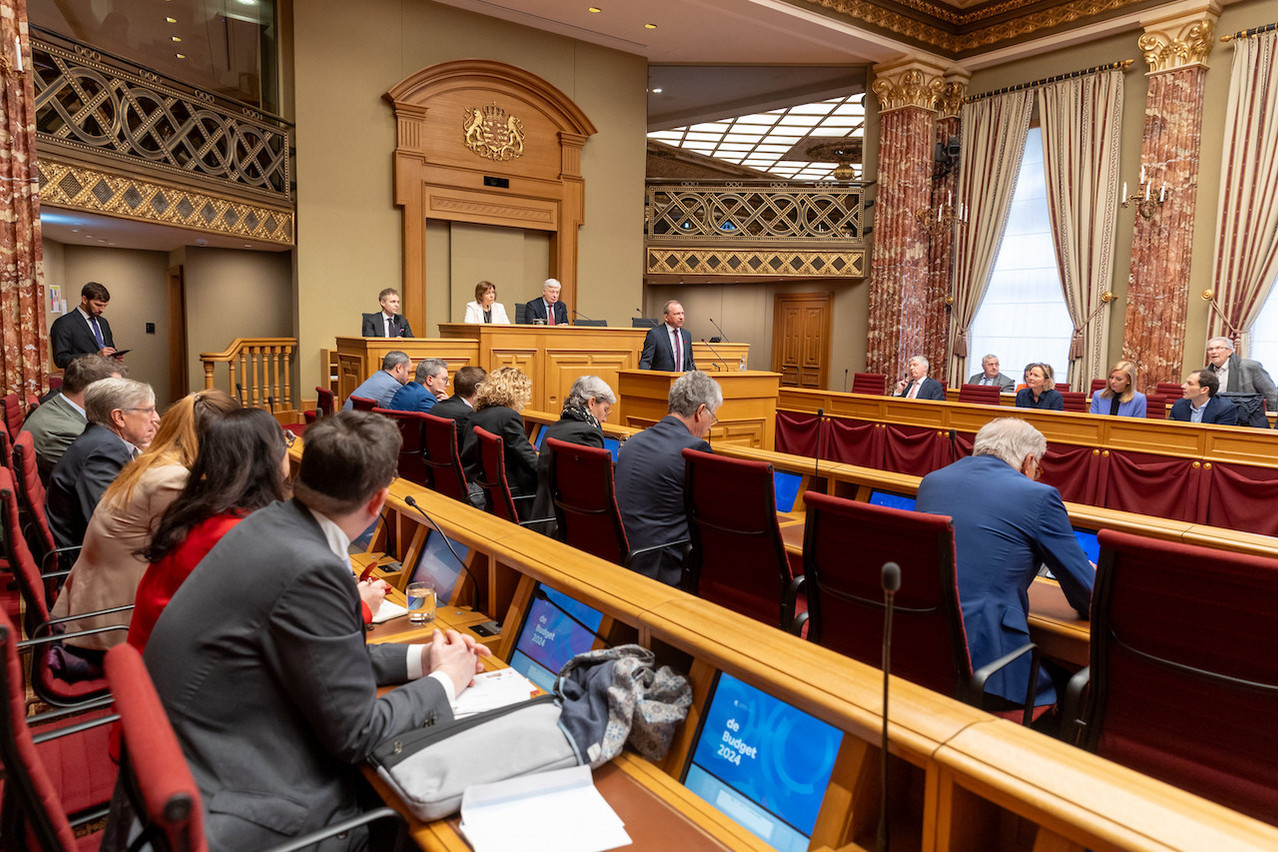
The nitty gritty of the draft budget is still being worked out: the Finance Committee will be meeting with the country’s three tax authorities--the Customs and Excise Agency; Luxembourg Inland Revenue; and the Registration Duties, Estates and VAT Authority--to fine-tune it. The opposition is particularly interested in clarification on revenue trends and possible tax increases.
In the meantime, Finance Committee chair  Diane Adehm (CSV) was pleased that the gap between expenditure and revenue was closing. The deficit? A necessary evil. In times of crisis, we need to have a counter-cyclical fiscal policy until things improve, she said.
Déi Gréng, for its part, is going to “wait and see,” said  Sam Tanson. “There’s a lot of talk about cutting spending and reducing debt, but we haven’t received any details this morning about the savings that will be made. With the announcement of savings to be made over the next few years, more difficult measures will probably be announced in the coming months. Two concrete announcements have been made: the increase in excise duty on tobacco--a good thing, in our opinion--and the reduction in corporate taxation. This raises the question of funding and the reduction in staff recruitment within the civil service, when we know that there is a real need for staff in many administrations.”
Tanson continued: “Conspicuously absent are the fight against poverty--no new measures announced, even though the need is immediate--and climate change, alongside the transition it requires, which is also not the subject of detailed developments or new measures. There is also a lot of talk about continuity in the projects begun by the previous government, which is surprising given the criticism that was levelled in the past.”
On the LSAP side, after the budget presentation,  Taina Bofferding pointed to “a lack of social measures.” The 47% of the budget earmarked for social transfers is not enough, in her view.
For  Sven Clement (Piraten), the text needs a close analysis, but he managed to highlight two shortcomings nevertheless. Firstly, a lack of support for tenants. “The measures announced for housing only benefit timeshare owners and forget about those who want to rent or who currently have no opportunity to become homeowners.” And secondly, neglect for the middle class. “Nowhere in the draft are there any measures to give the lower middle class any prospects of keeping their place.”
 Fred Keup (ADR) describes the budget as “disappointing” because it takes on debt to finance expenditure. “After €1.9bn this year, the projected deficit for the next few years will be close to €1bn each financial year. We are continuing to go into debt when we should have been cutting government spending.”
He added: “the government is running behind challenges that have been caused in large part by the disproportionate population growth of recent years (housing, mobility, personnel, infrastructure, etc.) and it lacks vision--or courage--for the future of our country.”
This article was originally published in Paperjam. It has been translated and edited for Delano.