
The Luxembourg House of Financial Technology (Lhoft) in July announced that it had initiated a research programme with the University of Luxembourg’s Interdisciplinary Centre for Security, Reliability and Trust (SNT). Could you tell us more about the project?

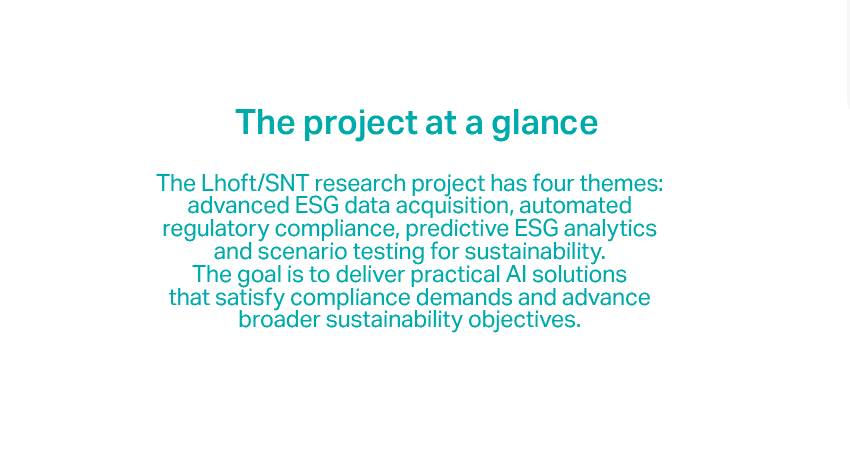
The first pillar of this research project concerns advanced ESG data acquisition. Past reports from the Luxembourg Sustainable Finance Initiative (LSFI) have highlighted challenges related to obtaining reliable and consistent ESG-related data, such as lack of transparency, cost issues and regulatory complexity. How can this Lhoft/SNT research project help tackle these data-related issues?
“By combining generative AI with advanced retrieval and validation methods, we hope the tool we create will help institutions locate, interpret and structure ESG data in line with regulatory standards. It will seek to clarify obligations, check the consistency of disclosures and align outputs with frameworks such as CSRD and SFDR. In short, it directly addresses the data-related challenges highlighted by the LSFI.
More broadly, how can fintechs tackle ESG data-related issues in the field of sustainable finance?
“Fintechs bring agility and technical innovation to complex challenges. They can automate data collection, use AI to identify gaps and prevent greenwashing, and apply blockchain to create auditable, tamper-resistant records. These solutions help transform ESG reporting from a compliance burden into a driver of trust and value.
Could you share some examples of fintechs that are driving ESG transformation?
“The Lhoft’s Catapult: Green Fintech programme is a good barometer. Some examples from the 2024 cohort: ClimateAligned, the programme’s winner, is building portfolio-alignment and transition-finance tooling for financial institutions; InvestConservation advances nature-positive finance through traceable biodiversity outcomes; Carbify provides near-real-time carbon data infrastructure; Datia streamlines investor ESG and CSRD workflows; Metricsat applies satellite analytics for environmental monitoring; Impact Scope brings carbon intelligence for digital-asset markets; and Connect Earth delivers transaction-level emissions insights.
The programme is sponsored by the ministry of finance, and we work very closely with the LSFI and other stakeholders to help the participating firms integrate into Luxembourg’s ecosystem. We’re equally excited about the new cohort that began on 15 September.
The use of artificial intelligence and AI-powered tools is often seen as a way to increase automation and efficiency in the financial industry. Are you already seeing some cases where AI is used to help financial institutions address challenges related to sustainability?
“Yes. AI is already being used to analyse sustainability disclosures, extract key indicators and flag compliance gaps.
What about blockchain and digital ledger technology (DLT)? Can these kinds of tech help financial institutions satisfy the need to comply with sustainability regulation?
“Blockchain and DLT can play a powerful role. They provide immutable records and verifiable audit trails, particularly useful in areas like carbon credits, green bonds and supply chain provenance. This ensures transparency, reliability and trust in sustainability reporting. I also feel tokenisation has a key role to play in advancing the market for sustainability-related assets such as green bonds.
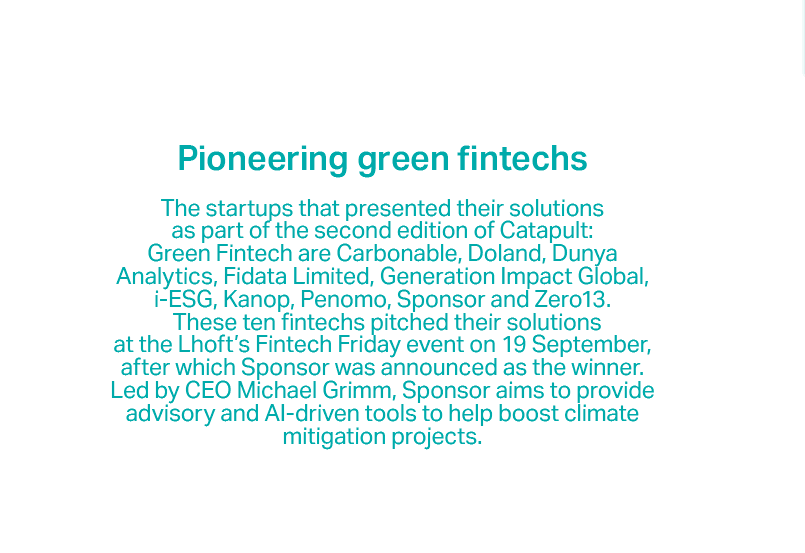
The Lhoft/SNT research project will be “interdisciplinary,” as University of Luxembourg professor Radu State explains, “bringing together multiple stakeholders ranging from finance, computer science and sustainability.” Why was it important to bring together so many different perspectives?
“Sustainability is not just a financial challenge. It spans regulation, technology and societal priorities. By bringing together finance professionals, computer scientists and sustainability experts, we ensure that the solutions are credible, practical and aligned with real-world needs.
How many people are involved in this research project, how long will it last and what concrete solutions do you hope it will produce?
“This is a multi-year collaboration, with several researchers at the SNT involved, alongside steering from the Lhoft and the LSFI, and the support of the Luxembourg Green Exchange. We are also looking to add more stakeholders from financial services to help shape the solution and ensure it is just right. The programme, at this early stage, has already delivered a first version of an AI-powered co-pilot for ESG reporting. Over the next phases of the programme, a key objective is to further enhance this generative
AI tool and develop a simulation framework to model the financial impact of ESG strategies. Together, we hope these outputs will help Luxembourg remain at the forefront of sustainable finance through practical, applicable innovation.”
This article was written for the ESG Finance supplement of Paperjam magazine's November 2025 issue, published on 22 October. It is published on the site to contribute to the full Paperjam archive. Click this link to subscribe to the magazine.