Climate disruption, the stigma of which is becoming more pronounced by the day, is forcing a myriad of sectors to adapt. Financial institutions are no exception. How can they integrate the risks associated with sustainability? Here are some of the answers.
The climate, a new risk factor?
A better integrated risk. The development of a more sustainable economy, and with it the greening of finance, implies the implementation of new approaches to risk management. “The insurance world was one of the first to integrate climate risk into its approaches. As far as banks are concerned, while it is not a new risk, it is becoming increasingly regulated as a result of regulatory developments,” comments Alexandre Dias, sustainable finance adviser at the Luxembourg Bankers’ Association (ABBL).
Whether you are an insurer, banker or fund manager, climate and transition risk—and more broadly sustainability risk—is now better taken into account in an overall risk management approach. “Market changes linked to the ecological transition can affect the value of a company,” explains Alexandre Dias. “Before granting credit, it is essential for banks to integrate these aspects and their financial impact if they wish to prevent losses or payment defaults. This is at the heart of their business.”
ESG data: still a weak link?
Data and expertise. How best to quantify sustainability-related impacts? “These can be expressed in many ways,” explains Sacha Reverdiau, a member of the board of directors of the Luxembourg Risk Management Association (Alrim). “Physical risks linked to climatic or environmental impacts are undoubtedly the most tangible today. For others, it can be more complex. Sustainability risk goes far beyond climate issues alone. Its subcomponents are multiple: they affect the exploitation of natural resources, such as water and biodiversity, but also social aspects or even the company’s reputation, with the threats of greenwashing.”
The Alrim representative cites two major challenges: on the one hand, the need to acquire, or even develop, new expertise; and on the other, the availability of data. “With regard to purely financial risks, we have a substantial volume of historical data and public access to it. The availability of data relating to sustainability risk, on the other hand, is far from being as comprehensive. We are moving forward in stages, drawing on various sources of information, with particular attention paid to their quality.”
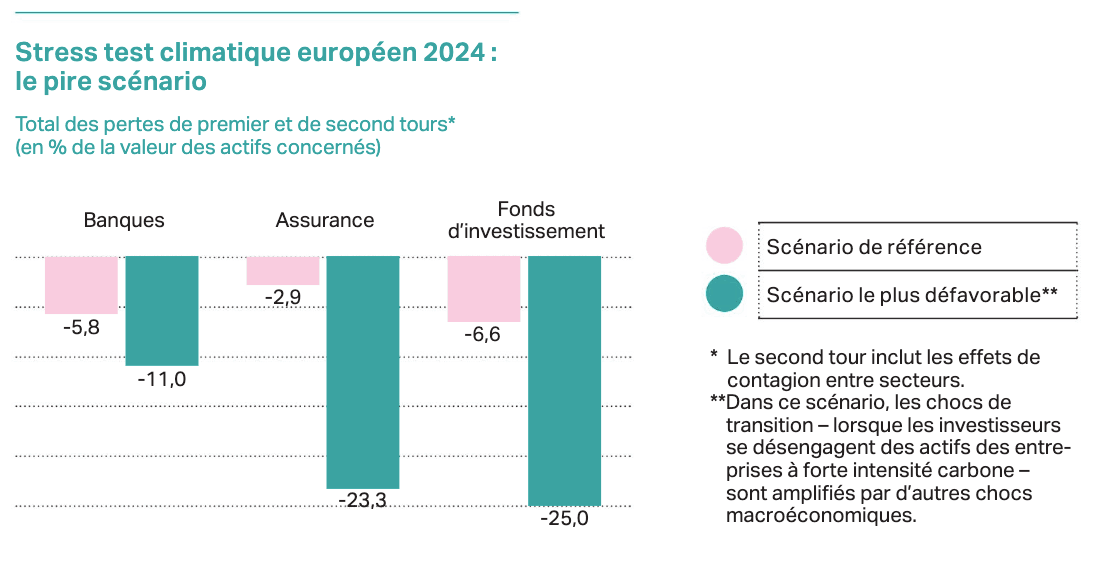
The European Central Bank (ECB) and the supervisory authorities have subjected the banking sector to an unprecedented stress test, focusing on climate transition risks. The exercise is part of the Fit-for-55 package. (Source: ECB, image: screenshot Paperjam)
How does regulation force adaptation?
Regulation on the move. Better consideration of climate risk, transition and, more broadly, sustainability, is supported by stronger regulation. The adoption of several texts has obliged companies to report on their extra-financial performance (notably with the generalisation of the CSRD or the adoption of the green taxonomy) and to guarantee greater transparency in terms of sustainable investment (SFDR and Mifid).
“The regulator, anxious to protect investors from new risks, but also to prevent systemic risks, is also requiring players in the financial ecosystem to carry out rigorous monitoring of sustainability risks,” explains Alexandre Dias. This is the purpose of CSSF circular 21/773, applicable to credit institutions, and, for all players, of the document entitled “Priorités de supervision” issued by the commission regarding sustainable finance. These texts currently define what is expected of everyone in this respect.
“The regulator expects supervised entities to put in place an appropriate risk management framework, with the requisite expertise and adequate governance. They must also be able to report on the risks identified in relation to the objectives pursued,” explains Sacha Reverdiau. As far as management companies are concerned, these requirements appear to be well taken into account overall, as indicated in a CSSF report published on 30 September, although there are still areas for improvement.
The European Banking Authority (EBA) recently published new guidelines on the management of environmental, social and governance risks. “Institutions under the direct supervision of the EBA will have to comply with these guidelines from 2026,” says Alexandre Dias. “For the others, the CSSF has just finalised a consultation of market participants with a view to defining how it might translate these new requirements at national level. The expected regulatory changes should contribute to a standardisation of risk management approaches.”
Should we standardise in order to compare?
Harmonising risk management. Until now, the regulator has favoured a principles-based approach. In view of the diversity of sustainability risks, the Luxembourg authority requires first and foremost that supervised entities demonstrate their ability to identify, assess and monitor the risks corresponding to their activities.
Difficult to establish precise rules applicable to all players.

For Sacha Reverdiau, if regulations are to evolve, it is with a view to harmonising practices, so that risk exposure can be compared more effectively. “In this area, it is difficult to establish precise rules applicable to all players. Given the diversity of cases, it would even be dangerous.”
What do the EU stress tests reveal?
Stress tests: anticipating tomorrow. The European Central Bank (ECB) and the supervisory authorities have subjected the banking sector to an unprecedented stress test, focusing on the risks associated with the climate transition. The exercise is part of the Fit-for-55 package, which commits the European Union to reducing its greenhouse gas emissions by 55% by 2030 and achieving carbon neutrality by 2050. The aim is to measure the resilience of banks and their ability to continue financing the economy in a context of an accelerated transition.
The analysis covers the period 2023–2030 and is based on three scenarios. The first adverse scenario, called “Run On Brown”, simulates a sharp fall in the value of carbon assets. The second combines this transition shock with a severe macroeconomic deterioration, fuelled by geopolitical tensions and an economic slowdown.
Depending on the results, European banks could suffer losses of between 5.8% and 11% of their exposures. Despite these shocks, the European banking system appears solid. Its high level of capitalisation and strong liquidity enable it to withstand even the most unfavourable scenarios. This stress test confirms that banks have the means to support the green transition, but it also highlights the importance of fully integrating ESG risks.
“Given the amplification of environmental, social and governance risks, it is normal for the authorities to pay increased attention to them,” explains Sacha Reverdiau. “Over and above the risk management framework that has been put in place, these exercises are essential tools for approaching risk. As managers, it is indeed important, when relevant, to expose ourselves to various scenarios in order to assess the impact, anticipate the risks and, if necessary, take the appropriate measures.”
Managing risk, more than ever, means anticipating.
This article was written for the November 2025 issue of Paperjam magazine, published on 22 October. The content is produced exclusively for the magazine. It is published on the site to contribute to the full Paperjam archive. Click this link to subscribe to the magazine.
Is your company a member of Paperjam Club? You can request a subscription in your name. Let us know via club@paperjam.lu.