
The key word for me is normalisation. We are entering an investment environment where inflation and interest rates are likely to be more normalised. The era of quantitative easing (QE) is over and we need to start getting used to seeing real interest rates in developed markets sit between 1% to 2%, higher than levels many have been accustomed to for over a decade.
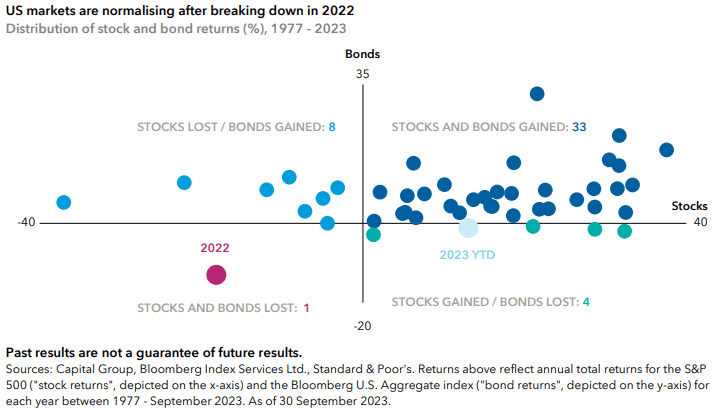
Another aspect that is normalising is the relationship between equities and fixed income. Looking at historical data, the two asset classes generated positive returns alongside one another in 33 of the past 46 years (as the following chart shows). The only year when the exact opposite happened was in 2022. But given how they have been performing in 2023, it seems that we are returning to a more normalised relationship between both asset classes.
Graphic provided by: Capital Group
What about cash?
There is loads of cash on the side lines with around US$5.6trn invested in money market assets as at end-September 2023. Cash has been generating nice returns given rising interest rates across developed markets. But when the amount of cash hits such an unprecedented level, it’s often a sign that investors ought to be thinking about diversifying their investments.
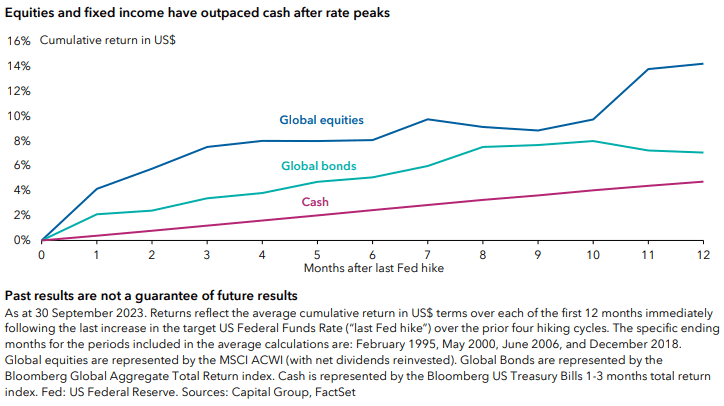
Investment professionals at Capital Group like to study history because even though none of us can predict the future, we can learn from past data and obtain clues as to how markets could potentially fare. If we look at the previous four hiking cycles in the US (from 1977 to 2023), global equities generated an average cumulative return of 14% in the 12 months following the last US Federal Reserve interest rate hike. Cash only generated a return of 4.5% while fixed income finds itself somewhere in between the two. If history were to repeat itself, money market fund yields would decline once rates peak, and investors would be better served by diversifying into stocks and bonds.
Graphic provided by: Capital Group
Have investors already missed the boat with equities?
The S&P 500 has had a strong run in 2023 (year-to-date returns of 14.6%) but a lot of that was driven by the ‘Magnificent Seven’--Alphabet, Amazon, Apple, Meta Platforms, Nvidia and Tesla. If we look outside of these seven companies, valuations are considered fairly normal. In fact, some sectors are down for the year because the US economy is in the midst of a rolling recession where different sectors are undergoing downturns at different times.
US residential housing, for instance, contracted sharply in 2022 after the Fed started aggressively raising interest rates. Now it looks like the housing market is starting to recover while other parts of the property market, such as commercial real estate, remains in a downturn.
Read also
Likewise, the semiconductor industry was plagued by supply chain concerns and lower demand for chips in 2022. That sent semiconductor stocks plummeting. The environment has stabilised in 2023, with demand returning and semiconductor stocks becoming one of the driving forces in global equity markets.
The chemicals industry is also showing signs of inventory bottoming and a similar situation is playing out in certain segments of the industrials sector. So, the key message is that equities still have a lot to offer and investors who have been on the side lines so far can still benefit from investing in the asset class.
Other areas of focus
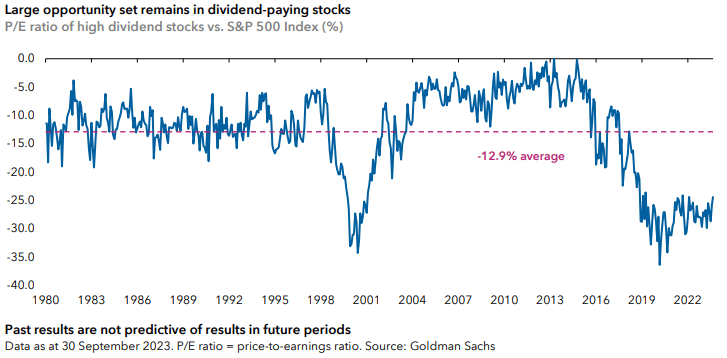
One area that I am keen to highlight is dividend stocks. Dividend-paying stocks acted as a cushion to offset some of the downside in 2022 but have lagged the broader market in 2023. Some of the underperformance are justifiable because long-end US Treasuries have been yielding higher, which have hurt the performance of many bond proxy stocks.
But there are certain parts of dividend land that I feel have been unduly punished. This includes dividend growers or stocks that consistently pay and grow the dividends. Capital Group’s analysis shows that dividend growers are typically higher quality companies with better capital allocation. This is because dividend growers typically generate earnings growth and free cash flow that back dividend growth. As a result, these stocks tend to be lower volatility investments that have a higher chance of doing better than the underlying market. Given how many of these companies have been negatively impacted by the wider dividend stocks decline, dividend growers are certainly an interesting area to look for opportunities heading into 2024.
What this also means is the potential broadening of the current equity market rally. History tells us that narrow market rallies coming out a recession have often been followed by steady gains for the broader market, which means opportunities outside of the magnificent seven.
In terms of sectors, I have been doing work with our analysts in the industrials, healthcare and energy sectors. The combination of low valuations and supply constraints has created several attractive opportunities across US and European energy companies. The US medical technology industry is also interesting because of its derating in 2023 despite continued innovation.
Graphic provided by: Capital Group
Artificial intelligence
Capital Group is of the view that innovation is critical to successful long-term investments. Innovation drives growth and enhances productivity. And better productivity could help cap inflation. Our investment professionals continue to conduct research around AI and the conclusion, so far, is this is going to be a big deal.
We are starting to see many companies globally adopt generative AI to accelerate their digital transformation (DX) and drive productivity gains by improving on existing work processes.
An example of this is a Europe-based multinational drinks and liquor company. The company spent five years transforming its operational data into a machine-readable, digital format. And through the use of generative AI, it has been able to build on the data by instantly analysing on-premise and off-premise sales data. That, in turn, enables the company to attain real-time feedback on how much inventory is required to go into a particular outlet or restaurant. The end result? With the same budget, it is now able to conduct 15 brand marketing campaigns concurrently as opposed to just five in the past.
Read also
Recently, I also met with the chief technology officer of an Asia-based insurance company to discuss their DX journey. The insurer has developed a direct-to-consumer app, which is effectively a one-stop portal for the company to engage in customer acquisitions and KYC (know-your-customers) processes as well as for customers to reallocate their portfolios and even submit claims. The central cog to the platform is the incorporation of a Gen AI co-pilot3 that enables interactive as well as iterative learnings.
One important question asked during the meeting was how did the CTO managed to convince stakeholders to invest in these tech initiatives? His answer was: the hurdle rate for their technology investments is 20% and the return is reflected in relatively flat operating costs while insurance premiums are growing at the low double digits. So even though AI is still at an early stage of development, companies are already seeing considerable benefits incorporating the technology into their operations.
Winnie Kwan is an equity portfolio manager in the Hong Kong office of Capital Group, an investment firm with $2.3trn in assets under management globally. Kwan helps run the Capital Group New World Fund (LUX) and Capital Income Builder funds.