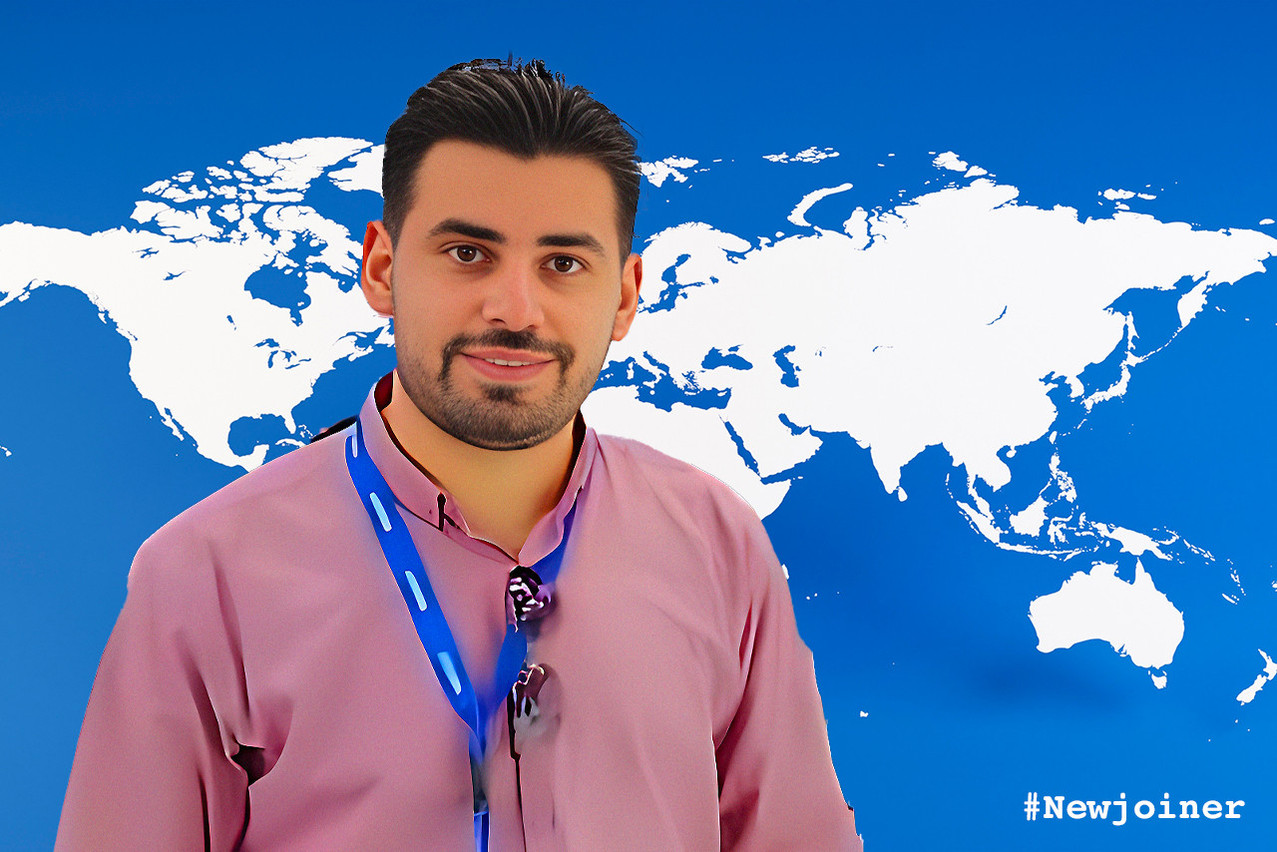
Paperjam: Please, introduce yourself.
Mohammad Abuabiah: Definitely. My name is Mohammed. I’m from Palestine. I’ve been here in Luxembourg since 2021, when I started working as a postdoc at the University of Luxembourg. I have an affiliation also as an assistant professor at An-Najah National University in Palestine. I have my master’s degree and PhD from Politecnico di Torino in Italy as a mechatronics engineer working in different applications like automotive robotics. And more recently, when I came here, on additive manufacturing, specifically on metal additive manufacturing.
Is that like 3D printing?
Yes, with metal.
All right. So Italy, Palestine--have you lived anywhere else?
No, just Italy, Palestine, now Luxembourg. I’ve visited a lot of countries for conferences in Europe, the US, Australia, but just for short-term stays.
And how did you find the postdoc opportunity in Luxembourg?
It’s a funny story! It was 2021, so covid times. I was teaching at the university, but everything was closed, so I was teaching remotely. And you know how, when you’re bored, you just go on social media? I was surfing on Linkedin and a post popped up saying that the University of Luxembourg is looking for a postdoc in control engineering. And I said: well, why not? And I was lazy--there is an option to send a CV or to have Linkedin generate a CV for you. I was really lazy! So, OK, just generate a CV from Linkedin… and I just clicked, and it worked, you know?
After two months, I received a call from a foreign number and I picked up. And the voice said: “I’m a professor at the University of Luxembourg. Do you have 30 minutes for an interview? You applied for a job here?”
I said: yes, no problem. But you know, I had totally forgot that I applied for that job! And I started searching about Luxembourg… what is the University of Luxembourg? What is Luxembourg? I’d thought Luxembourg was a city in Belgium! [He laughs.] And I had the call with the professor. It was really nice. We discussed the project.
And then at the end of the call, he said: “OK, now we will maybe move to the next step. We will have a second interview, and then we will look at your files and CV.”
And, as I told you, I was lazy… so I asked him a direct question. I said: maybe this is weird, but can I know the results now? Because in order to apply for the visa and all that stuff, that will take time--and if you want me in July--and this was May--then I don’t really have time--and I’m also married, I have kids, so I would like to prepare myself.
He was laughing, the professor. He said: “You know, for the procedure usually you need to have different interviews, etc.”
And I said: But I think 30 minutes with my profile, you already have the information… if you can give me an answer…?
He was really laughing--he’s from Germany--and he told me: “OK. You got it. Prepare your visa.”
Then [laughing] I got up and immediately went to my wife. And I said: let’s pack up and move to Luxembourg. She thought that I was joking! Because we’d never spoken about that. And I said: no, I’m serious: let’s move to Luxembourg! And this is how the story began. I just came for one year and a half on my contract--and now it’s four years and counting.
Wow, OK, yes. And your wife was on board with the plan?
Yes, yes. I had a kid at the time, and in 2023 I had another one here in Luxembourg. So, yeah. Settling down.
So you had never visited Luxembourg before you decided to come here?
No. And it was covid times, so there was also no visit before I moved here. It had to be a move right away. You couldn’t come and visit to come back. I was lucky even to find a flight at the time. Come and live! That was the strategy.
And what were your first impressions?
The first impression was that it’s really calm--a calm city, and a small one. I was a little bit afraid of the languages, because I was living for six years in Italy, and in Italy they usually speak Italian, so I had problems acclimating at the beginning--but when I came here I was really surprised. Everyone is speaking English, no problem, it’s international, there are many languages. So my impression was really nice. The weather, maybe, is a little bit cold. Even though I came in July, it was raining. That’s what I remember!
And I also had to get used to the free transportation. I told you, I didn’t know anything about Luxembourg, so when I came I was searching for where to buy the tickets for the bus! And I was surprised that it’s all free. So that was also nice.
What about the arrival and settling in process?
For the visa, unfortunately we don’t have a Palestinian embassy for Luxembourg; it’s the Belgian one. So you need to apply for Belgium but then convince the Belgians that you would like to go to Luxembourg instead. It took a month and a half. Then I got the visa. Then I booked the flight.
It was a little bit difficult to find accommodation, because it was really sudden--I couldn’t contact an agency before I came. So that was a little bit of a challenge. I spent three weeks looking for an apartment, renting an Airbnb at that time. But when I came, I came alone--I didn’t come with my family right away, so it was a little bit easier.
The good thing is that the university has a really nice working rule: they give you two weeks to find accommodation. You don’t need to come to the university, you can go and find accommodation. Also the supervisor, by the way, he was really friendly, he knew that there was a struggle to find accommodation, he didn’t push me, he even tried to help me, contacting people who could help. Finally, we found a place. And then I told my family: now you can come.
Any culture shocks or strange discoveries about Luxembourg?
No… I mean, maybe two surprising things: that everything is closed at 7pm, which is not the case in my country! Back there [laughing] the shops only start opening at 7pm! So that was a surprise--luckily, restaurants are still open after 7pm, which is nice.
The second thing: I’m still amazed today about the languages. How people here switch between three, four languages--it’s blowing my mind! It’s something you cannot find elsewhere. In Germany, in Belgium, in Italy. My son is going to school and he learns new words and my wife and I--we don’t know if the new word is French, Luxembourgish or German! So [cracking up] we just put it into the translator on auto-detect! Just to know which language he’s speaking! Which is nice, it’s really great. To see my son start speaking these languages.
And in your daily life, which languages do you use?
English. English with my students--I’m also teaching some courses here at the University of Luxembourg. You can speak English freely: Luxembourg is multinational and the university itself is really multinational. One semester I had 26 students: from these 26 students there were 19 nationalities. So you can imagine! And all of them speak English. The ecosystem here for English is fine. It’s totally fine. I mean, in grocery stores you can hear French… but even the bus drivers can speak English.
Between Palestine, Italy and Luxembourg, what differences in work culture have you observed?
The vibe of Italians is friendly… it’s nice for young people, let’s say. They have a party culture. In Palestine it’s more strict. You have rules, you need to respect these rules. You need to be always professional. Luxembourg is in between. I’m a parent now, so it’s really nice sometimes to have a professional working environment that is not too strict and not too fun! [He laughs.] Something in between.
Do you find Luxembourg kid-friendly?
Yes, absolutely. The first thing is that there’s a lot of playgrounds. Wherever you go, there’s a playground. That’s really nice--my kids are really loving that. And also they have really nice pedestrian areas where there are no cars, like for example Hamilius, where I can just put my kids down and let them run freely. You know, I was in the Netherlands, there’s a lot of bicycles, so I was always worried about my kids--in Italy it was the same situation with a lot of cars.
Also the schools. They have really nice schools, crèches, kindergartens. Also my wife, we had our second child here in Luxembourg, but even that process was nice and easy. I was worried because we have no family here… but they provided us with everything. Everything was really clear. They took care from the first day, and even after the birth for three months they come and visit you.
How’s the food here?
I was living in Italy, which is famous for food. I was a little bit struggling, to be honest, here in Luxembourg! Maybe there is not a lot of variety… to be honest, I still stick with Italian food, Italian restaurants! But this is a good thing in Luxembourg: you don’t have just one cuisine here. If you like Italian, you can go to Italian restaurants--you have Turkish, Syrian, which is like where I come from, Indian… but in terms of Luxembourgish-Luxembourgish food--it’s a little bit of a struggle! That’s [laughing good-naturedly] all I can say!
And I believe you said the weather was a little cold?
Yes--not a little bit--more than a little bit! It’s a grey winter. Last week we had rain… I sent it to my parents in Palestine, like: look, now it’s raining! And there it’s summer. But sometimes it’s nice. In Palestine it can go up to 45 degrees: we’re roasted. So it’s refreshing here. If it’s not raining, it’s a beautiful day. But you need to be expecting more dark days than sunny days.
Anything to add that I haven’t asked about?
One topic, if I may… I’m living in a stable, really nice environment here in Luxembourg, really multinational, stable, peaceful. But I cannot forget my family, my parents, my friends, my students who are living in Palestine in a not-peaceful, not-stable environment. So let’s not forget them. I hope one day that they reach the same stability, freedom, peace--that everyone can enjoy the same human rights.


