
Ultimately, no two customers should see the same Zalando. One will be looking for an outfit for a wedding with 200 euros to spend. The other will open the app without knowing what they want. The platform promises each customer their own personalised shop. “We’ll be able to create 62 million versions of our app, just as we have 62 million customers,” explains Laura Toledano, Zalando’s general manager for Western Europe, a region comprising France, the United Kingdom, Ireland and the three Benelux countries.
Founded in 2008, the technology platform specialising in fashion and lifestyle now operates in 29 European countries. It has 62 million active customers and recorded a turnover of €17.56bn in 2025. Laura Toledano describes it as Europe’s leading fashion and lifestyle platform.
The stated aim can be summed up in one sentence: “It is now the machine that will adapt to the customer, and no longer the other way round.” Instead of selecting a category, size, colour and brand one after the other, users can explain their needs directly to the Zalando Assistant. They can ask for an outfit for a date or a wedding, specify their budget and indicate the location or time of day.
The assistant can then request further information, check the weather and cross-reference the request with what the customer has already viewed, purchased, placed in their basket or added to their wish list. Their reactions to the initial suggestions – expressed, for example, by giving a thumbs-up or thumbs-down – are used to tailor subsequent suggestions. The customer can make a purchase directly from within this conversation.
A flying start for the assistant
Laura Toledano states that the service was used more than 10 million times in the first quarter, without specifying whether this refers to requests or unique users. This dialogue does not mean that the app will systematically search for the cheapest item of clothing. Price becomes a factor when the customer specifies a budget or when their purchase history reveals a typical price range. “We don’t push prices down. Our aim isn’t to drive down the whole market,” the executive insists.
The recommendation is based firstly on the user’s stated intention, and secondly on the data already collected. A customer who has never spent more than €150 on an item should therefore receive suggestions within a comparable price range. However, Zalando does not specify the respective weighting given to price, availability, past preferences, a product’s popularity or the commercial relationship with the brand.
This issue is becoming a sensitive one as the platform simultaneously expands its advertising business. Revenue from its retail media, which enables brands to buy visibility, rose by 42,4% in 2025. It now accounts for 1,8% of B2C turnover, compared with 1,4% a year earlier. Zalando is aiming for a share of 3% to 4% by 2028.
For consumers, the challenge will be to distinguish between a recommendation calculated for its relevance and a product benefiting from brand-sponsored exposure. Laura Toledano points out that Zalando also maintains organic visibility, particularly to promote brands deemed relevant by its local teams. Smaller retailers can create their own page, contribute to an editorial section or take part in communications aimed at customers. They can also purchase campaigns through Zalando Marketing Services.
However, not all products sold on Zalando follow the same model. In its ‘wholesale’ business, Zalando buys items from brands, becomes the owner of the stock and decides on their prices, presentation and the countries in which they will be sold. In its Partner Programme, the platform acts as a marketplace: the brand retains ownership of its stock and controls its prices, content, promotions and the markets it wishes to serve. For the customer, this difference remains largely invisible, yet it determines who manages the products on display and bears the risk of unsold stock. It is also playing an increasingly significant role in Zalando’s business model. Sales generated by partners accounted for 32,1% of B2C turnover in 2025. The group aims to increase this proportion to between 40% and 50% by 2028.
The assistant dedicated to the ‘vanity size’ limit
Artificial intelligence also comes into play before a purchase is made to minimise one of the main frustrations of online fashion shopping: receiving a product that doesn’t look like the picture or doesn’t fit. Zalando uses the reasons provided for returns to determine whether a pair of shoes or an item of clothing runs smaller or larger than usual. The app can then recommend that the customer choose a different size from their usual choice.
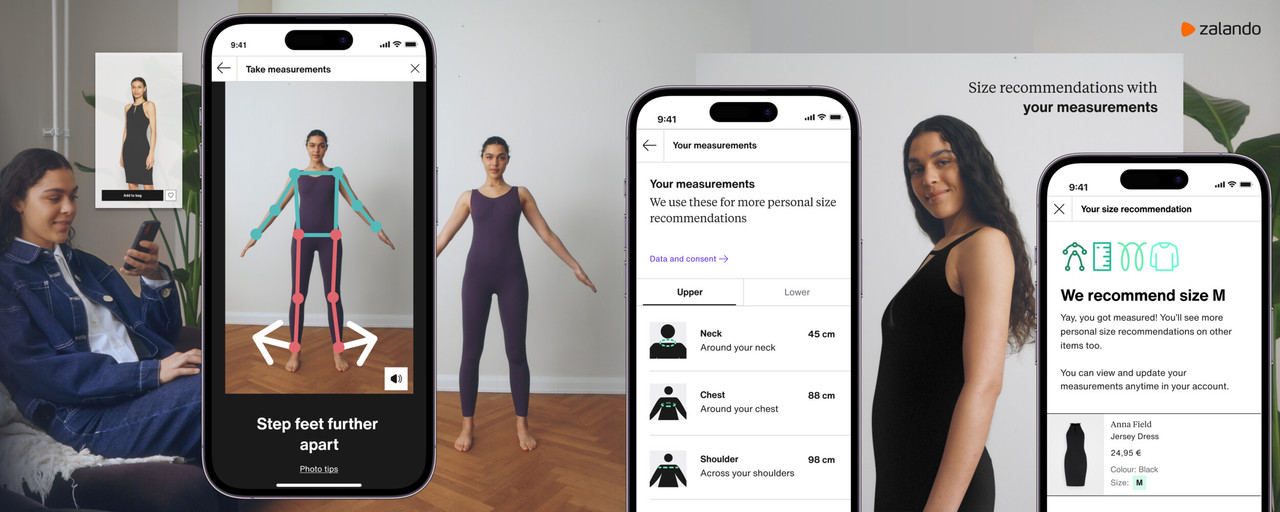
The range of size-related services has reduced returns caused by the wrong size by more than 9%. The reduction in returns benefits both the customer and the platform’s profitability. It avoids the need for a new order and further delays for the buyer, whilst reducing the logistical workload borne by Zalando or the brand. (Illustration: Zalando)
The platform also offers a virtual fitting room. Using a front-facing photograph and a side-view photograph, it generates an avatar based on the customer’s measurements, onto which certain items of clothing can be superimposed. Laura Toledano assures us that the photographs are not stored by Zalando: “We’ll use them to work out your measurements, but the photo is never stored by Zalando – it stays on your phone.”
According to her, the range of size-related services has reduced returns caused by the wrong size by more than 9%. The reduction in returns benefits both the customer and the platform’s profitability. It avoids the need for a new order and further delays for the buyer, whilst reducing the logistical burden on Zalando or the brand. The company states that it tests each new feature with a limited group of customers and measures its impact on turnover, profit or returns before rolling it out more widely.
Strict control of personal data
However, the widespread use of AI-generated content creates another risk: widening the gap between the product shown on screen and the one the customer receives. Zalando says that more than 90% of its marketing content on its app and website was produced using AI in December 2025. Laura Toledano points out that this proportion relates in particular to banners and campaigns, whilst many of the photographs used in product listings are still taken in real-life settings.
When faced with the disappointment that may arise from the texture of a garment discovered after delivery, Zalando’s response remains a more traditional one: check the product’s composition, then return it free of charge if it does not meet your expectations. “Our role is to provide you with as much information as possible so that you can make an informed choice,” summarises the director.
This personalisation depends on an ever-increasing amount of information: searches, clicks, abandoned baskets, purchases, returns, reviews and, where applicable, body measurements. Laura Toledano states that this data remains within the Zalando ecosystem and that customers can opt out of its use for personalisation purposes. However, users who exercise this option forgo part of the personalised experience promoted by the platform.
Agent-based commerce: a ‘friend’ rather than an ‘enemy’
The next change could take place outside the app itself. Zalando is preparing to allow external artificial intelligence agents to search for and purchase clothes on behalf of its users. In particular, the group supports Google’s Universal Commerce Protocol, which is designed to enable transactions directly via the US group’s AI services. The payment feature introduced by Zalando is currently limited to the United States.
Laura Toledano sees these agents as a new entry point rather than a threat. She points out that less than 1% of traffic currently comes from large language models. Users who go via ChatGPT, Gemini or Claude are mainly looking for a specific product, a price, a size or fast delivery. Those who go directly to Zalando are more likely to be looking to discover an outfit or a brand. According to the executive, 72% of customers say they visit the platform first to find inspiration.
Zalando acknowledges that some purchases may nevertheless be made outside its app. “There may be a bit of cannibalisation – honestly, it’s possible – but at the moment, we’re not seeing it,” says Laura Toledano. The company hopes to offset this shift by becoming the infrastructure that connects brands, their stock and buyers.
Zalando: the infrastructure for brands
This transformation explains the expansion of its services to brands. Zalando offers them its logistics, software, advertising tools, sales data and, now, a dynamic pricing system. B2B revenue reached €1.091 billion in 2025, representing a reported increase of 14,6%. Logistics still accounts for 93% of this business.
For the customer, this infrastructure must make the same stock available across several online shops and in several countries. An item returned in France can be quickly restocked and sold to a customer in another market. Zalando states that its multi-channel logistics service was working with more than 70 retailers across 18 channels in 2025.
Luxembourg is a small but rapidly growing testing ground for this trend towards personalisation. Zalando previously operated there via its Belgian site. For about a year and a half now, the country has had its own website and a service tailored to Luxembourgish consumers. Laura Toledano states that local business is growing strongly, without disclosing the number of customers or the corresponding turnover.
The promise made to these customers is therefore no longer simply about giving them access to 7,000 brands. Zalando wants to anticipate what they are looking for, suggest the right sizes, organise delivery and enable purchases to be made via a chat. However, the simpler the experience appears on the surface, the more precisely the platform needs to know who is behind the screen.