Director of RTL and chairman of Luxair on the front, but a passionate and tireless painter on the back. Gust Graas was one of the great Luxembourg figures whose centenary was celebrated throughout 2024 thanks to the energy and tenacity of his daughter Kit Graas.
A tireless entrepreneur
Gust Graas was born on 19 December 1924 in Esch-sur-Alzette. From an early age, he showed an interest in the visual arts, drawing and painting in particular. After studying law, he worked for several years as an independent lawyer. But it was at the Compagnie luxembourgeoise de télévision (CLT), of which he was one of the founders, that he forged most of his career.
Starting out as a lawyer, he became head of personnel at the Compagnie luxembourgeoise de radiodiffusion, then secretary general. From 1957, he worked on developing a German-language radio programme, paving the way for Radio Luxembourg. In 1969, he was responsible for the famous programme “Hei Elei Kuck Elei,” the forerunner of Télé Lëtzebuerg. In 1972, he became deputy director of CLT and general manager in 1975.
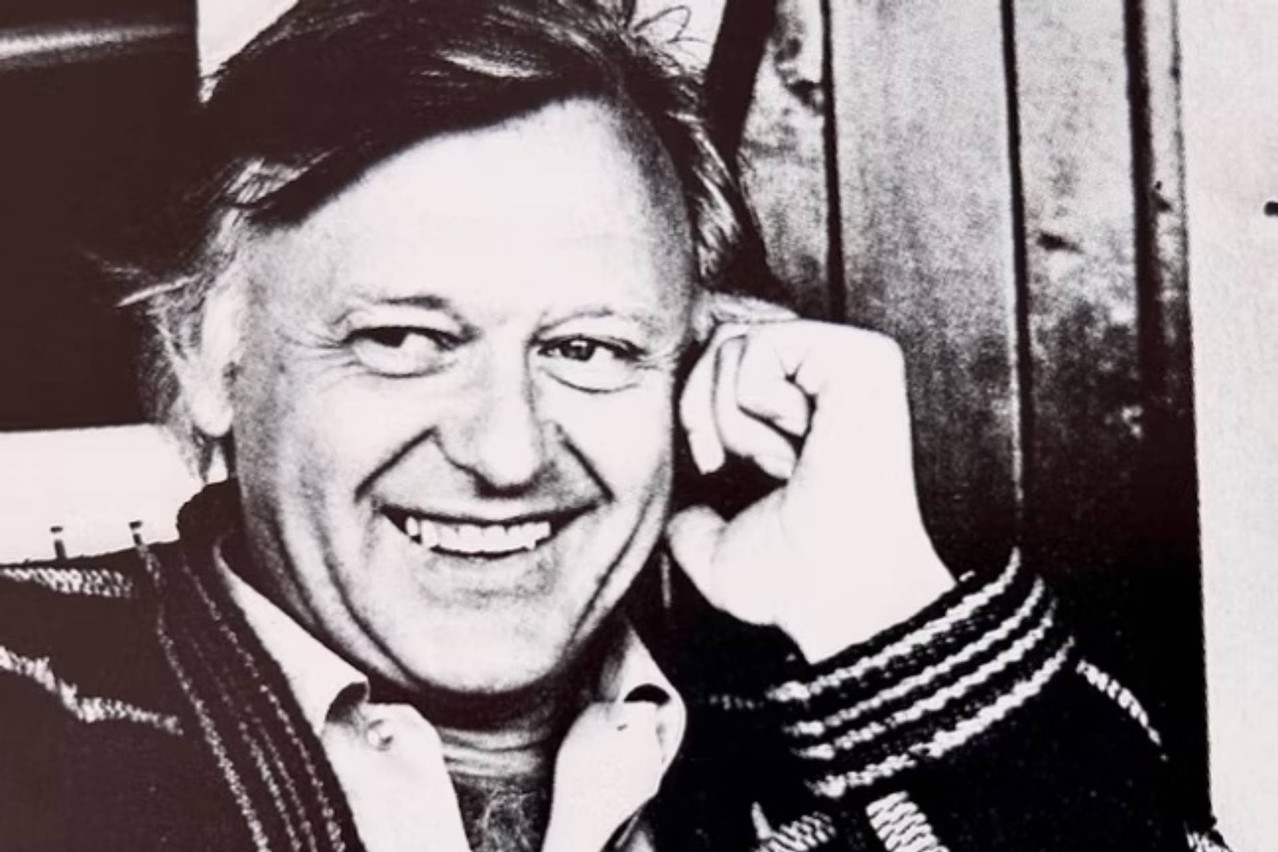
Gust Graas was an important figure in Luxembourg. Photo: Graas family
“He dreamt of Luxembourg having its own satellite,” explains his daughter Kit Graas. “He worked hard for that and bought a lot of programmes to that end. He was also responsible, for example, for RTL Plus in the 1980s. All this work led to SES becoming a reality. You have to realise that at that time, the steel industry was no longer the country’s main source of wealth and that RTL helped to recreate value in Luxembourg, employing a large number of people... It was a great responsibility.”
Thanks to these experiences, he was also called upon to found Luxair. “My father had experience of dialogue with the state for RTL. That’s why he was asked to set up Luxair, to create this company on the basis of dialogue between the private sector and the state,” adds Kit Graas. He would go on to chair the company for more than 20 years. When asked about her father’s political involvement, Kit Graas replies, “He certainly founded the youth section of the CSV, but he thought he was much more useful as an entrepreneur than as a politician.”
A passionate painter
Gust Graas died in 2020 at the age of 95. But throughout his life, he worked tirelessly as a painter, leaving behind a large number of works. “My father really had two lives,” confirms his daughter. “His professional life, in which he was very involved, and his life as a painter, in which he was just as passionate. In fact, he set himself the target of completing one painting a day. But these two lives were very compartmentalised. They were really two different careers, which developed in parallel, but he lived them both to the full.”
"My father really had two lives. His professional life, in which he was very involved, and his life as a painter, in which he was just as passionate.

From an early age, Gust Graas loved to paint and draw. A large drawing of the Château de Clervaux and, a little later, a self-portrait in military uniform, remain from those early years, when he was forcibly conscripted into the Nazi army in 1942. After this dark episode, “from which he retained no hatred for the German people, but great faith in Europe, says Kit Graas, he left to study and began his professional career. But drawing and painting remained his daily private pursuits.
It was in 1963 that he exhibited a work for the first time in public, in response to a call for projects for the CAL on the theme “Luxembourg Millénaire.” “The painting was an instant hit," says Kit Graas. "He had never thought of exhibiting before; he was painting for himself. Following this, Jos Wampach, who was then director of the Esch theatre and director of the town's gallery, asked him to exhibit his work. He accepted. After that, he dared to show his work much more publicly, and even though he was wary of gallery owners, he nevertheless agreed to exhibit in Luxembourg galleries such as Galerie La Cité and Galerie Angle Aigu in Brussels in 1973.”
In 1970, he was awarded the Grand-Duc Adolphe Prize, and his success was confirmed with exhibitions at the Musée national d’histoire et d’art and the Villa Vauban, for example. His painting explores different artistic currents, ranging from figurative art to lyrical abstraction. He is also influenced by the École de Paris and Maurice Estève. Here and there, we also see inspirations from the works of Miro and Klee.
Of course, his works also reflect his inner questions and moments in his life. “The family was never excluded from his creations. If my mother didn’t like a piece of canvas, an element of his painting, he would rework it for her. We were allowed to join him in his studio too, and he didn’t hesitate to represent his family in his work,” recalls Kit Graas.
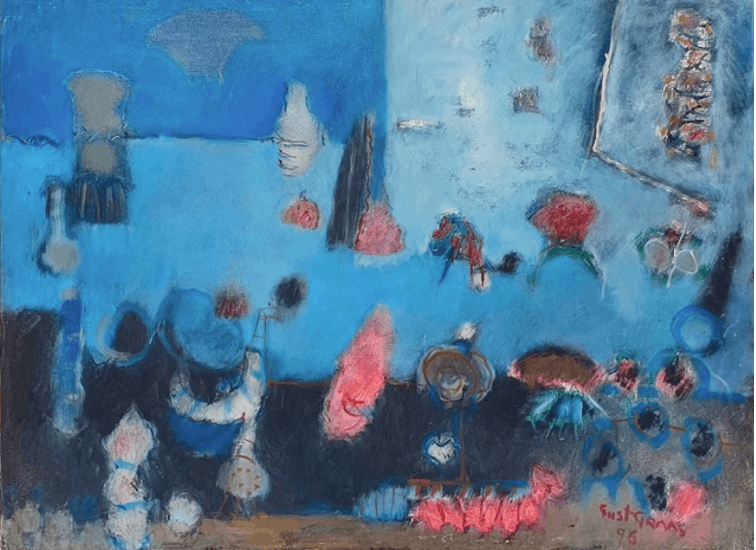
Gust Graas, " Harmonie bleue" (1996) Photo: Kit Graas
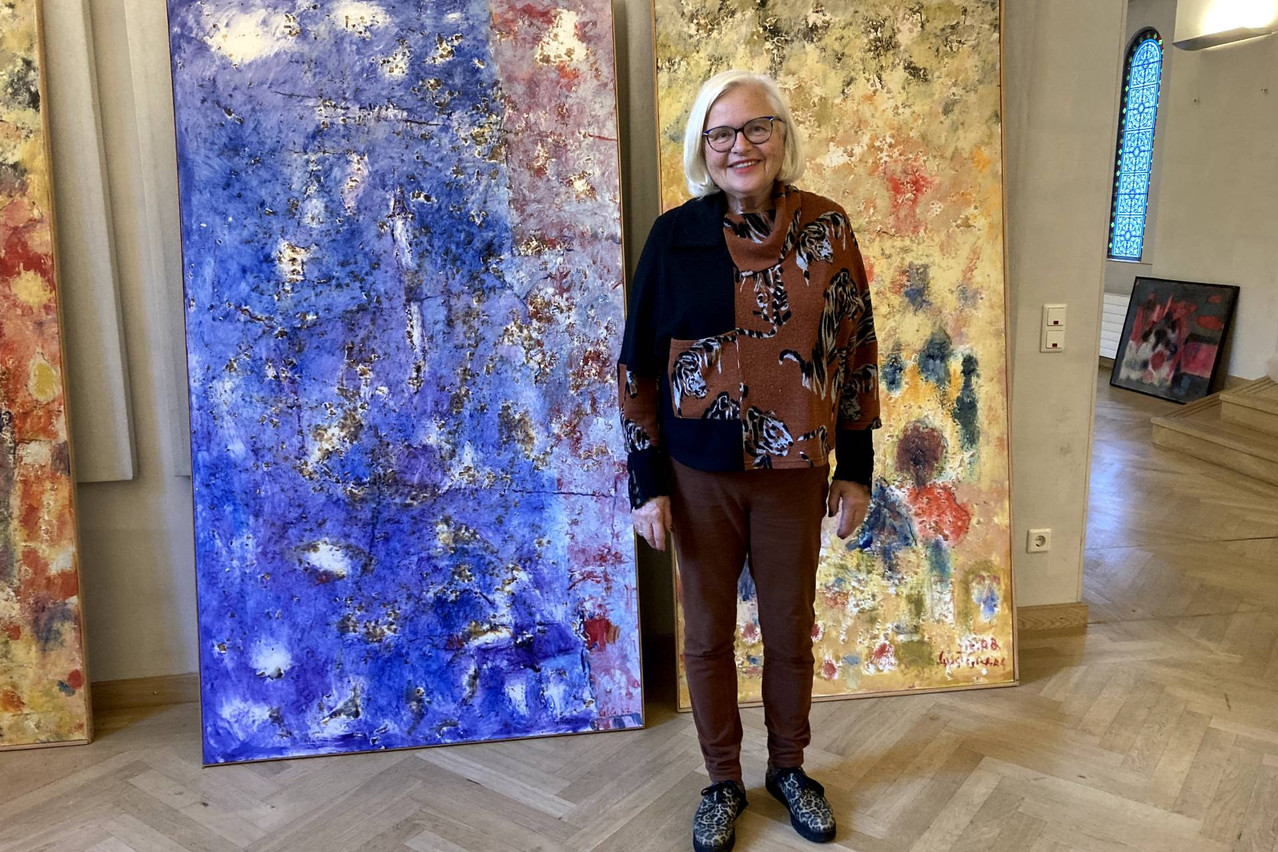
In 1988, Gust Grass left RTL and moved to Mallorca, where he had bought a house in the early 1980s. This marked the start of almost 30 years of creative work, influenced by the sun and landscapes of this Mediterranean island. A selection of works painted during this period are on show in the “Poesia” exhibition in the chapel in Neimënster, which has already been presented in Mallorca and attracted no fewer than 11,000 visitors. “You can tell from his paintings that he was a little lost at the beginning of his stay on the island. He was an important man in Luxembourg and in Mallorca nobody knew him,” explains his daughter. “Then, as time went by, you could feel that he was finding his new feet, his painting was calming down and he was taking full advantage of his new stress-free life and of what Spain had to offer: the sea, the sun, the markets…”
This exhibition is the latest in a series organised in Luxembourg throughout the year to celebrate his centenary. “My father painted so much! His output is huge. The exhibitions I’ve put on are based solely on the canvases I own, but there are many more. These days, I try to mount as many of his works as possible. That’s why I’ve organised all these exhibitions. And I’m currently writing his biography, which I hope will come out in 2025,” concludes Kit Graas.
“Poesia” is on display until 26 January 2025 at Neimënster.
This article was originally published in French.