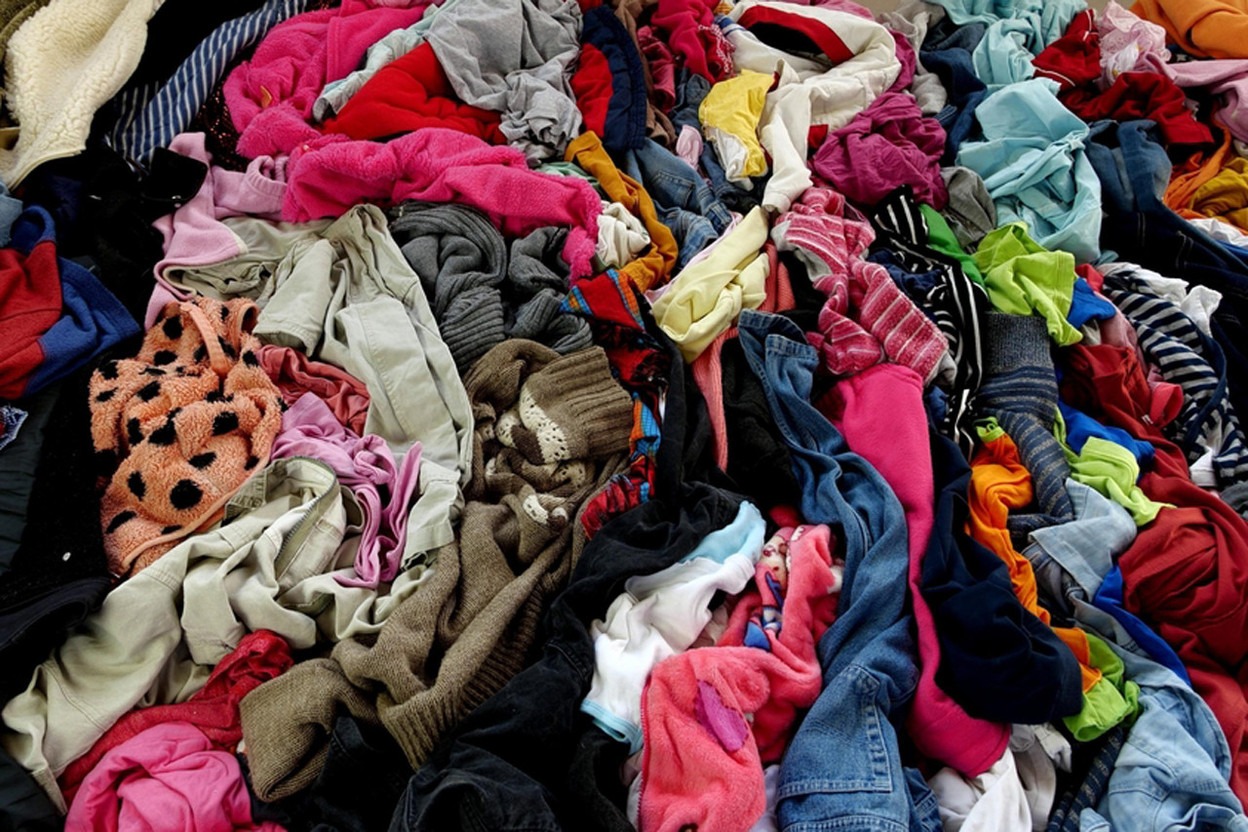
Buy. Throw away. Buy. Throw it away. Cheaper and cheaper. Faster and faster. A vicious circle that makes no sense. According to the study “Textile Flows in Luxembourg”, carried out in 2022 for Caritas Luxembourg and Fairtrade Lëtzebuerg, on the basis of TNS Ilres data, 7,454 tonnes of textile waste were generated in Luxembourg in a reference year. On a per capita basis, this represents 12.26 kilos of discarded clothing per inhabitant per year. On this scale, the equivalent of 95 T-shirts is disposed of every minute. The study also highlights an underlying trend: since 1993, the volume of textile waste has risen by 31%, while the household budget spent on clothing has almost halved, an indicator often associated with the spread of low-cost, fast-moving consumption models.
More recent data, communicated by the minister for the Environment, Climate and Biodiversity in a parliamentary response published just before this weekend of 28 February, confirms the scale of the phenomenon. According to the reply, around 7,562 tonnes of textiles are thrown away every year in Luxembourg. Of this total, 5,450 tonnes are collected separately via resource centres, door-to-door collection, public containers or direct donations, while a further 2,012 tonnes end up in residual waste from households and businesses. This corresponds to 11.76 kilos of discarded textiles per person per year, a level comparable to that observed a few years earlier.
Circularity remains limited. Less than 2% of discarded textiles are actually reused locally. The national sorting centre Spëndchen, run by Caritas Luxembourg and the Red Cross, is a notable exception, redistributing between 60% and 70% of the clothes it collects to local social organisations. But on a national scale, these volumes remain marginal compared with overall flows, a significant proportion of which is exported or directed towards recovery channels outside the country.
The burden will shift from municipalities to manufacturers
Institutionally, textile waste management is currently mainly the responsibility of municipalities. Since 2022, separate collection of textiles has been compulsory in Luxembourg under the amended Waste Act of 21 March 2012. Municipalities must factor the costs of this collection into their budget planning, with varying financial impacts depending on the systems in place and the service providers available. In his parliamentary reply, the Minister for the Environment states that the administration is closely monitoring the continuity of the service, particularly following the cessation of activities by certain associative players, highlighting the operational fragility of the current system.
It is in this context that Luxembourg is preparing to transpose a European directive from last September, which amends the Waste Framework Directive and introduces a harmonised extended producer responsibility scheme for textiles, accessories and footwear. Member States must adopt the necessary legislative provisions by 17 June 2027 at the latest and put in place the extended producer responsibility schemes by 17 April 2028. Micro-enterprises will have an additional period until 17 April 2029 to comply with the financial obligations.
Concretely, the directive provides that producers who place textile products on the European market for the first time will have to cover the costs of collection, sorting, reuse, recycling, consumer information, data collection and support for research and development. The financial contributions will be calculated mainly on the basis of the weight and, where applicable, the quantity of products placed on the market, with modulation linked to the eco-design requirements set out in the European regulation on sustainable products. This obligation will apply to all producers, including those who sell remotely or via online platforms, whether they are established within or outside the Union.
73% of clothing and textiles in Europe are imported
For Luxembourg, the stakes are twofold. On the one hand, the aim is to gradually transfer the financial burden of managing textile waste from local authorities to producers. Secondly, the directive explicitly targets value chains that are largely globalised. According to European data cited in the text, around 73% of clothing and household textiles consumed in Europe are imported, mainly from Asia. The regulatory pressure will therefore fall not only on local players, but also on the international brands and distributors that supply the Luxembourg market.
It remains to be seen whether this reform will make it possible to reduce the volumes of textile waste or whether it will initially result in a better distribution of costs without significantly altering the flows. The figures available show that the challenge goes beyond the organisation of collection alone. It affects product design, business models and consumer practices. As the transposition of the directive approaches, Luxembourg finds itself at a tipping point, between a system that is still largely linear and the European ambition to make textiles a pillar of the circular economy.