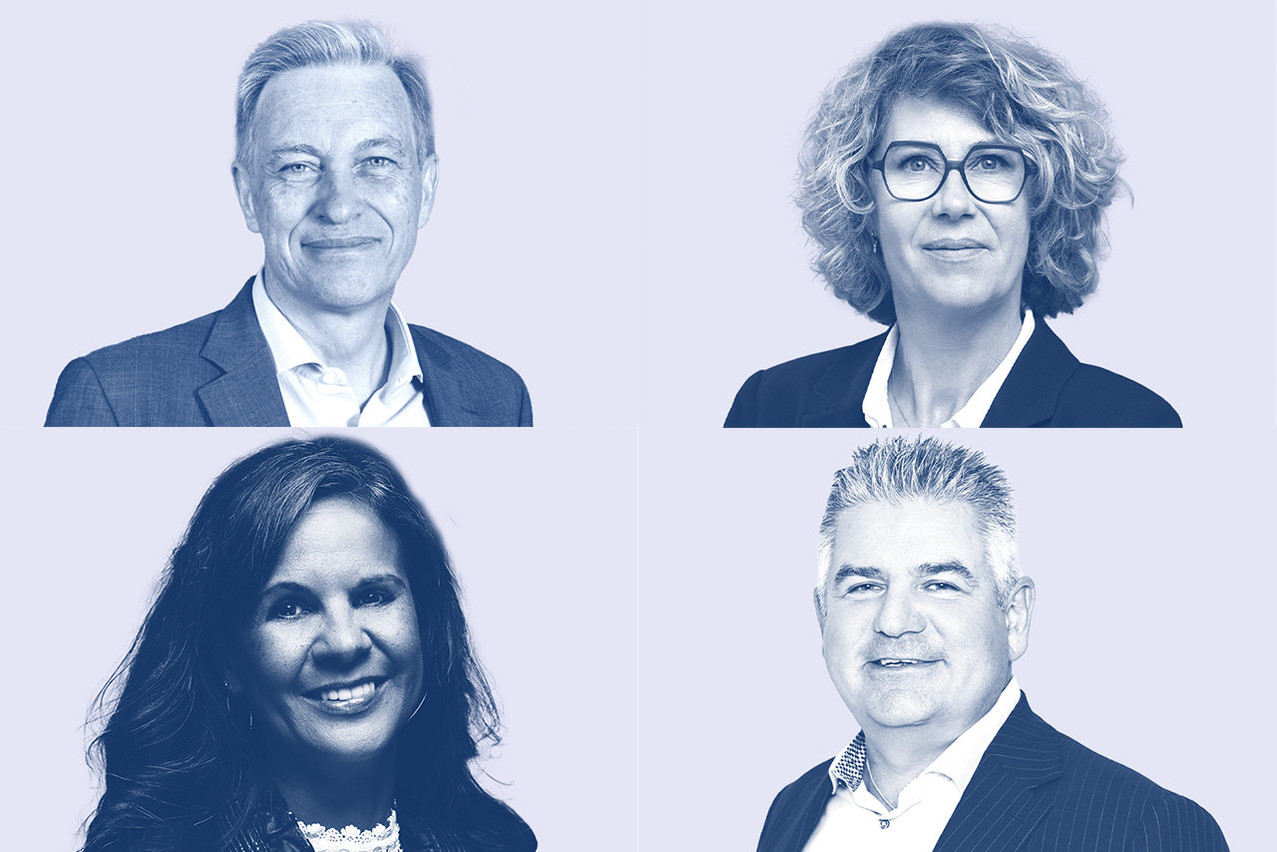
“As HR directors, we have become aware of the importance of all types of diversity within the decision-making bodies, as a lever for greater collective performance, based as it is on a wealth of exchanges and points of view. The various HR processes (recruitment, internal mobility, development, learning) are the source of support and encouragement for diversity,” explains Nicole Dochen, from Banque de Luxembourg. As to whether she sees the ‘exemplary’ company as a utopian dream or an attainable goal...
“To answer this question,” she says, “we first need to ask ourselves what an ‘exemplary’ company is. I remain convinced of the richness of a diversified environment. An ‘exemplary’ company would be one that respects everyone for who they are and what they bring to the group. One that has a vision that motivates and inspires everyone. One that allows all employees to grow and develop without denying themselves. Utopia? I don’t think so: what’s important is the vision and values that we defend over the long term. If this long-term vision is sustainable and fair, anything is possible. But for that to work, our employees have to be at the centre of this mobilising, long-term project. At Banque de Luxembourg, our raison d’être revolves around ‘caring for future generations,’ and this drives our commitment and our actions.”
“The HR director must be the guarantor”
“The role of HR directors is to promote an inclusive culture, guarantee fair recruitment processes and ensure equal opportunities. Setting an example is an objective that can be achieved through concrete actions and a constant desire to improve,” says Julien Bossu, from CDCL.
Laurent Derkum of Banque Raiffeisen agrees: “The HR director must be the guarantor of DEI issues. By adopting inclusive and fair practices, we can create a working environment where every employee feels valued and respected. And this is entirely in the interests of the company itself--we have no choice if we are to be successful in the long term.”
“The HR director is responsible for creating a framework conducive to this inclusion, by developing initiatives tailored to these issues,” says Aurélie Ederle, for Société Générale Luxembourg. “This involves defining and steering strategic orientations, raising awareness and training, collaboration between the various departments, and setting up external partnerships (for example, the IMS).”
“An exemplary company is an attainable goal if the commitment is constant, sincere and sustained at all levels,” says Christopher Frères at the Luxembourg Stock Exchange. “This requires regular assessment of our practices, corrections where necessary and an ability to evolve with societal expectations.”
“My role,” sums up Edith Brunner from Lombard International Assurance, “is to make sure that all employees have the same understanding of what DEI means for our company, so I train them, then make sure that good practice is followed in managing teams and that inappropriate behaviour is reported. We need to provide tools that enable us to manage our employees as effectively as possible in a DEI spirit.”
“A source of performance”
“Diversity and inclusion are a source of performance and innovation, and at a time when there is a shortage of talent, they are a strategic lever for companies,” points out Delphine Bath of La Mondiale Europartner. “This means putting in place concrete policies to promote fairness in recruitment, promotion and remuneration processes, as well as raising awareness and training teams in these issues.”
At BGL BNP Paribas, “this is a subject that particularly resonates with me and, as HR director, I feel that I have a responsibility and the power to act to create a fair and respectful working environment, where everyone has the opportunity to develop and express their full potential. The exemplary company must be an inspiring world for those who live it on a daily basis and a driving force for change and evolution for society. This means taking responsible decisions, ensuring that we offer the best and being a vehicle for progress for everyone,” says Louis de Looz-Corswarem.
“At BDO,” says Matina Korma, “we are proud to have a diverse workforce representing over 45 different nationalities and to have succeeded in eliminating the gender pay gap. Despite these achievements, we remain committed to continuing to foster an inclusive culture. By committing to strategic initiatives and fostering a culture of support and inclusion, organisations can make progress towards this exemplary ideal.”
“This requires inspirational leaders, clear alignment, a secure culture and fair rewards. Increased commitment has a positive domino effect on all employees,” adds ING Luxembourg’s Julian Troian.
Management support
Setting an example, says Marc Parage of Lalux, “requires an organisational culture based on strong values, ethical management, social and environmental responsibility, and constant attention to the needs of employees. Although the challenges are many, tangible progress can be made, making this objective both ambitious and achievable.”
“I believe that we are the guardians of an environment that offers everyone the same chances and opportunities. Regardless of our religious beliefs, our gender or our ethnic origins, the organisation must allow everyone to be themselves and to flourish in an inclusive environment. But beware, this is not just the exclusive prerogative of the HR director; these aspirations must be shared by the entire management team if they are to become a reality,” insists Magali Maillot from A&O Shearman.
“At PWC Luxembourg,” says Delphine Berlemont, “we strive for diversity, equity and inclusion in everything we do, for our employees, our clients and society. Our DEI strategy focuses on the entire life cycle of employees, from recruitment to integration, via performance, assessment and promotion. In all of this, we adopt a data-driven coaching approach to build the right direction for our people. We have identified the following key drivers of change: gender, the LGBTQI+ community, disability, cultural awareness and generational empathy.”
“Each company needs to find its own key”
“As co-head of HR,” says Didier Lemeire from Spuerkeess, “I believe I have a major responsibility in this area, and the bank’s commitment to the Diversity Charter, supported by our head of HR & people management, Sandra Schengen, is proof of this. One of the reasons I decided to make a competency framework a central element of our HR policy is to enable objective (unbiased) decisions to be made throughout the HR life cycle.”
“Perfection is out of reach, but becoming an exemplary company is a realistic goal. It’s based on a continuous process requiring determination, consistency and adaptation,” says Christelle Noel at Dussmann, “supported by a pragmatic approach and clear, measurable commitments. Each company needs to find its own key.”
“We talk a lot about these issues,” says Chantal Trausch, at Rak Porcelain Europe, “but they should be part of the DNA, the very essence of every member of a human resources team. For every talent that we recruit, that we train, these issues shouldn’t exist because they’re an integral part of the game and it shouldn’t come down to percentages or criteria.”
“Our role is to promote an inclusive environment within a naturally diverse academic body,” explains Claire Audollent. “This includes the ULearn platform offering training on the inclusion of LGBTQIA+ people and unconscious bias, mentoring to develop talent, a gender equality policy, the use of common names for students, as well as fair recruitment processes for researchers, and much more, guaranteeing equal opportunities. As a signatory to the Diversity Charter, we evaluate and adjust our actions to ensure a lasting impact.”
“Key role”
“As a social leader, the HR director plays a key role,” notes Karine Rollot from Fondation Hôpitaux Robert Schuman. “They ensure that all employees at all levels of the organisation are aware of, committed to and supported in inclusive strategies (recruitment, training, promotion and pay equity). It ensures they are followed up and responds as far as possible to societal requirements which are currently undergoing a profound transition.”
From there to an exemplary company... “Exemplary, I don’t know, because we manage people... Learning certainly, like any system in permanent movement whose wealth is first and foremost human resources, where success depends on our ability to concentrate energies around a vision to achieve,” says Olivier Schmitt at the CHL.
For the Luxembourg Red Cross, Dorothée Schneider says, “DEI is not just a question of process, it’s also a question of skills--in the most objective sense of the term. We want to be pioneers in this field, and that means that it’s a collective approach, made possible by everyone joining in, from the highest to the lowest level of the pyramid. These values must be reflected in our relationships with our customers, as well as with our colleagues.”
Tatiana Escure of Stëmm vun der Strooss concludes: “For each new employee, I hand over a wooden jigsaw piece to complete the puzzle already in place. This gesture symbolises our conviction that we are not perfect, but that every employee is a key element of our organisation, essential if we are to move forward together.”
Setting an example, according to the winners
Lise Roda (Banque Pictet & Cie), HR Leader of the Year and winner in the financial centre category, says: “DEI is everyone’s business, and Pictet is very attentive to it. A DEI policy alone (no matter how good it is) has little impact unless it is put into practice, communicated and passed on.”
Isabelle Faber (Post), winner in the services category, says: “The exemplary company is not a utopia at Post, but a concrete requirement: each project, activity or product must simultaneously meet the criteria of profitability and CSR. This dual requirement is no longer an ambition but an operational prerequisite.”
Myriam Sibenaler (ABBL), winner in the Institutional category, says: “The exemplary company is an entirely attainable objective, even if perfection remains an ideal. The important thing is to make continuous progress by embodying strong values and listening to its employees and society. After all, setting an example isn’t about being perfect, it’s about showing that you’re prepared to roll up your sleeves and improve every day.”
Ann De Jonghe (Sodexo), winner in the retail and hospitality category, says: “We have to do everything we can to aim for this exemplarity, although it’s not realistic for many reasons. First of all, because we work with men and women, who are therefore fallible. Because there isn’t just one truth or one model that suits every organisation. And also because the themes of diversity, equity and inclusion are constantly evolving and, here too, expectations are changing and we have to constantly question ourselves and adapt our practices.”
This article was written in French for the HR Leaders supplement to the February 2025 issue of Paperjam magazine, published on 29 January. The content of the magazine is produced exclusively for the magazine. It is published on the website as a contribution to the complete Paperjam archive. Click here to subscribe to the magazine.
Is your company a member of the Paperjam Club? You can request a subscription in your name. Let us know via club@paperjam.lu