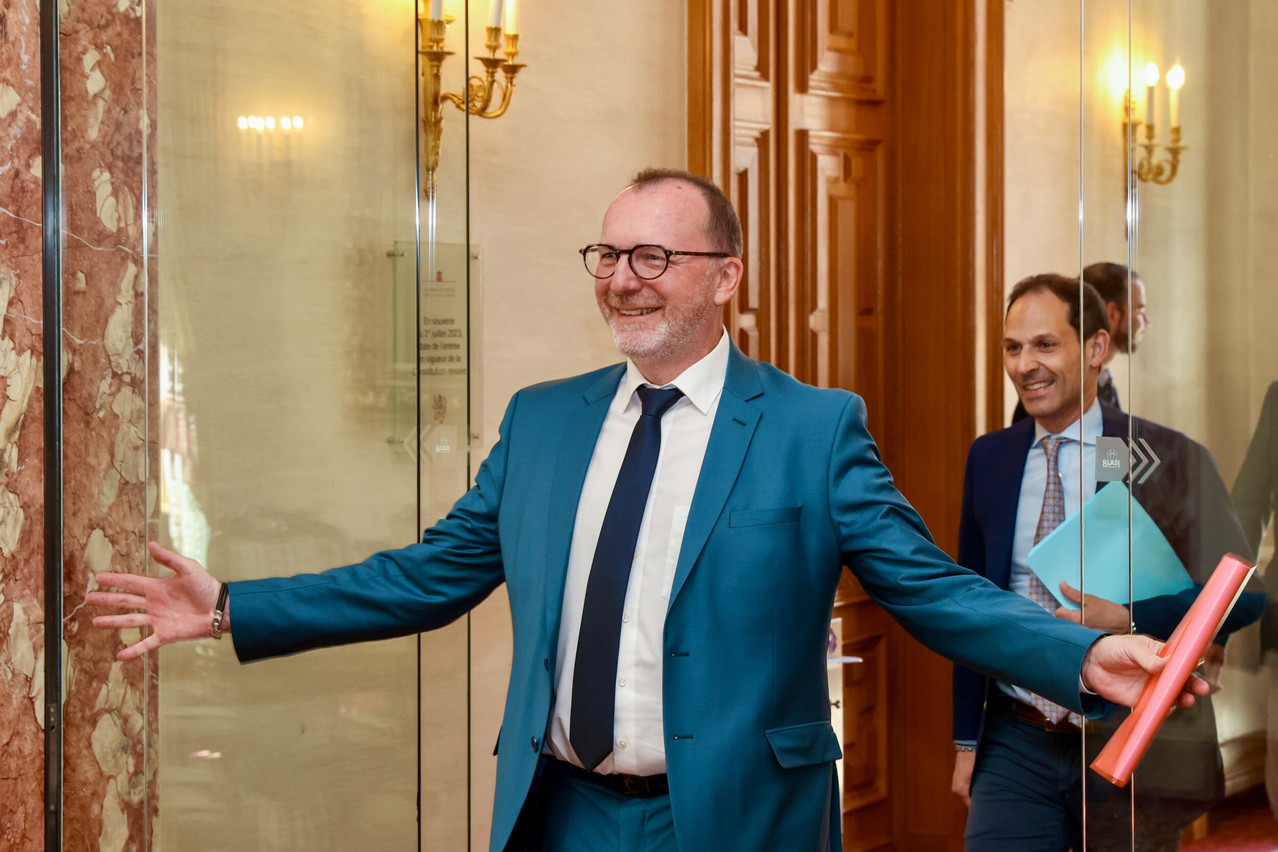
Georges Engel has said Luxembourg’s tripartite agreement must remain subject to parliamentary decision-making, after warning against creating “a parliament next to parliament”.
The LSAP co-chairman, MP and former labour minister said he was not criticising the tripartite process or the unions’ right to make proposals. But he said major spending decisions, particularly on housing, had to remain in the hands of elected representatives.
“I am a member of parliament, so it is normal that I defend the interests of parliament,” Engel said.
His comments point to one of the political questions now surrounding the €450m package: how far social partners should remain involved once the agreement moves from negotiation to legislation.
Engel made the initial remarks in a 3 June interview with Radio 100,7, referring to union proposals for a long-term housing fund discussed through tripartite structures.
Asked after Monday’s signing about Engel’s comments, Nora Back, president of the OGBL, said unions were not trying to displace elected institutions. “We respect parliament and the work of parliament, of course,” Back said. “What we wanted here was to restore the value of social dialogue in Luxembourg. That is not about replacing parliament.”
Parliamentary route
The signed agreement creates several follow-up structures, including a quarterly tripartite monitoring committee and a housing monitoring committee chaired by the prime minister.
Engel said those structures should not obscure parliament’s role. The package covers finance, housing, working conditions, the minimum wage and energy prices, areas that would normally be examined across several parliamentary committees.
He argued that MPs should consider creating a special parliamentary committee to scrutinise the package as a whole, rather than splitting the measures across separate committees.
Prime Minister Luc Frieden said after Monday’s signing that the government would prepare draft laws in the coming weeks. Some measures apply immediately or during the summer, while others will only take effect in 2027.
Housing criticism
Engel said the agreement was strongest on minimum-wage support and energy-price measures, but weaker on housing.
The signed text creates a housing monitoring committee and includes tax measures linked to the super-reduced VAT rate and home-savings contracts. But Engel said the package did not go far enough on what he described as Luxembourg’s biggest problem.
“The tripartite was not good for housing, but it was good for the minimum wage and energy-price measures,” he said.
He said housing should be debated in parliament rather than handled mainly through tripartite structures.
Budget pressure
Engel also placed the €450m package in the wider context of public-finance pressure.
He described the agreement as an investment in social stability during a crisis, but said the government also faced major spending questions linked to defence, tax reform and possible future losses in tobacco-tax revenue.
The LSAP had proposed raising the social minimum wage by €200, split between employers and public support. Engel said the tripartite compromise delivered the amount but placed the full burden on public finances through the tax-credit route.
He said the energy-price cap was not ideal from a climate-policy perspective, but could be justified as a temporary measure to limit inflation and preserve social stability.
The debate now moves beyond the agreement itself. Engel’s warning points to the next question: how much political weight should be carried by social-dialogue structures, and how much by parliament once the package becomes law.