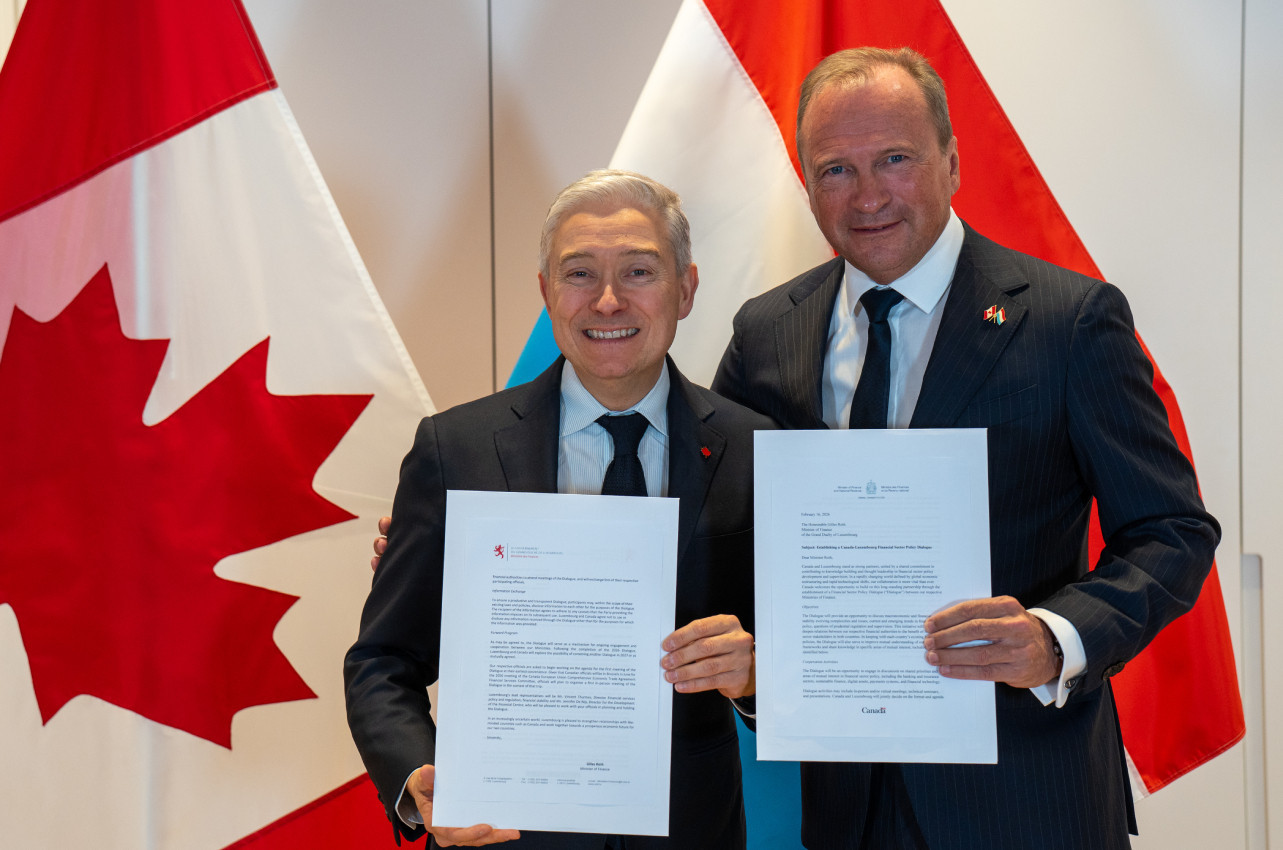
On Monday 16 February, Finance Minister 

An examination of eight realities that give substance to this idea of a strengthened partnership between the two countries.
1. Two robust but different financial centres
In Luxembourg, the financial sector is highly concentrated. On the one hand, the investment fund and asset management industry dominates, with €7.4trn in assets under management in 2024. It accounts for 18% of financial employment and generates 22% of the sector’s added value. On the other hand, private banking and insurance and reinsurance, organised around the security triangle, constitute leading niches, with 66 insurers and 195 reinsurers established in the country. In total, Luxembourg’s financial sector contributes almost 20% of the country’s GDP, an exceptional ratio that reflects the country’s role as an international financial hub.
In Canada, the financial sector is much more integrated into the national economy. It is underpinned by major global banking groups, powerful insurers and a high volume of employment, with around 614,300 people employed in financial services, including insurance. Its economy, with a GDP in excess of €2.1trn, is based on a vast and diversified domestic market. The financial sector is deeply integrated into the real economy. In 2024, the sector’s contribution to GDP was around €115bn, or around 8.5% of GDP, a level comparable to that seen in most developed economies. Assets under management are also very high: around €2.2trn were invested in mutual funds and ETFs at the end of 2024, to which can be added around €4.1trn managed by public pension schemes, making Canada the third-largest country in the world for pension assets.
2. Complementarity based on asymmetry of size
This difference in scale largely explains the logic behind the merger. Luxembourg is first and foremost an international financial infrastructure centre. Its stock exchange hosts more than 44,000 securities, denominated in over 70 currencies, issued by entities from nearly 100 countries. Clearstream, one of the world’s two international central securities depositories, holds some €10.2trn in assets under custody. The country has also established itself as a central platform for international bond issues, including sovereign, supranational and sustainable.
Canada, on the other hand, is a major centre of capital production. Canadian public pension funds are among the world’s largest institutional investors, with long-term investment strategies heavily focused on infrastructure, real estate, energy and alternative assets. The geographical diversification of this capital, historically concentrated in North America, is a recurring strategic challenge for Canadian managers.
In this context, Luxembourg appears to be a natural platform for channelling these flows to Europe. Thanks to the European regulatory passport applicable to Ucits funds and AIFs, a Canadian manager can, via a Luxembourg structure, distribute products to investors throughout the European Union (EU). Conversely, Luxembourg managers find a deep institutional capital market in Canada, capable of absorbing large volumes over long time horizons.
3. Interlocking sector specialisations
Complementarities are particularly apparent in the respective specialisations of the two centres. Luxembourg is home to the global management of cross-border investment funds, particularly for international investors, as well as recognised expertise in hedge funds, fintech and financial structuring. Canada, on the other hand, concentrates on domestic savings management, commercial banking, life insurance and funded pension schemes.
These differences are already reflected in concrete practices. Some Canadian financial groups, such as the Royal Bank of Canada, use Luxembourg structures to issue securities in euros. Canadian pension funds choose Luxembourg to domicile hedge funds for European investors. Conversely, European players use Luxembourg vehicles to channel investments into Canadian projects.
4. A regulatory dialogue made necessary by complexity
The regulatory frameworks differ significantly. Luxembourg applies the European directives extensively, in particular Ucits and AIFMD, providing a harmonised framework and a single passport within the internal market. Canada has a more fragmented model, with banking supervision at federal level and capital markets mainly under provincial jurisdiction. While Canadian banks are renowned for their prudential soundness, the lack of a financial passport often complicates their international deployment.
In practice, a Canadian management company wishing to distribute funds in Europe must set up a European structure, often in Luxembourg, in order to benefit from the passport. Conversely, a Luxembourg manager entering Canada must comply with multiple provincial requirements. The structured dialogue that has been announced is aimed precisely at making these interactions more fluid, particularly with regard to funds, fintech and cross-border supervision.
5. Taxation at the heart of everything
Luxembourg offers an attractive environment for financial vehicles: competitive corporation tax (25% sliding scale) with exemptions (parent-daughter regimes) and minimal fund subscription tax. Capital gains in SIF/AIF/RAIF funds are generally not taxed. Luxembourg and Canada are linked by a bilateral tax treaty (usually entered into force in 1978, 2013 protocol) offering deductions at source (e.g. 5% on significant dividends, 10% on interest). The two countries have also signed the OECD’s Multilateral Tax Convention (MLI) to combat tax evasion.
Canada has a less advantageous tax system for international structuring: higher combined federal/provincial taxes (26–31%). It encourages investment via tax-sheltered accounts (RRSPs, TFSAs) for citizens, but the institutional structures have no direct equivalent to Luxembourg’s FIS. However, Canada has a vast network of DTTs (nearly 90 countries), including Luxembourg. In practical terms, a Luxembourg fund invested in Canada will avoid double taxation (adjusted dividends and interest), and vice versa. For example, a Canadian pension fund investing in a European company via Luxembourg can take advantage of the local parent-subsidiary regime to avoid taxation on the dividend received. Conversely, a Luxembourg-issued Ucits fund open to Canadian investors may have its income taxed in Canada under DTT rules, with a tax credit to avoid double taxation.
6. Access and gateways
Luxembourg benefits fully from the European Economic Area (EEA): any authorized financial service (bank, fund) can be deployed in the EU/EEA without additional formalities via the regulatory passport mechanism (e.g. a Luxembourg Sicav can freely sell its shares in Germany, France, etc.).
Canada, meanwhile, depends on sector-specific agreements: it is part of the USMCA with the US and the CPTPP in Asia-Pacific, but these do not provide a “financial passport” at scale.
The EU and Canada share Ceta (which came into force in 2017), which encourages investment and services, but it does not contain a broad passport provision like the EU. In practice, Canadian companies looking to conquer the European market (for example, to launch a fund or an online bank) often open a subsidiary in the EU, and the Grand Duchy is a preferred choice because of its small size and regulatory expertise. Conversely, a Luxembourg financial company must register with the provincial authorities to operate in Canada. Recent discussions aim to facilitate such regulatory exchanges.
7. Sustainable finance, infrastructure and capital markets
Sustainable finance is another pillar of the rapprochement. Luxembourg has established itself as the world’s leading place for listing green and sustainable securities, while Canada is rapidly developing its green bond issues, particularly at provincial level. Quebec has already used the Luxembourg Green Exchange (LGX) for issues aimed at specialist European investors.
This dynamic extends to market infrastructures. Canadian institutional investors frequently use Luxembourg infrastructures for the custody and trading of international securities, while Canada offers large-scale investment opportunities in infrastructure, energy and the climate transition.
8. A common political and institutional foundation
Finally, the partnership benefits from a specific human and cultural foundation. Canada’s institutional bilingualism and Luxembourg’s multilingualism facilitate operational exchanges and recruitment. Many Luxembourg institutions recruit Canadian graduates, particularly from Quebec, who are appreciated for their mastery of civil law and their fluency in English.
Institutionally, the two countries share strong involvement in multilateral frameworks, particularly within the OECD, the G7 and international financial stability bodies. They apply the Gafi standards in the fight against money laundering and participate in international work on prudential supervision. The structured dialogue introduced in February 2026 is intended to give a bilateral dimension to these multilateral exchanges.
All in all, the financial partnership between Luxembourg and Canada rests on clearly identifiable structural foundations: a specialised, internationally-oriented financial centre on the one hand, and a large, capital-producing national financial system on the other. The letter of intent signed on Monday does not create this complementarity, but gives it a political and institutional framework designed to strengthen its coherence, visibility and long-term effectiveness.