With more than 200 hospitalised patients, including over 40 in intensive care, hospitals are in the midst of the second wave--following the first alert of it in July, counting around 50 hospitalisations.
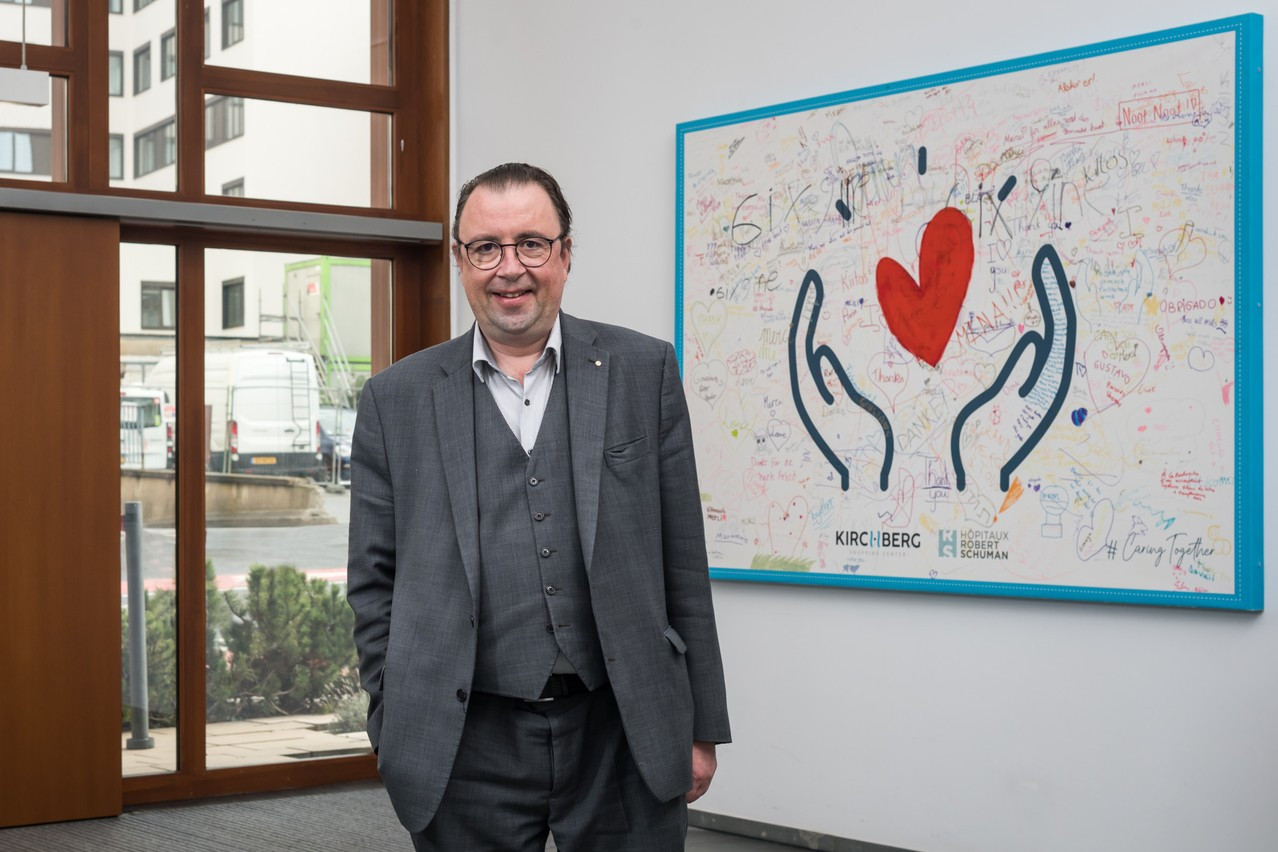
Coordination has not relaxed since. "We talk on the phone daily if need be, and we meet twice a week," says Dr Claude Schummer, managing director of Hôpitaux Robert Schuman (HRS). "There is great solidarity among the hospitals."
Proof of this is the daily transfer of two covid-19 patients from the Centre hospitalier Emile Mayrisch (Chem) to HRS, as well as to the Center hospitalier de Luxembourg (CHL), in order to relieve Chem, which is "overwhelmed by patients from the south of the country, which has become the hotspot of the epidemic”.
Dr Schummer adds, "Solidarity also plays a larger role: the entire health system must function, and not just the hospitals,” referring to the difficulties of the Center hospitalier du Nord at the start of the second wave, due to the disorganised care in nursing homes. Care homes, care networks for dependent people, general practitioner care lines: “everything must work”. And downstream too: the Rehazenter has just opened 10 places to accommodate covid convalescents in rehabilitation, while the Château de Colpach is requested to accommodate 20 additional beds.
The main obstacle? "The bottleneck is the personnel," says Dr Schummer. Hospitals, while well-equipped and better prepared, are facing an upsurge in potentially serious cases with a new variable that is difficult to control. “We have to keep the hospital running as usual, since we cannot deprive people of non-covid care for months. This situation can last another six months while awaiting a vaccination plan for the population.”
In fact, each hospital had to negotiate and close one or more unit(s) in order to save a reserve of personnel. At HRS, one unit and an operating theatre are on standby--around 30 caregivers made available to other units or kept in reserve. At Chem, three units are also closed.
Consequence: "We are trying to encourage the shift towards ambulatory care," explains Dr Schummer. Promoted by the 2018 hospital law, this shift takes on its full meaning when a hospital lacks staff to take care of patients hospitalised for more than a day. “We gave a quota to each specialty based on its initial volume of activity. It is the doctors themselves who decide which patients to prioritise. ”
Emergencies and oncological surgery (cancer) remain 100% insured. Endoscopies, medical imaging, and the polyclinic are also functioning normally. “We are not engaged in a sprint like in the spring, but a marathon. It’s very important for us to keep non-covid care at the highest possible level. ”
Another pitfall for staff: with the virus being more widespread amongst the population, quarantine and isolation are increasing, given that caregivers could also be exposed to a case of covid in their personal circle, beyond their work in the hospital. Staff needs are also higher in covid zones: 30% more in normal care, and 50% more in intensive care.
Resilient but tired staff
Hospitals took advantage of the summer to generalise training courses which had started in the spring. “Through short training sessions and introductions, nurses from the Bloc op, polyclinics, emergency services and others have been prepared for the adequate care of covid-19 patients,” according to Chem. “The trainings focused on the theoretical background and treatment options, the dressing and removal of protective equipment (gown, mask, cap, gloves, glasses, etc.), as well as positioning patients [while they are lying down]. Positioning on the stomach is one of the central therapeutic measures and a very complex technique. Didactic and educational videos were produced and made available to nursing staff on the intranet." In Chem alone, 200 healthcare professionals had been “familiarised with the basics of treating many covid-19 patients”.
Suspended from the evolution of the spread of the epidemic, hospitals are holding out. “During the first wave, you could sense the enthusiasm of the personnel to go to the front lines,” notes Dr Schummer. “Something has changed. The staff--and doctors too--are resilient, but tired. ” Another reason the vaccine is long overdue. And if HRS cannot impose it on their staff, they will ask those who do not wish to be vaccinated to wear a mask at all times.
This article was originally published in French on Paperjam.lu and has been translated and edited for Delano.