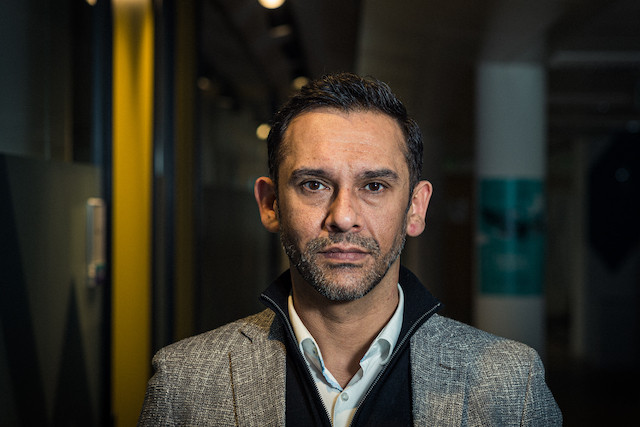
It’s been a challenging year for everyone. What changed at the Lhoft over the past 12 months?
I shut down the office three or four days before the official lockdown. And obviously, just as everyone else did, we had to pivot to a digital remote model. A lot of our work, which is around community events, domestically and internationally, all shut down. There hasn’t been a physical event for a year. We had a quick strategic review and part of the agility we have as a team is that we pivoted everything to digital.
Also, what we started seeing among members was confusion. At the beginning nobody quite knew what was happening, there was a lot of uncertainty to do with lack of business or business shutting down and managing costs. So, we focused very much firstly on providing a lot of information. We put together cheat sheets for all the different funding schemes because, yes, there was a lot and the government did a fantastic job to put out all these funding schemes, but wading through each one knowing which one was right, it wasn’t easy. We put together an A4 slide saying, ‘this is applicable to this business, with these criteria’. We tried to hold their hands and soften the blow.
Have there been any surprises during this period of uncertainty?
For three to five months, a lot of the firms here were really anxious because a lot of them are servicing the banking sector and the finance sector and obviously the finance sector themselves had to dig in and look internally, to see how they would ensure business continuity during this period.
But after these three to five months, operations began running smoothly. That’s when we started to see demand seeping in from the finance sector for technology tools. Because a lot of them realise that technology is critical to their business continuity. How do you get a signature and verify the identity of somebody if you can’t meet them face to face?
Arguably I will say somebody signing a piece of paper is nonsense anyway. Many firms would have somebody sign something and fax it. But how do you pick up a fax if you can’t go into the office? I find the whole thing archaic! I wouldn’t know how to send a fax. So, a lot of firms which we look to develop in Luxembourg in the regtech sector became quite in demand because they provided these solutions. A lot of institutions started saying we need to talk to them. And suddenly we saw a big spurt in digital demand. A lot of firms have done quite well as a result.
We know that a lot of innovative tech startups like Airbnb and Uber emerged in the fall-out of the 2008 crisis. Who do you expect to be the winners in Luxembourg of this crisis?
I’m not going to say anyone is going to be the next giant like that. But I think the firms that will do well over the next few years will be the tokenisation platforms, the blockchain companies. There’s a multitude. Also, cybersecurity firms. With this increased use of digital comes the issue of protecting digital. So, I think security is going to explode in terms of firms that are helping deal with cybersecurity issues as a general sector and I think we’re well placed for that as well.

Lhoft has 162 members, of which 75 are resident. Photo: Mike Zenari
How does the current surge in demand for fintech compare with the period after the 2008 crisis?
I’ve only been in Luxembourg for five years. I don’t have any knowledge of what came out in Luxembourg around that time.
Was the sector lagging behind in Luxembourg?
The fintech sector? Definitely. That’s partly why we were set up in the first place. The minister of finance said there was a lot going on around the world and there didn’t seem to be much going on in Luxembourg around financial technology, which is really the sort of the foundation of setting up the Lhoft. There weren’t many fintech firms in Luxembourg, let’s put it that way.
To what extent will this surge in demand for fintech solutions be lasting?
When you have a crisis of this kind of scale, and there have been other crises in history, the economic impacts tend to be delayed significantly after the actual point in time. When I hear others, be it from economic institutions, think tanks or public sector bodies, saying Luxembourg’s doing OK, I’m like, ‘it is today, but not tomorrow’. You often see in the GDP figures that Luxembourg doesn’t seem to be doing too badly, better than every other European Union country. And then you have to ask yourself how much of that is actually attributable to the real economy, i.e., physical business, and how much of it has just actually happened?
Asset prices are at an all-time high, the US market is flying. What is our core business in Luxembourg? It’s investment funds. You saw the numbers probably recently that we’ve now surpassed 5 trillion [euros] in assets. Do you think any of that is attributed to business? No, it has just happened. That doesn’t mean the economy’s necessarily doing well. Businesses, horeca particularly, is in dire trouble. You can just see the high street over here is shutting down. And we’re beginning to see now in our sector one or two firms getting into trouble as well. But that’s expected to happen. Not all firms are going to survive this.
Surely that’s true even in good times?
Exactly. Actually, generally I’m quite chuffed that we seem to have a very robust sector. I mean, if you look at the data, 8 out of 10 small businesses will go bankrupt. I think over the past four years, I’ve known of five firms in our sector to go bankrupt. So, it’s held together pretty well. But every sector is going to suffer.
On the innovation side, the incubator at the University of Luxembourg is seeing unprecedented numbers of new products and services from wannabe entrepreneurs. How does this feed into your ecosystem?
It’s great to see young people innovating and being enthusiastic about innovation. Theirs is broadscale innovation, it’s not just finance. Although there’s been some great success stories. I’m not wearing them today, but Filip Westerlund [of Our Choice] gave me a special pair of his sneakers early on. He’s doing great job, he’s very charismatic, you can tell the guy’s going to be successful. There’s also a guy who does sustainable housing.
At the Lhoft we love to support education very heavily and we’ve seen over the years more and more of a pivot towards focusing on education, particularly under digital. We’ve run over 90 webinars and seminars, online since last March, all education focused. We’re currently running a series on AI. So, we’re focused on finance, the fintech ecosystem, but we have programmes focused on children from the age of 3 or 5, and we focus on older youth at university and the Luxembourg Tech School.
Tell me more about that.
It’s an initiative by a guy called Sergio Coronado. I don’t understand how many hours in a day he has. He’s chief information officer at [the] Nato [Support and Procurement Agency] but somehow managed to set up this tech school which provides technology education to teenagers between the ages of 13 and 18. And the terms of Tech School are aligned with school terms and they do it as an afterschool activity. They have a hackathon. It’s amazing what they develop in 36 hours and demonstrate, it’s incredible!
Generally, where does the fintech innovation in Luxembourg come from, outside of the grand duchy or among residents and natives?
There’s a bit of a mix and match. But, Luxembourg is always going to have limitations because of the numbers of people, with a population of just 600,000. A lot of the innovation is coming from abroad into Luxembourg, where firms choose Luxembourg as a good place to set up their business, particularly in fintech services. It’s the leading EU financial services centre.
You also need to look at it from an incentive perspective. If you’re already in Luxembourg, working in Luxembourg, let’s face it, the salaries are very high here, the cost of living is high. Everyone has an element of risk aversion and to take the risk to set up your own business is a big thing when you’ve got a nice, cushy job paying quite a lot of money and you’ve got a mortgage to pay off or high rent.
So, sometimes it’s the renewal or freshness of new talent coming in, the people who don’t have that history, that will bring in a lot of innovation. I do think [that] we are beginning to see job cuts occurring. Not everyone is suddenly going to leave Luxembourg. But as is always the case in times of recession where people lose jobs, that spurs opportunity for people to set up new businesses, to try to build something for themselves because they’re forced into a corner. So, hopefully, we’ll see a lot of new innovation coming from that.
How does the Lhoft work with other financial platforms like Luxembourg for Finance? You do have a sort of promotion role, but you also really develop financial solutions while LFF is purely promotional.
That’s a good way to look at it. We work closely with everyone, since day one. I remember a lot of the suspicions when I was meeting people initially until we proved this. We’re here to collaborate with everyone. The strength of Luxembourg is working together. It’s a small country so that’s really the USP in this country.
I see it almost from a small business perspective, in that LFF are the sales guys or business developers and we’re the product managers. We’re a product within Luxembourg but, because we’re the experts in what we know, we often support LFF internationally. We’ve often been going all over the place when we can to support LFF. We also work with the ministry of economy, ministry of foreign affairs, the Chamber of Commerce, and with [the Association of the Luxembourg Fund Industry]. Everybody.
You mentioned that you used to host a lot of events before the pandemic. To what extent are virtual meetings able to replace the physical interactions of pre-pandemic times?
Right now, everyone is doing online conferences and events. I think we’ve all suffered fatigue from it. It’s dull. It’s great listening to people you might learn something [from], but I’m not going to sit at my computer screen looking at Zoom, watching a bunch of intelligent people tell me stuff. Yeah, I might pick up a few good things, but I’m not going to do that for 8 hours a day. What’s missing is the networking. That’s the main reason people go to events and nobody has solved that problem online yet. How do you do new business development? That’s the area that’s sorely lacking. Even if you don’t have anything particularly newsworthy but if you’re good at what you do, and a CEO has to be good at that, they’re at events, putting their brand forward and making their brand known, even if they haven’t got the full product yet. They’re letting people know about the problem they’re trying to solve, getting feedback as well. And that’s just been cut off.
Have you seen any promising solutions globally?
No. I mean, Zoom, Webex and all these things, they’re not much different to the solution we had 20 years ago, which is Skype. There are not masses of innovation. Where do you get engagement, networking and interaction online? It’s in gaming. I have a 14-year-old and a 12-year-old. If you watch online gaming and once these kids are playing, they’ve headsets on, their mobile is next to them with some sort of chat room and they’re engaging as part of that experience. The gaming companies know how to do it. We need to get the gaming know-how into this conference business side to build the engagement. I’ve seen a few little things, little gimmicky things that look like games, coming out. But it’s still not there. Nobody’s cracked this nut. There’s little to no networking on these platforms.
So, what is coming up for the Lhoft?
Lhoft TV has launched. We’ve been filming a show, which we hope to put out at least every month. It has little sub-segments, focusing on different things. I interviewed an interesting character, John Holloway, with little segments. We just want to do something a bit different. Also, a little bit upbeat as well, because everything’s so miserable in terms of news. We wanted to do something a bit more energetic and fun.
Is the goal to inform people or for exposure for your members?
So, for exposure, there will be highlights and interviews with some members, and general information on user trends and deep dive insights and interviews.
Are there any new innovation programmes coming up?
We’ve been an accelerator programme under financial inclusion for the past two-three years, where we bring in the ministry of foreign affairs with these fantastic tech firms. We will launch another one. It will be Catapult Kickstarter, targeting early-stage businesses across Europe, principally. Initially, it will be a digital programme lasting four weeks. The first edition will run in June.
This will be in collaboration with the ministry of economy, where the target will be to have ten early-stage firms participating. And five of those firms will receive funding up to €50,000 each as well. And then we’ll run it again in November. Not every firm that participates will get the money, they have to show engagement participation and they’ve done a good job. It comes under the grant scheme so they would have to set up their business in Luxembourg.