Last October, the ECB launched a consultation on the digital euro for individuals. The consultation received 8,221 responses, mainly from citizens (94%), men between 35 and 54 years old, of German (47%), Italian (15%) and French (11%) nationality.
The results show that citizens are in favour of such a development. Provided that the digital euro respects privacy and confidentiality of transactions and that it is sufficiently secure to prevent fraud. In practical terms, the respondents want a "Euro 2.0" that is easy to use, without additional costs, and that allows for fast and reliable payments via payment cards or smartphones. Finally, they want to be able to use the digital euro outside the eurozone.
A huge project
This accession should allow Europe to accelerate the development of digital currency, which is officially seen as a complement to, not a substitute for, cash. It is now up to the Eurosystem--which includes the ECB and central banks of countries that have adopted the euro--to decide whether the project should be launched. A decision is expected by mid-year.
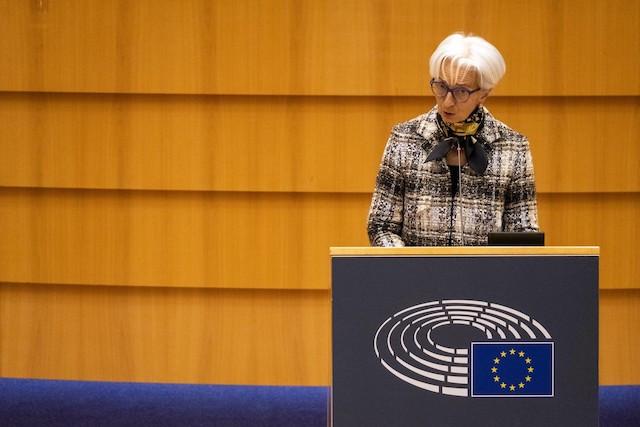
And if the green light were given, it would take four years before users could use it, according to ECB president Christine Lagarde. The ECB report stresses that a digital currency could pose a number of problems for banks. Notably in the event that savers would massively transform their deposits in banks into central bank money, for example in case of economic or financial crisis. This could increase the cost of financing for banks, and in turn the interest rates on bank loans. A balance will have to be found so as not to threaten the stability of the European financial system.
One of the avenues of deployment being studied is to make “central bank” money available to citizens and companies, which until now has been reserved for commercial banks only. This currency would not replace cash and would be convertible at parity with physical currency.
Double competition
This is a strategic issue for Europe, which is caught between the double competition of private currencies like Bitcoin, Facebook's DIEM (formerly Libra) and national currencies being digitised.
Unlike crypto-currencies, which were conceived as instruments of exchange in the digital world and which now appear more as financial assets than as sovereign currencies, the Central Bank Digital Currency (CBDC) remains under the control of monetary authorities. The first consequence, if the price of crypto-currencies is volatile and subject to all kinds of speculation, the value of a CBDC will remain stable.
Is there competition between these two digital “currencies”? If, in the words of Robert Shiller, Nobel Prize winner in Economics, “a narrative presenting crypto-currencies as the future of money has gradually taken hold”, his detractors insist that they are only pale imitations of real money. They point out that they are still very little used, that they do not provide any security in terms of reserve of value and that nobody uses them to establish prices. And they insist on their less attractive side, the multiple abuses and the use for illicit activities.
Competition between states is not controversial. Here, the challenge is clearly to seduce users and investors to make its currency the international reference currency.
CBDC projects are multiplying. Already well advanced as in China or in the process of being launched as in the UK where the central bank and the treasury have just announced they are working on a British digital currency.
In Beijing, in addition to the domestic advantages, the authorities hope that the project will contribute to the international influence of the renminbi. The Chinese Central Bank is also considering a massive deployment of the “digital yuan” during the Beijing Winter Olympics in 2022.
The relative decline of cash
Issues that go beyond individual users, at this level, include the confidentiality of transactions and, in turn, that of the disappearance of cash.
The trend--accelerated by the pandemic--is the increase of dematerialised payments. But 73% of payments in the euro area shops are “still” made in cash, according to the latest ECB data covering the year 2019 published in the Space study (Study on the payment attitudes of consumers in the euro area). In 2016, the figure was 79%. In terms of value, the decline is even sharper: the share of cash fell from 54% to 48%. In 2019, cards accounted for 24% of transactions last year and 41% of amounts.
The decline of cash, however, varies from one member state to another. In Europe, the biggest users of cash are the Maltese (88% of transactions), Cypriots and Spaniards (83%). Conversely, cash is used the least in Finland (35%) and the Netherlands (34%). In Luxembourg, cash still represents 54% of payments.
Although cash is declining, citizens do not want it to disappear.
The paradox of the banknote
The ECB has dubbed this phenomenon the “banknote paradox”: on the one hand, payments in stores are increasingly becoming contactless and paperless. On the other hand, there is a steady increase in the number of banknotes in circulation. Banknotes that are not deposited in bank accounts but are kept by individuals, either to build up liquid savings, or for illegal fraudulent activities, including tax evasion and moonlighting.
It is to fight against this “fraudulent” use of cash that some people are pushing towards cashless societies and promote the gradual dematerialisation of the tangible towards the intangible of computer codes. This perspective frightens privacy defenders who point to the Chinese example where there is no guarantee of anonymity and where the state can trace all the expenses of an individual in real time.
This scenario is not on the agenda in Europe, where the fight against the excesses of cash is more likely to involve capping the amount of cash used. A project to limit the amount to a maximum of €10,000 is being studied in Brussels.
This article was originally published in French on Paperjam.lu. It has been translated and edited for Delano.