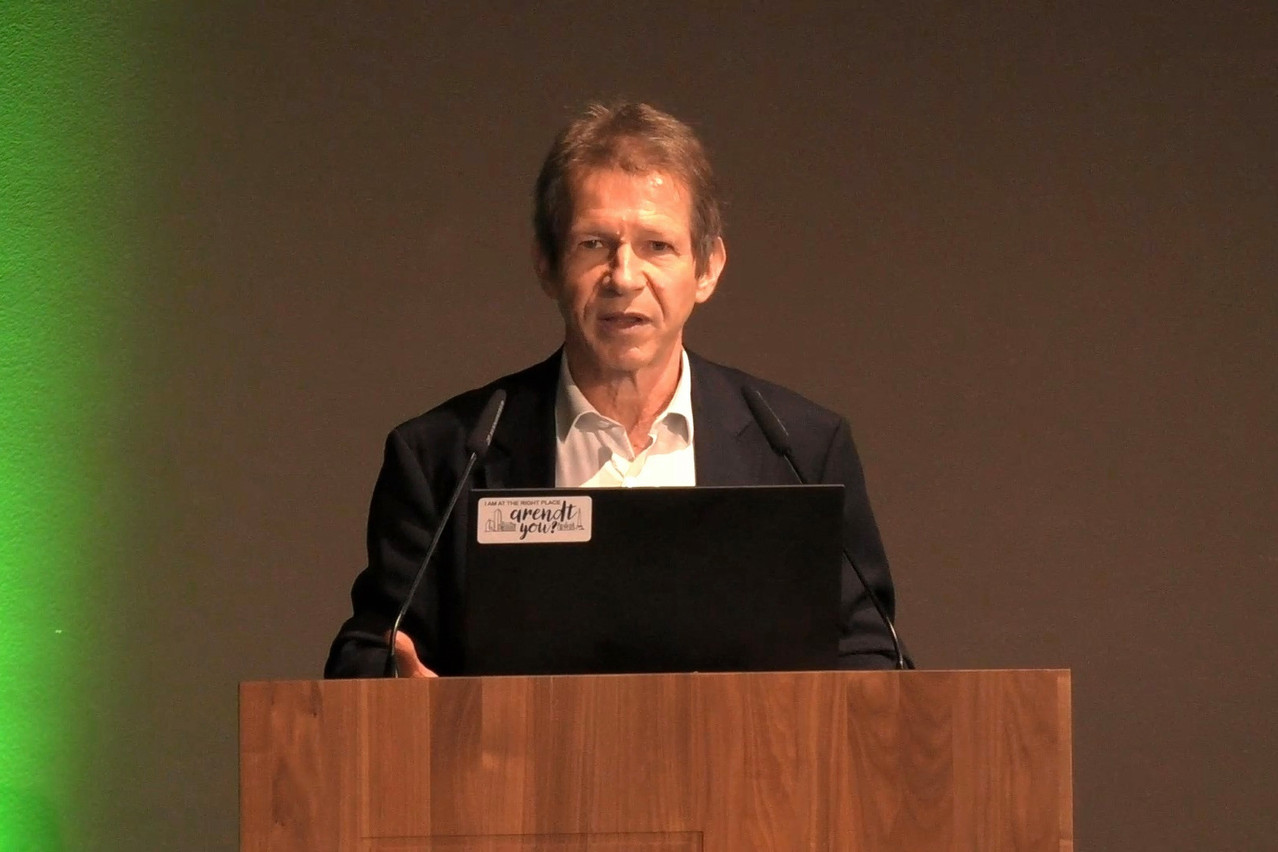
“For the last two centuries… we thought our love story with fossil fuel to be everlasting,” said Jean-Marc Jancovici, founding partner at Carbone4 during a speech in Luxembourg on 26 November 2024. He explained that economic output has been highly intertwined with energy consumption (R-squared: 0.98)--which itself is highly linked to CO2 emissions (R-squared: 0.996)--since 1965. In the first part of his presentation, he stated that he was unclear whether energy consumption and GDP association is a cause-consequence relationship or whether it's simple correlation.
Jancovici explained that in physics, “energy… allows to quantify… the change of state of a given system.” Besides, changes in the physical world such as “temperature, speed, shape, and colour” all require a certain level of energy. Consequently, “the more energy we use, by definition, the more changes we provoke. And conversely, the more change happens, the more energy has been involved. It is strictly equivalent.” It is therefore not surprising that the R-squared figures are so elevated.
If you have less oil, basically, you have less economy
Yet he went as far as saying that “our love” for a growing economy and energy consumption make him believe that “we actually love having plenty of CO2 for the time being.”
No end in sight. Ever higher.
Jancovici remarked that despite an increasing use of renewable and nuclear energies in the last 20 years, we haven't significantly decarbonised the world. The carbon content of kilowatt hour of energy use at the global level has not changed. Consequently, it is “difficult” to reconcile the need to decrease CO2 emissions with the development plans of developing countries and the unwillingness of industrialised countries to decrease energy consumption. Indeed, these industrialised countries continue to grow comfortably while using more and more energy.
Using the example of the SNCF, one of Jancovici’s important messages was that energy expenses may not be significant in relative terms--3% against around 50% for labour cost for the French train operator--yet the company, as is the case for the rest of the economy, cannot operate without it.
It will therefore come as no surprise that Jancovici suggested that there is no elasticity between the price and volume of oil because “if you have less oil, basically, you have less economy.” Without transportation, where oil is “indispensable,” he argued that “you cannot have an economic system running.”
Have new sources of energy replaced previous ones?
Jancovici noted that the world’s energy consumption has constantly gone upward with new sources of energy piling up on top of the previous ones. The substitution of previous energy sources has not happened. Worse, he noted that “almost all the energy is from fossil fuels.” Surprisingly and despite its small contribution to energy supply, low carbon energy supplies, in relative terms, “have not significantly increased lately.”
Irrespective of his initial comment on the causal relationship, Jancovici affirmed that the usage of fossil fuels is growing at the same pace as low carbon energy, which explains why “it is a cause-consequence relationship. It is not a correlation.”
Will a greater recourse to renewables reverse the trend?
Jancovici reminded attendees that coal and other fossil fuels are required to manufacture steel for a wind turbine’s mast and concrete for its foundation, as well as plenty of other metallurgies such as copper and aluminium. Plus, oil is necessary to transport all these bits and pieces.
Yet in a separate interview with Paperjam, Jancovici claimed that wind turbines are quickly reaching their “energy break-even point.” This point--when the energy produced by the wind turbine on its own surpasses the energy needed to build it--falls around a year after the turbine’s construction.
“Nobody knows”
A wind turbine is “an industrial product that has benefited, for the last 20 years, [from] the tremendous industrial productivity that fossil fuels have brought us.” But for Jancovici, it’s unclear how many wind turbines could be built or how much their construction would cost without using fossil fuels, or, in other words, to make them fully green.
It’s probably fair to assume that it would not currently be economically viable given the low margins in the industry on the back of high competitive pressure between players in the Western world and China. Jancovici is not so affirmative. “We cannot deduce that in a world where there will be only windmills and solar panels, we will be able to manufacture for a very cheap price, windmills and solar panels.”
Why can’t we live without machines
Jancovici estimated that the “world fleet of machines… large machinery or machines operated at home… is as powerful, at any time, as 200 times the muscles of humanity.” In other words, should the world run out of fossil fuels tomorrow, he thinks that the world’s GDP would be divided by 200. “We would go bankrupt.”
So, we continue thanks to these machines. “We work less, we are less tired and we have more stuff.” He believes that fossil fuels have brought gender equality. In her book “Féminicène,” Véra Nikolski wrote that fossil fuels have freed women from “ancient burdens,” said Jancovici. Improved agricultural production resulted in reduced burden during pregnancy, thus leading to a fall in child mortality. Women did “not need to be pregnant as many times for the population to maintain its size,” said Jancovici.
Moreover, he observed that the decline in physical efforts required to occupy a job has been a great advancement for women, not to speak of the advent of the washing machine, which replaced the washhouse in the cold of winter. Without providing evidence, he also claimed that fossil fuels have “also played a major role to decrease inequalities… in Western countries.”
Changing the mindset
“We are blind because we believe that in economic figures lie all the information necessary to frame the future.” Jancovici concluded his speech by arguing that the world “cannot behave like this if we want to have the slightest chance--the slightest chance--to overcome issues… such as climate change.”