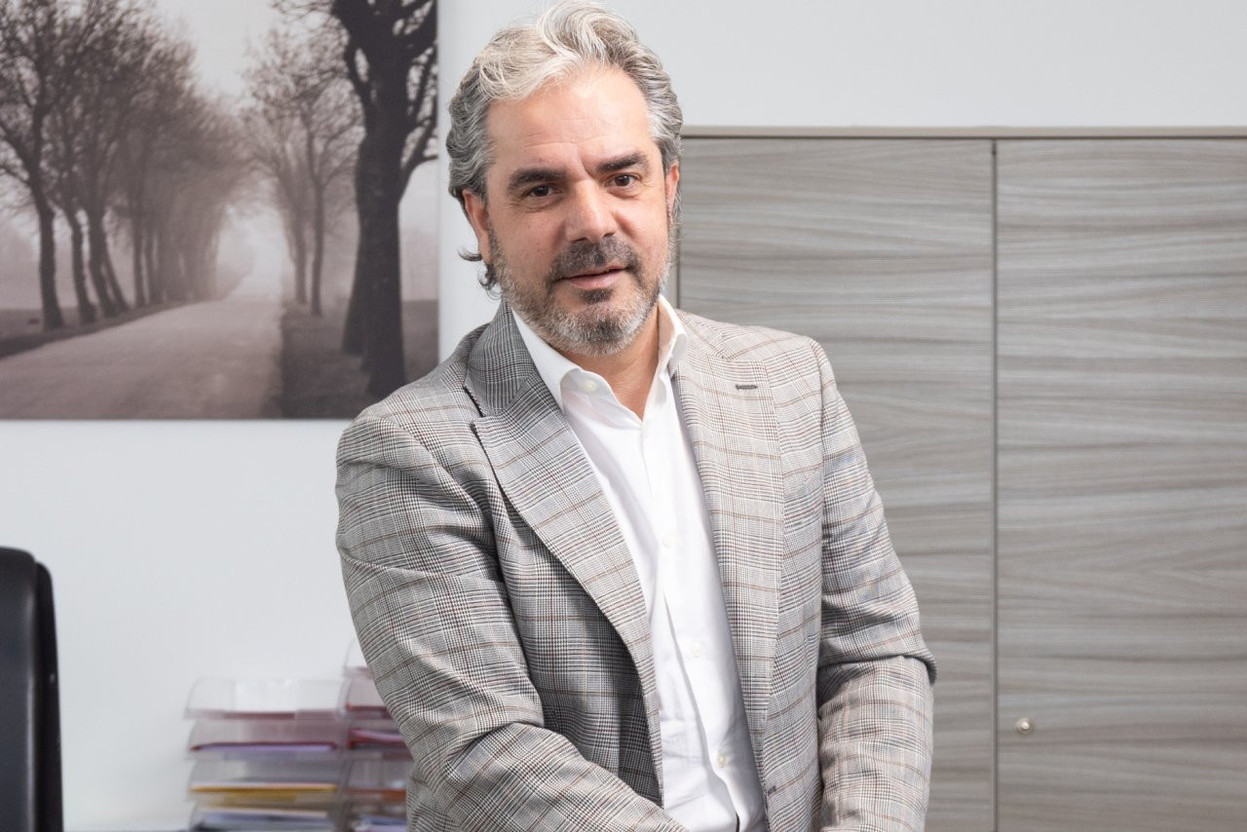
Change of direction. After more than 20 years in various key positions within Banque internationale à Luxembourg--from financial markets to human resources, branch network and private banking--
Paperjam: What was your very first contact with the world of work? The first memory?
Christian Strasser: A student job at Mondorf, during a horse-riding tournament. A superb experience. I arrived there by chance, following in the footsteps of my parents who were volunteers. I was 14 or 15 years old, and I was proud to be put in charge of a cash desk. I liked it so much that I went back the following year--on a voluntary basis.
At the end of the tournament, there was a need for clean-up labour and for the next four or five years I worked there for three or four weeks, doing the preparations and helping with the operational side of things. We made a great team, we worked in the open air, we drove all sorts of machines, we started early in the morning and ended up staying up late talking for part of the night, it was great. The pay was interesting too: it was your age multiplied by 10 Luxembourg francs. If you were 18, you earned 180 francs; if you were 19, then it was 190 francs... Of course, we all cheated a bit on our age [smiles].
To this day, my mum tells me that when I was 11, I dragged her to the bank because I wanted to buy my first shares.

What happened next? Before insurance, you spent a long time in banking. What attracted you to this field?
Finance has always been there... To this day, my mum tells me that when I was 11, I dragged her to the bank because I wanted to buy my first shares. Why? Because I’d been following share prices in the Luxemburger Wort. I had chosen two or three. Of course, I couldn’t buy them myself, so my mum had to come along and sign for me.
I always wanted to work in this field. At the time, banking was very, very sexy. By comparison, investment funds and insurance were not. Even today, I see myself more as a financier and manager than as an insurer or insurance technician.
And yet insurance has been a part of your career...
And this was because of two banking crises that taught me a huge amount in a very, very short space of time. I realised that banking is an extremely political world, whether you like it or not.
Someone I like a lot--Martial De Calbiac, an insurer at heart from generation to generation--once told me that banking is actually a very easy job but done by very complicated people, whereas insurance is a very complicated job but done by very easy people. Bankers shouldn’t be told this, but it’s not untrue [smile]. Even if, in truth, these two worlds are equally beautiful.
Let’s go back to what will have been the decisive turning point transporting you from one world to the other....
I loved the bank I worked at for 21 years. I learnt an enormous amount there, I was lucky enough to work with people who I loved on a human level. So I didn’t just learn technically, but also on a human level. And without the support, help and challenge of many of these people, I wouldn’t have been able to have the same learning experience.
Clearly, I couldn’t see myself leaving, because I was happy where I was. Then there was a managerial decision by the shareholder, who thought it was time to replace our CEO. He was replaced by someone very pleasant, very charming and very competent. So I can’t hold anything against him. But I realised at the time that... It may be a trait of character or arrogance on my part, but I said to myself, “I want to be the one to raise my hand.” I come from football, and the fact is that I’d rather be the one who raises his hand to let the coach know that he wants to leave the pitch than wait to be replaced by that same coach. I’d had some interesting offers, but it was time to look at something else. Otherwise, at some point, I would have become part of the furniture.
At the same time, two and a half doors opened for me--one of which attracted me very strongly. Which is why I am where I am today.
I was lucky enough to have people around me who told me: ‘Making a mistake isn’t a problem. On the other hand, if you make the same mistake twice, then we have a problem.’

Always, at the same time, have you ever thought about making a radical change of direction?
Some friends have left Luxembourg to open a gîte in the south of France, others have opened a farm in Africa... Sorry, I’m too down-to-earth for that. What I don’t find in my job, I balance out with other things.
But go figure: at 54 years of age, the “midlife crisis” may be yet to come! And that wouldn’t be so bad: it would mean I still have many years ahead of me!
Looking back, what rookie mistake would you rather not have ever made?
None. Fortunately, I’ve never made a mistake that would have made me cry for weeks. But every mistake I’ve made has been a learning experience. And I’ve also been lucky enough to have people around me who have said to me: “Making a mistake is no problem. On the other hand, if you make the same mistake twice, then you’ve got a problem.”
How do you bounce back from difficult moments?
In the past, I’ve done lots and lots of sport, particularly running. Running makes you think. I’d often stop and start taking notes or leaving myself voicemails. These days, with the weight gain... I go to the spa in Mondorf more often. The baths and sauna have the same effect as running. Except that my mobile phone is always in the bathrobe...
Which means you can’t seem to switch off?
I love what I do, so I don’t have the willpower to disconnect. I give the people I work with all the leeway they need, but for me it’s important to know where you’re going. And I know very well that if I go away for a week and have to start from scratch when I get back, I’ll be more stressed. On holiday, it’s more relaxing to take half an hour during the day to take stock of what’s going on. I’m by no means saying that you have to do it that way, but that’s how I do it.
And as I get older, I’ve even come to enjoy celebrating team successes more than my own. The day I say ‘I succeeded,’ that’s it.

Which achievement are you most proud of?
I don’t think there's one achievement. More like a multitude of things. For example, I’m extremely proud of what the teams do on a day-to-day basis with our customers and for our customers! Year after year, Lalux is the insurance company that does best in terms of customer appreciation. That makes me very proud. The fact that we bring together people with different backgrounds, different experiences, different values, different cultures, different mother tongues, and that everything fits together to achieve the best possible result....
Did there come a time in your career when you said to yourself: “This is it, I’ve made it”?
If that moment comes, I’ll retire right away! Maybe that’s what sport has taught me too. And as I get older, I’ve even come to enjoy celebrating team successes more than my own. The day I say “I succeeded,” that’s it.
What’s that called? Wisdom?
If we want to use a positive vocabulary, we can call it wisdom. My wife, on the other hand, would have another word for me. And it would be much less positive.
What term would she choose?
She would certainly call me a “workaholic.” Here at Lalux, people I love working with tease me by calling me a “control freak”... and they’re not wrong. But there’s something in it for everyone.
It’s not just from the people at the top of the hierarchy that I’ve been able to and can learn things, quite the contrary!

Is there a person or mentor who has been especially important in your journey?
At various times, different people served as my guide. When I started at the bank, Dominique Saussez, the former head of human resources management. Then, 
These four helped me to learn a lot quickly, but in reality, there are so many people I’ve had the good fortune to work with who have helped me to learn and continue to do so today. It’s not just from the people at the top of the hierarchy that I’ve been able to and can learn things, quite the opposite!
What is the piece of advice have you always kept with you?
Work hard if you want to achieve results. Be yourself and have integrity. Because if you’re not, you’ll be caught out sooner or later. And play as a team. These are the most important things for me.
What’s the toughest criticism you’ve ever heard? The one that challenged you the most?
I don’t have any concrete examples to give. Maybe that means that I’m pretty open to criticism. At one point, I was told that I didn’t listen enough. And yet I think I do listen. But listening doesn’t always mean doing what the other person wants. I listen to the point and then I have to take a decision.
In fact, criticism, as long as it’s honest, is all legitimate. It’s a subjective point of view confronted with another subjective point of view. And objectivity can sometimes be found somewhere in between. Criticism that comes to harm, on the other hand, is something else...
To what extent do those around you weigh in on your choices?
It’s a crucial factor. If you have moments of instability in your private life, health problems or other things, that inevitably has an impact on your professional life too. We are human beings, not robots. A healthy environment is essential at times like these.
Are you a man who takes decisions on the spur of the moment?
I love playing with emotions... No, actually I shouldn’t phrase it like that. I’d rather say that I think it’s important to show your emotions. Because we have them. But I nevertheless never make my decisions without involving my head.
What is the most important thing your career has taught you about yourself?
At the risk of repeating myself, that with hard work, committing yourself, the fact of going, of doing it with others, of involving others, everything--or almost everything--is possible. I mentioned the banking crises earlier. It wasn’t us, in Luxembourg, who were at the source. But we got together, we worked, we explained to customers, we explained to everyone and we worked to find solutions...
In fact, it’s always the same: if you have a problem, you have to solve it. As long as you’re hard-working, honest and have integrity, and you work together--and not against each other--it works. Not always, of course, but very very often.
Just because someone ends up a director or manager doesn’t mean their life is better than another. It’s also a matter of choice and luck.

What would the 11-year-old kid who went to buy shares at the bank think of the person you’ve become today?
There would be a form of respect in front of the course. On the other hand, I think this young boy would also say to himself: “Compared to the sacrifices you've made, you’re crazy.” Everyone follows their own path, with the investment--professional or personal--that they feel is best. And no one path is preferable to another. Just because someone ends up as a director or manager doesn’t mean that their life is better than another. It’s also a matter of choice and luck. I’ve known people who had all the human, intellectual and other skills to follow certain paths, but who said: “Listen, no, I have other priorities.” And there’s nothing negative about that.
It’s a question of priorities and balance with other things that everyone has to define for themselves. My children, who are of age now, reproach me--with understanding, when they want to [smiles]--for having been absent a lot. And they are right. My honeymoon was six days. And even then, I was connected all the time because we were in the process of finalising an important project. At least, I thought it was an important project... whereas today I wouldn’t be able to give you the slightest detail about it. It was a choice I made at the time. My wife reminds me of it regularly [smile].
If you could capture one moment and then relive it over and over again, what would it be?
All the moments when we were simply able to be together and celebrate our shared victories or successes. Or simply to realise that we were there, that we did it. Whether in a professional or private context. And that’s still what gives me the greatest pleasure in sport, the shared celebration of victories. You forget about the day-to-day and savour the moment, saying to yourself: “Look what we’ve achieved together.” So not just one moment, but all those moments. I hope there will be many more in the future, at all levels.
If your career were a book, film or song, what would the title be?
A book: “Fish!” [a self-help book that has sold several million copies worldwide, editor’s note]. The book shows that we can all choose our mindset for each day, how satisfying it can be to be engaged in the moment, and that work can be a source of pleasure--for yourself, as well as for your colleagues and clients.
A film: “Any Given Sunday” (Oliver Stone, 1999), because it illustrates the importance of leadership under pressure, the need to accept change and that hard, collective work, with pleasure and passion, leads to results. And also because it has Al Pacino and... Cameron Diaz [smiles]!
This article was originally published in French.