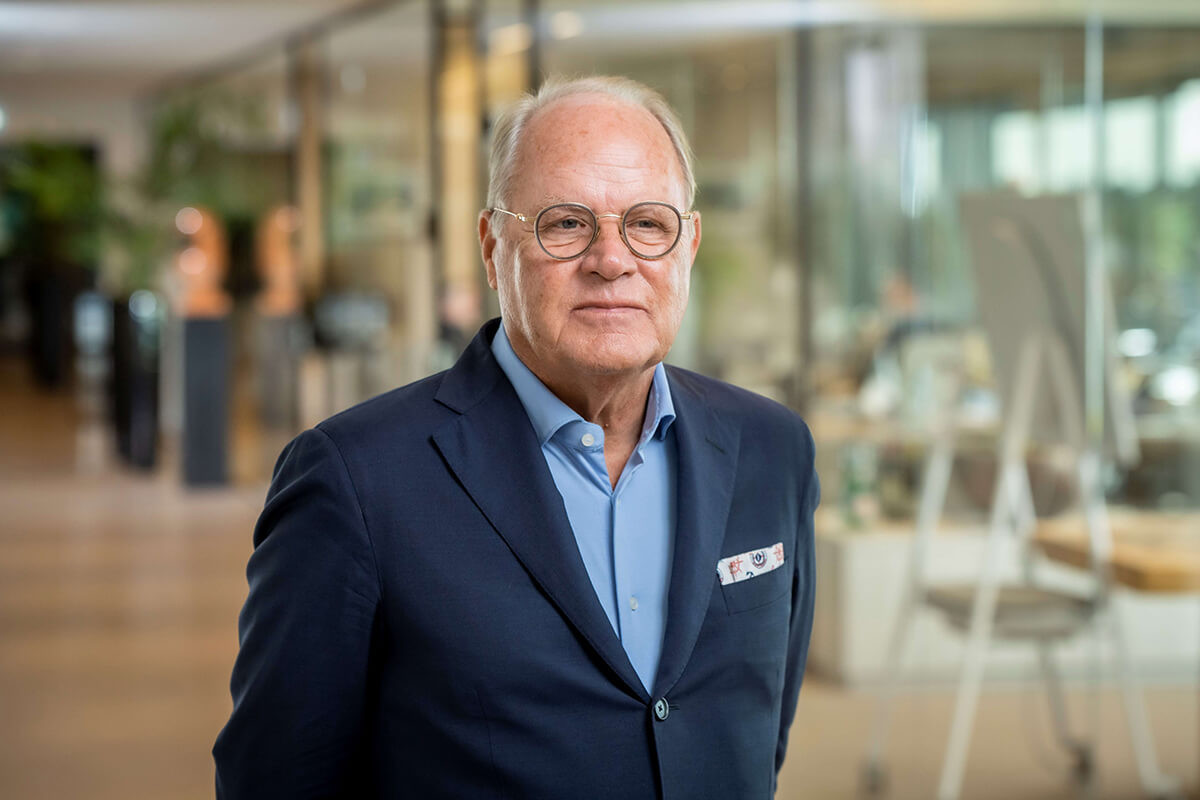
For half a century, Willem A. Blijdorp has built up one of the most unique distribution networks in Europe. He didn't create a brand, patent a technology or invent a product: he built an empire in the interstices of world trade, where spirits, perfumes, cigarettes, electronic gadgets and consumer goods circulate. A massive but invisible empire, fashioned far from the spotlight, in areas where logistics, taxation and opportunities meet. In 2025, this empire is closing. B&S Group left the stock market, and its founder, already silent for two years, faded further into the background. The duty-free emperor disappears from the radar.
It all began in the 1970s, when the young graduate of the Maastricht Hotel School set sail on the quays of the North in a business that has now disappeared: the "Butterfahrten". These day trips, which he discovered in Germany, took passengers beyond territorial waters, where customs rules were waived and alcohol, perfume and cigarettes suddenly became cheaper. This hybrid system, which was part grey economy and part popular tourism, offered a unique field of observation. Mr Blijdorp spotted a mechanism that others had not yet understood: where borders change, margins are created; where taxes vary, flows are redrawn; where rules are relaxed, trade accelerates. It was here, in this legal in-between, that his founding intuition was born.
At the turn of the 1980s and 1990s, this improvised trade became a structured activity. With his partner at the time, Jacques Streng, he founded B&S. In the early days, B&S was only a modest player, but the guidelines were already there: knowing where to buy, where to sell and how to move goods before others. B&S specialised in the niches of global trade - duty-free, institutional sales, inventory arbitrage between markets - activities that few players knew how to manage on a large scale. This discreet but sophisticated model proved extraordinarily profitable when the group began to multiply its logistics facilities and international contracts. Growth was steady. B&S became an essential supplier for public organisations, European distributors, free trade zones and electronic partners. As volumes increase, the company develops industrial mechanics, capable of managing global flows with rare agility.
Listed in Amsterdam since 2018
When the group exceeds €2 billion in annual sales, an IPO appears to be the logical step for global expansion. In March 2018, B&S Group was listed on Euronext Amsterdam, joining the AScX index the same year. But this flotation was atypical. The founder, via his Luxembourg holding company Sarabel Invest sàrl, retains more than 65% of the capital. The operation is not intended to dilute power, nor to transform the structure of the group. B&S becomes public without really ceasing to be private. The company benefits from the visibility of the stock market, but governance, strategic decisions and the financial structure remain firmly in the hands of Mr Blijdorp.
From 2022, the balance becomes tighter. An internal investigation revealed that some executives had benefited from private loans or advantages granted by entities linked to the shareholder. B&S states that the company has not suffered any financial loss, but admits that certain transactions should have been disclosed in the annual reports in accordance with IFRS rules on related party transactions. Governance was reorganised, senior managers left and controls were tightened. At the same time, the Dutch press reported allegations of commercial disputes involving Mr Blijdorp, which he denied. The combined effect of these episodes led the founder to step aside from 2023, leaving operational management to others.
On the financial markets, the situation was hardly any better. With a free float of only 32.7% of the shares, B&S remains poorly liquid. At the end of 2024, the share closed at 4.15 euros, a far cry from the ambitions announced at the time of the IPO. However, the company's operating fundamentals remain solid: sales reached €2.4 billion in 2024, compared with €2.2 billion a year earlier; consolidated net profit came to €47.19 million, of which €39.9 million was attributable to the company's shareholders; EPS rose to €0.47. But these figures no longer really influence the market: a group more than 70% controlled, with no prospect of dilution or raising capital, no longer attracts outside investors, even when it delivers growth.
Governance revisited
The 2024 annual report, published in March 2025, confirms that the company has become a listed company with no stock market utility. Sarabel holds exactly 70.47% of the capital, i.e. 59.3 million shares out of the 84.18 in circulation. The majority shareholders control not only strategy, but also appointments to the Supervisory Board and most of the financial guidelines. The market, which has become a mere spectator, no longer adds any value. All the more so as B&S no longer relies on the stock market to finance its development: everything is done by the group itself. The accounts of Sarabel Invest, the lead holding company, show that it is financed to the tune of 764.6 million euros by a long-term loan from its ultimate shareholder. This massive intra-group debt illustrates a model that is entirely self-centred: capital comes from the top of the structure, not the market.
In these circumstances, the decision announced in 2025 by Sarabel to delist B&S was no surprise. Mr Blijdorp had already envisaged a delisting in 2022, but failed to win the support of the independent directors. This time, the configuration is different. Governance has been tightened, financial structures consolidated, and the founder has withdrawn, but his capital influence remains unchanged. The market has ceased to play a role. The transaction is taking place without any significant opposition and marks the end of a brief stock market interlude, opened in 2018 but permanently out of step with the reality of the group.
Thus the duty-free emperor disappears from the radar, without a press conference or interview. B&S is once again a private company, faithful to its original modus operandi. As for Mr Blijdorp, he remains silent. The man who built his empire in the grey areas of global trade continues to exist on the sidelines, as he always has. The only difference is that this time, his withdrawal is total. The spotlight shines elsewhere, in the collaborations with start-ups or humanitarian causes that he himself describes on his blog. The empire continues, but behind closed doors. Luxembourg is home to one less listed company.