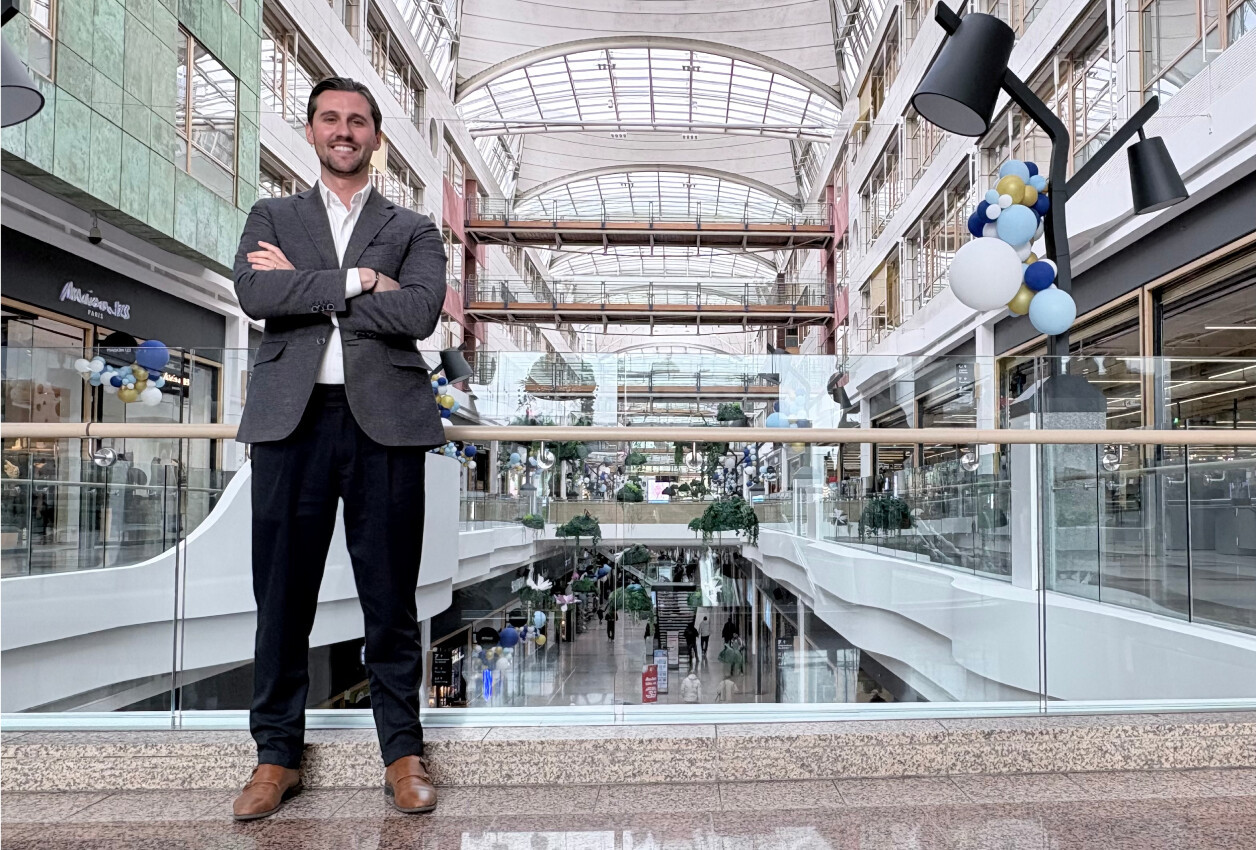
Encouraging staff to stay on after their working day. Modernising a building that opened in 1996. Testing new retail outlets without losing the established brands that already attract several million visitors a year. Now in its 30th year, the Kirchberg Shopping Centre is undertaking several projects at once.
The first event will take place in the evening. From 2027, the shopping centre plans to organise after-work events to extend activity beyond lunchtime. “The food court is open at lunchtime and in the evening. Several ideas have been identified and will be rolled out from next year to create a new atmosphere in the evenings,” explains the shopping centre’s director, Manuel Filipe.
The project is aimed at the thousands of employees who work in the Kirchberg offices. “The aim is really to organise after-work events that encourage people to come along in groups, in collaboration with all the local restaurants: happy hours, special offers. The key is to create a more festive atmosphere through the décor and music.” Price will be a key selling point. The centre’s director mentions, in particular, complimentary drinks and special offers available at certain times. “That’s what will draw people in – seeing a financial benefit.”
The gallery also has two practical advantages: the tram, which runs directly to the site, and free parking for the first few hours. But the director acknowledges that habits have changed since the pandemic. “These days, customers prefer to finish their work and head home, especially given the number of cross-border commuters who have an hour or two’s drive ahead of them.”
The aim therefore remains modest. It is not necessarily a question of keeping staff there all evening. “Our aim is to gradually regain the pre-Covid momentum so that they can spend half an hour or an hour or so with colleagues before heading home.” Management says it has involved local restaurants in this initiative. “This project will only succeed with the support of local shops and restaurants.” The challenge will be to coordinate opening hours, special offers and the atmosphere across the various venues.
Lunchtime and at the weekend: peak times to ‘work through’
Lunch is now the main daily peak. “The busiest time is indeed at midday. However, on Friday evenings we see a peak in restaurant trade, as well as on Saturday lunchtimes.” At the weekend, the pattern is different. “Customers come in the morning to do their shopping at Auchan and then go to eat together as a family in the restaurants.”
This initiative enables the Kirchberg Shopping Centre to maintain high visitor numbers despite the development of other shopping centres. The shopping centre recorded 7.4 million visitor visits in 2025. It recorded slightly fewer in 2026, with figures ranging between 7.2 and 7.4 million according to the information provided during the interview.
Manuel Filipe puts the competition from the Cloche d’Or into perspective. “Before the arrival of all the residential developments, offices and shopping centres, we also had between 7 million and 7.5 million visitors.” He adds that footfall has been rising since the unusual period of the Covid pandemic, without providing the full annual figures. This data comes from equipment installed at the entrances. “We have a counting system at all the shopping centre’s entrances so that we can know exactly how many customers we have every day, every hour, every minute if we want to.”
These figures therefore refer to visits, not unique visitors. Nor does footfall directly indicate the amounts spent in the shops. “Of course, there is the performance linked to the retailers’ business, but also that of the centre itself, because our aim, in all the work we do on a daily basis, is to attract people.”
Auchan, that driving force
Auchan remains the main draw. “Auchan has been a key driving force right from the start, ever since the centre was established. Auchan remains one of the key driving forces – if not the most important one – in our centre.”
However, the hypermarket’s influence appears to have diminished in the overall balance. “Before the pandemic, I’d say that Auchan accounted for perhaps more than half of the centre’s footfall. Today, we’ve struck a balance between the other retail outlets and Auchan.”
The manager describes how food shopping complements the rest of the offering. “Auchan complements the shopping centre’s retail activity. The high-street retailers also complement Auchan’s business. And that’s what customers are looking for: sometimes they want to go shopping, but at the same time they want to do their grocery shopping.”
Zara, H&M and Sephora are among the other key players mentioned. According to Manuel Filipe, Gérard Darel and Nespresso attract a loyal clientele who make a point of visiting the city centre specifically for these shops.
Catering also plays an important role, with outlets located on the first floor and at the foot of the rotunda. Services are also becoming increasingly important. “For the past three years now, we’ve seen that customers are looking for services such as a post office, a shoe repair shop, a hairdresser, a dry cleaner’s, and so on.”
A crèche has been set up next to Auchan in partnership with the hypermarket. According to the manager, it is particularly busy at weekends. Auchan’s Sunday opening hours, from 9.00 am to 1.00 pm, cater to a different customer base. “Feedback from customers has been very positive. They appreciate being able to do their shopping in a calm atmosphere.”
At the same time, the shopping centre is seeking to adapt its retail offering. Manuel Filipe estimates that around 4 per cent of units are renewed each year. Among recent changes, he cites the arrival of Burger King, Kaito, Only and Glyco. Foot Locker has been moved to the ground floor, to a location considered premium, vacated by Spuerkeess, which is implementing a different strategy for its branches but is retaining an ATM. A new area for kiosks has also been created.
Flagship products and brands for the whole family
The director has noticed a shift in the formats sought by retailers. “Brands are now favouring larger flagship stores, bringing together men’s, women’s and children’s fashion under one roof to save customers time. That’s exactly what Only has done here.”
The centre does not wish to position itself exclusively in the high-end market. “Our strategy is to offer retail outlets to suit all levels of purchasing power.” Above all, the concepts we are looking for must offer something different from what is already available.
When asked which brand he would like to attract, Manuel Filipe remains diplomatic but acknowledges that “distinctive brands such as Decathlon, which have revised their strategy to move into new formats, are very interesting”. However, he did not mention any negotiations or plans to open new outlets.
The shopping centre also sets aside part of its space for pop-up concepts. “We maintain a vacancy rate of around 2 per cent to allow entrepreneurs to test their concepts.” This rate therefore does not necessarily correspond to units that remain unoccupied in the long term. The pop-up tenancy serves as a trial period. “If the experiment is successful, we convert the short-term lease into a commercial lease, as was the case with Devred.” This arrangement enables the manager to refresh the offering whilst limiting the risk taken by new retailers.
The centre is also trialling initiatives designed to attract customers. Undelivered parcels have been sold by weight on two occasions. “We’ve done this twice, with very positive results.” The manager says he analyses online reviews before selecting his service providers.
To mark its anniversary, the shopping centre organised family-friendly activities and face painting for children. It also put on an immersive 360-degree projection in the rotunda at the central entrance. The six- to seven-minute show traced the neighbourhood’s development, the construction of the centre and the shopping centre’s transformations. “In 1996, when the centre was built, there was absolutely nothing here. It’s incredible. Today, when we look around us, we can see how much the neighbourhood has changed over the last 30 years.” According to Manuel Filipe, families came especially at the end of the day to watch the projection.
€5 million in investment
The second major project concerns the modernisation of the building. “An investment plan worth over 5 million euros has been approved, running until 2031.” The initial investments focus on energy consumption. “We have already begun modernising the heating and air-conditioning systems by installing modern heat pumps in partnership with Luxenergie.”
The facilities enabling movement within the building must also be replaced or refurbished. “At the same time, we are modernising all mechanical systems, lifts and escalators.” One of the lifts on the John F. Kennedy Avenue side has already been brought up to accessibility standards for people with reduced mobility. The property manager has also, in collaboration with Auchan, introduced ‘quiet hours’ for people who are hypersensitive to noise and light.
The director acknowledges that rising energy prices are putting pressure on the centre’s costs. He says he is looking for solutions to make savings without compromising the service provided to customers. However, no figures regarding energy consumption or the energy bill have been disclosed.
Above all, technology should make it easier to find your way around the shopping centre. Interactive terminals installed at the entrances allow visitors to search for a shop and its location. Manuel Filipe, however, sets a limit on this digitalisation: “Technology will never replace human contact or the pleasure of seeing and touching the products.”
The growing international diversity of the customer base also raises the issue of languages. Auchan informs the checkouts which languages each member of staff speaks. In the shops, management encourages the presence of at least one member of staff capable of welcoming customers in English.
These stated ambitions do not mean the difficulties facing the retail sector have disappeared. “The retail sector is facing a challenging economic climate, but on the ground, there are retailers that continue to perform very well. The average basket size and shopping habits have changed.”
Kirchberg vs Cloche d’Or: two teams going head-to-head
Nhood manages both the Kirchberg Shopping Centre and the Cloche d’Or shopping centre. Manuel Filipe, however, rejects the idea of a coordinated strategy between the two competitors. “These are two completely separate teams, with different objectives, owners and interests. The strategies are independent and tailored to each site.”
“I’d like to thank our retailers and customers for their trust,” he says. After 30 years, the Kirchberg Shopping Centre has no intention of abandoning its current model. Instead, it aims to broaden its scope: more services, spaces for testing new concepts, new brands, a modernised building and extended opening hours into the evening.
The after-work events in 2027 will be the first visible test of this ambition. They will need to demonstrate that employees in Kirchberg can become more than just a lunchtime clientele, without undermining the centre’s long-standing customer base. “There’s always the question of the shops’ appeal, but also the customers who come just to eat, have a good time or do some shopping.”