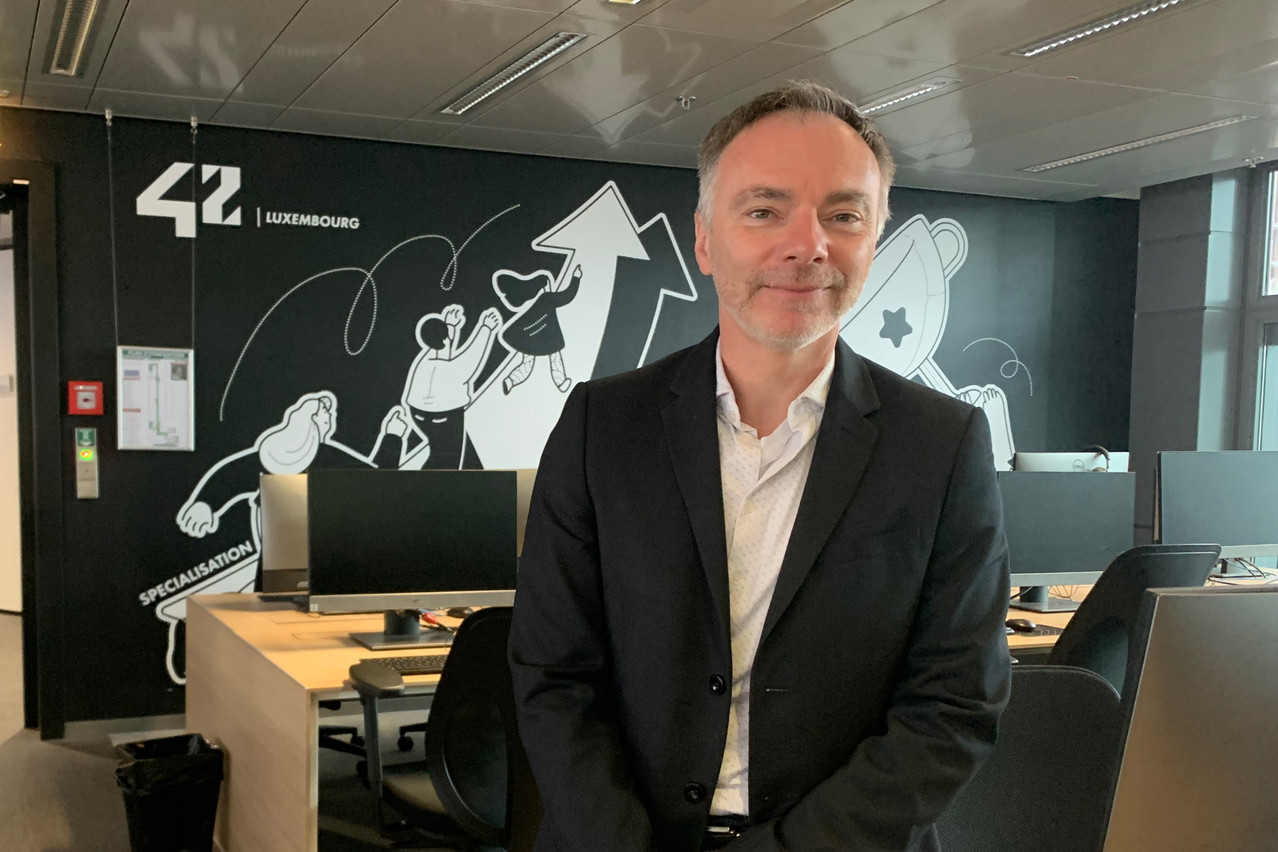
Faced with the emergence and potential competition from AI-based solutions, which make it possible to code without having any skills whatsoever, what does the future hold for 42 Luxembourg, this coding school that is open and free to all, part of the network of computer science schools set up in 2013 by Frenchman Xavier Niel, launched in May 2022? “I’m not worried at all, firstly because I’m a very positive person, and secondly because I myself wrote my doctoral thesis, which goes back a few years after all, on AI (Serge Linckels’ research covered the field of semantics, a sub-field of artificial intelligence, 30 scientific publications bear his name, editor’s note). So I think I know a bit about what goes on behind the scenes and I also give a lot of training in artificial intelligence, I’ve met hundreds if not thousands of people on the subject,” replies 42 Luxembourg’s managing director, 
“For me yes, there will be a lot of changes, which are already happening and will accelerate further. Change is always a bit scary for people, some of them are going to get out of their comfort zone, the programming profession is going to change, that’s for sure, with the support of AI which is already offering and will offer even more in the future code suggestions to work faster. But the concern that I see, and which is not specific to our professions but is global to the use of AI, is rather the awareness of professionals, who are less critical. They put too much trust in AI, they don’t check enough what it offers, even though at the moment it’s not 100% reliable.”
But for Serge Linckels, PhD in Internet technologies and systems and former teacher-engineer at the Lycée Guillaume Kroll, artificial intelligence is also “a good tool and a partner for having more life time. For example, if I can program faster, I’ll save 50% of my time - I’ll work four hours instead of eight. And maybe instead of thinking ‘how can I use these four hours I’ve saved to work even more?’ You could use them to take time out for your private life”, adds the director of 42 Luxembourg.
First graduation ceremony on 17 October
42 Luxembourg will see its first graduating students on Friday 17 October. “There will be around twenty of them on stage, and every year there are more than a hundred who take part in each launch in the ‘pool’,” adds Serge Linckels. The very first 42 Luxembourg pool was organised on 20 November 2023 with 150 participants - the maximum it could accommodate. Part of the network of computer science schools set up in 2013 by Frenchman Xavier Niel, which currently has 54 campuses in 31 countries, this coding school, which is open and free to all, “offers free, innovative training open to all. The process, which we call ‘the pool’, throws candidates into the deep end of the coding pool for 26 days, to determine who will manage to get their head above water, or not, and which constitutes the final stage of selection to become a student. It’s a course that doesn’t involve lessons or teachers, is 100% free and requires no skills or qualifications”, adds Serge Linckels.
“In a month’s time we’ll already be launching the seventh pool. The learning process is peer learning. We provide a survival guide and the students are literally thrown into the coding bath. The system gives them exercises to programme. At the start, the students are lost, they tell me ‘it’s hell’, but after about 10 days something magical happens and things click. The first three or four days after the start of the course are decisive, because that’s when we lose the most students. We always tell the students to fight to get through those first four days, because once they’ve passed the hardest part is over.”
The training course lasts a maximum of 24 months, but some progress a little faster than others “and we have students who complete it in nine months. But at the end of the course you have learnt the job of a programmer and we issue a certificate attesting that the student has successfully completed the program. Over the past three years we’ve worked on our reputation and as the country is desperate for programmers, they have no trouble finding work.”
The first intake will therefore graduate on 17 October (and an open day is also being organised on 20 September). “There are around twenty of them, as not all have finished the program yet. We have 300 students on the course in total, aged between 18 and 62, and I’m proud to say that in the core curriculum we have around 20% women, which for the coding profession is a huge number. At the Digital Learning Hub, we even have around 50% women.”