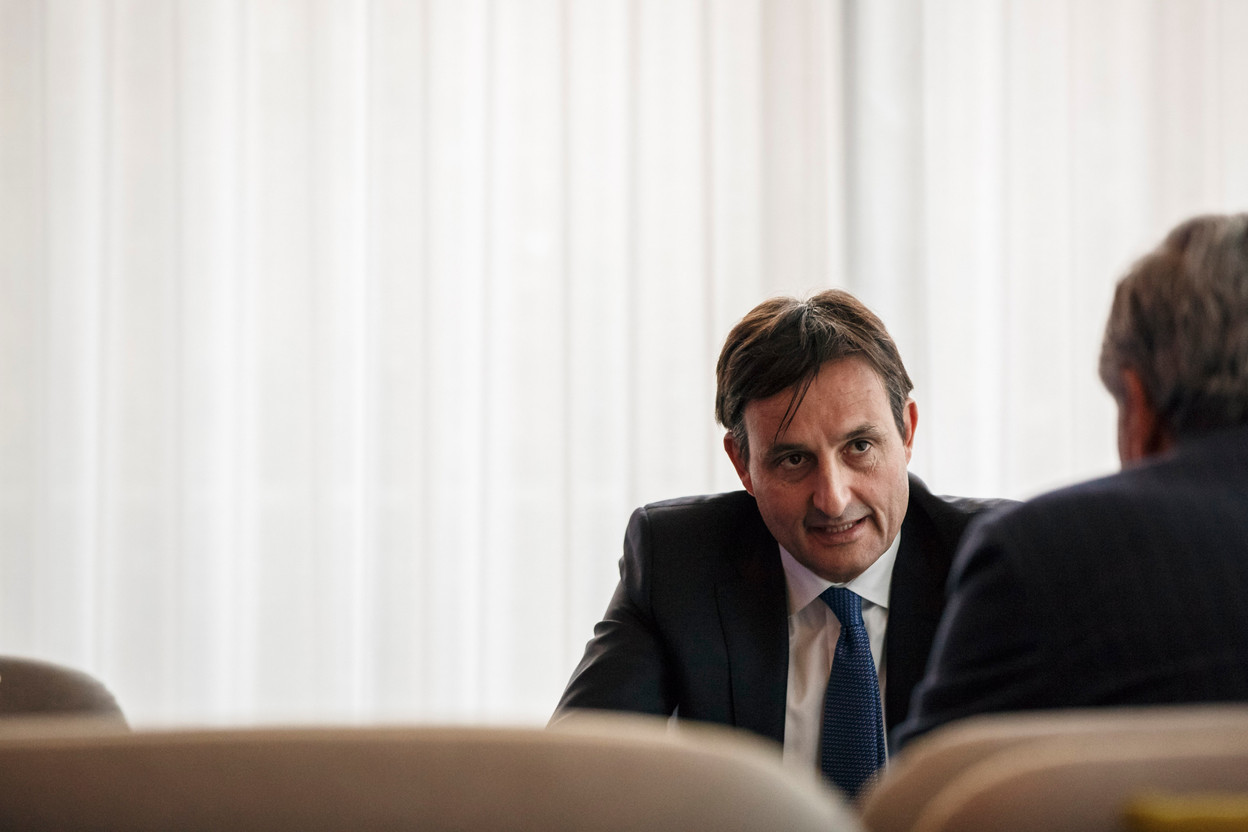
In front of an audience of some twenty European financial journalists gathered in London, Guy Henriques, the head of distribution for Europe and Asia at Capital Group, is proud to stress that the manager’s growth is “entirely organic”. And this has been the case since 1931. Not only is Capital Group one of the oldest asset managers, with almost $2.3trn in assets under management, it is also one of the top ten players in the market.
Capital Group’s active management approach is all the more interesting given that the asset manager has domiciled the majority of its investment funds in Luxembourg and was named “Best Asset Manager 2022, Luxembourg” by Morningstar.
A third of our bond team was already working together during the Asian financial crisis. So this is not their first rodeo in the crisis arena and this long-term perspective is important.

“Our 90-year history is really important. We were founded during the Great Depression and it highlights how we have invested through economic cycles,” said Henriques. So the asset manager has lived through all the financial crises in modern history. This is an important detail, as Capital Group expects its portfolio managers to develop their careers over the long term within the company. Being paid on the basis of their performance in one-year, three-year, five-year and eight-year cycles, the average tenure of portfolio managers at Capital Group is 22 years. “That’s quite an unusual number,” he observed, while illustrating the significance: “A third of our bond team was already working together during the Asian financial crisis [that started in July 1997]. So this is not their first rodeo in the crisis arena and this long-term perspective is important.”
We want our portfolio managers to really invest in their best ideas and not end up holding positions they don’t believe in.

Low stock turnover
While the success of Capital Group’s active management relies on these portfolio managers, he refuses to employ any ‘star managers’. Indeed, Henriques was keen to dispel any preconceptions: “That’s not how we manage money. We have star management teams, but we don’t have star managers that a particular strategy could rely on.”
Read also
For her part, Alexandra Haggard, head of investment products and services at Capital Group, confirmed the structuring of management teams based on a diversity of opinions: “No portfolio manager is expected to be good at everything at the same time.” In some cases, this can result in teams of up to 10 portfolio managers for a single strategy.
There is also an emphasis on manager conviction. “We want our portfolio managers to really invest in their best ideas and not end up holding positions they don’t believe in,” stated Haggard. This, she said, allows for a low turnover of positions in the portfolios. “The average holding period is four years per security.”
Our analysts all manage money from day one.

Importance of analysts
However, the results achieved by portfolio managers would be nothing without the support of investment analysts. According to Andrew Cormack, fixed income portfolio manager, Capital Group’s approach to employing analysts is different from the competition: “Our analysts all manage money from day one.” So when an analyst suggests an idea, Cormack would say: “I’m not a partner in an idea, I’m a partner in an idea that the analyst invests in.” This illustrates the asset manager’s bottom-up approach.
Of course, a top-down approach also exists, but it is limited to semi-annual forums where investment ideas and macroeconomic trends are disseminated to the portfolio managers. Each month, portfolio managers exchange views with each other through teleconferences on allocation strategies by sector or by currency, for example. But it is essentially on a day-to-day basis that analysts and traders work together to refine investment ideas.
The lack of a real top-down strategy is reflected in the “absence of an in-house view”, according to Caroline Randall, equity portfolio manager and member of the asset manager’s management committee. “There is no homegrown view on interest rates, there is no homegrown view on growth,” she noted. So it depends on the portfolio manager and the analyst, both of whom are not obliged to follow internal macroeconomic forecasting models.
Read the original French version of this article on the Paperjam site. This article was published for the Paperjam+Delano Finance newsletter, the weekly source for financial news in Luxembourg. Subscribe using this link.