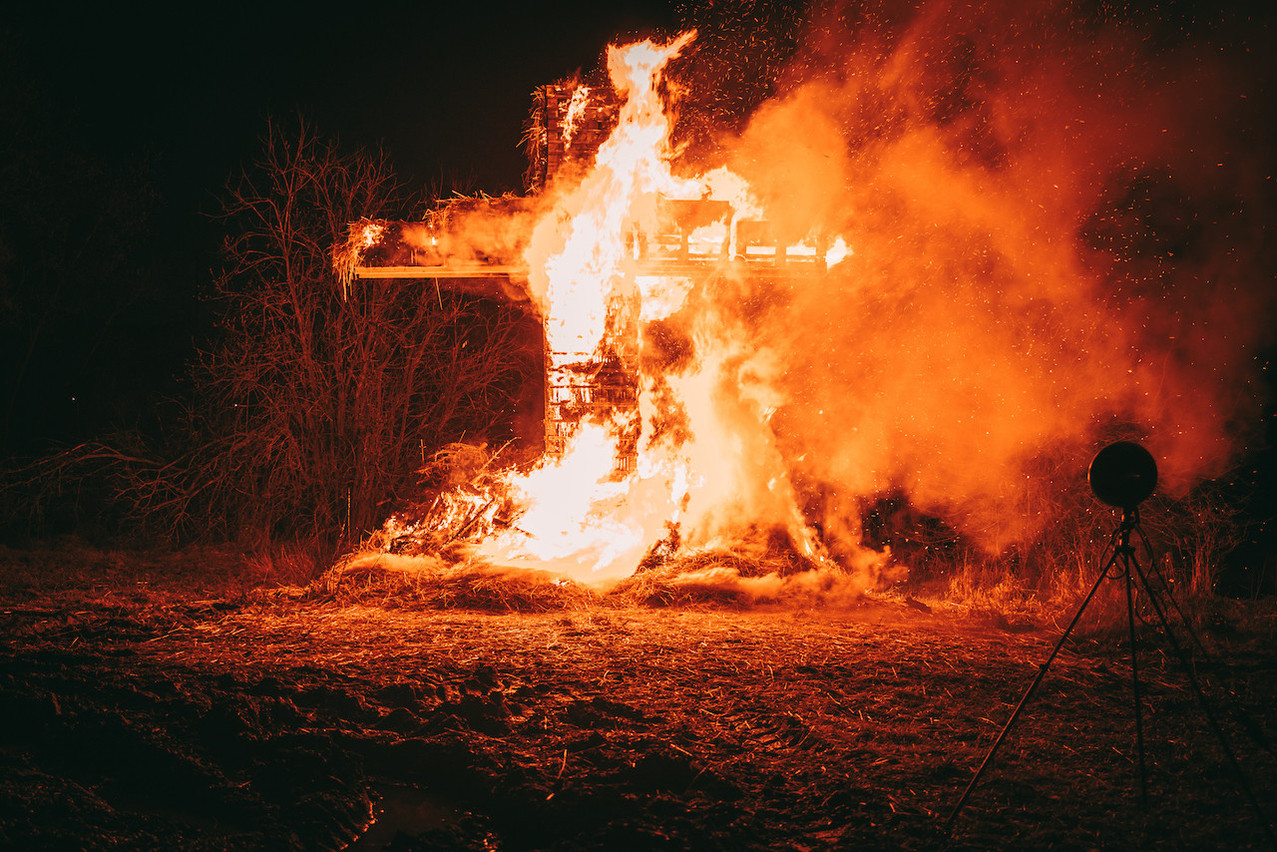
Buergbrennen takes place on the Sunday after carnival, which is also the first day of lent. It is a tradition in Luxembourg, the German borderland and in some places in France, where it is called “Fête des Brandons”. Typically it is organised by the local section of the scouts, fire brigade or youth club.
Although the word suggests that one would burn down a castle, it is actually a cross that’s going up in flames. The bonfire symbolically represents the end of winter. According to legend, the quality of the fire is supposed to be a good indicator for the farmers as to how the beginning of summer will be.
In my youth I was a scout and Buergbrennen was the one major event for my local group in Neudorf; we took weeks to organise it. The preparations started at the beginning of January when we would collect the old Christmas trees from the pavements outside the houses. Together with wooden pallets, these conifers were one of the main ingredients for our wooden construction.
In addition to the cross, we built stalls on the “Buergplatz”, in which we’d prepare and sell all kinds of food and beverage such as the local “Mettwurscht” (sausage), “Ierzebulli” (pea soup) and of course hot mulled wine.
Local competition
During the whole of Saturday, whilst we were busy building, some locals would visit the construction site and offer us drinks and cake and sometimes Schnapps, which helped us to stay warm. There was a lot of competition between the different groups and we were always worried that somebody could prematurely set fire to our Buerg during the night, so we stood guard until the sun came up.
On the actual Buergsonndeg, we would meet early in the morning and with our decorated cart we’d take the streets of Neudorf and walk from house to house, collecting money and inviting people to the bonfire night. At the back of the wagon we’d hung up a straw man, which would be fixed to the cross that same night, before it was lit.
I was always told that the scarecrow represented carnival, which ended with the beginning of lent and hence had to be burnt together with winter.
In some villages they organise torchlight processions to set the “Buerg” on fire; others follow the tradition that the newly married couple of the village will start the fire.
According to experts the word “Buerg” has nothing to do with today’s meaning of the word “castle”. Some sources say the word derives from the Latin word “comburo” which means “to burn”. If that’s the case, the tradition would be related to the new year celebrations in Roman antiquity, which was held on March 1.
Whatever the meaning and the origin, Buergbrennen is another fine tradition; you get together with your neighbours for dinner, around a nice big fire, with a drink in your hand… honestly what more can we ask for on a cold Sunday evening?
Buergbrennen events will take place in various communes in the country including Luxembourg City, Fentange, Itzig, Junglinster, Niederanven. Check out your local commune’s website or social media pages for info.
Native Luxembourger Carole Miltgen is CEO of Prisma S.A., a project and document management firm in the funds sector.