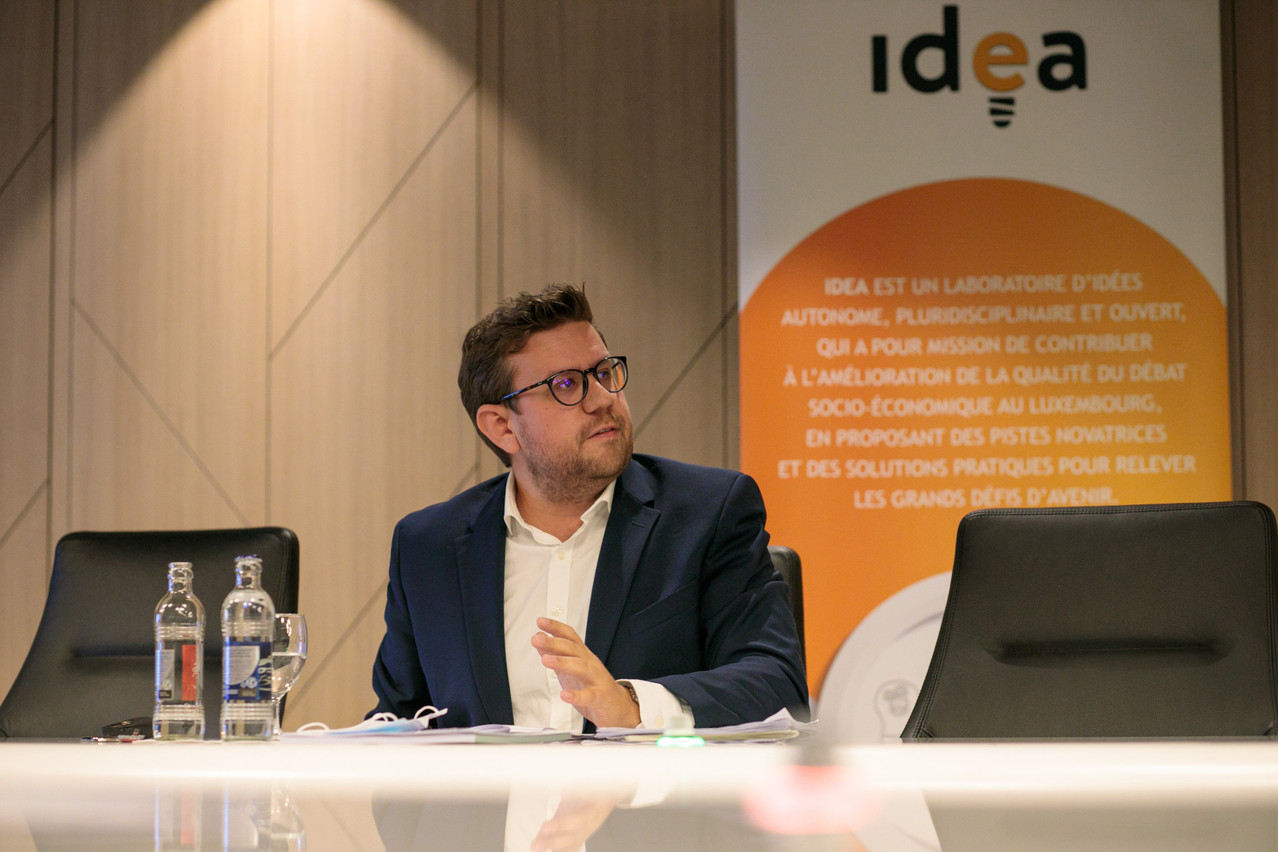
What do you mean when you say “doubt” in the title of your report, “Shadow of a Doubt”?
Vincent Hein: Even if there are tangible and significant risks, they will not necessarily lead to the darkest of scenarios, hence the idea of doubt. Because if we look at the picture of the first part of the year, the Luxembourg economy has remained in a good dynamic.
How do you interpret the risks to the country's economy?
First of all, we must ask ourselves the question of the impact of the geopolitical context and therefore of the war in Ukraine. Inflation is the most visible impact at the moment and for which exceptional measures have been taken by the government, in agreement with the social partners, to create a shock of confidence. That said, the geopolitical context is not impacting--at this stage--sectors that were in a good post-covid recovery phase during the first quarter. I am thinking, for example, of construction, restaurants and personal services. On the other hand, the war in Ukraine does have an effect on inflation and uncertainty in relation to the sanctions that are being taken, particularly in relation to gas supply.
Government intervention is important in such a context, as it was during the height of the pandemic. This shock of confidence, which is intended, is likely to reassure economic agents, even if our scoreboard also shows us that consumer confidence is falling. I would add that the indicators are less good in the financial markets, which is not insignificant for a country like Luxembourg, which is a major financial centre.
Since the beginning of 2022, non-market employment has slowed down and the private sector has taken over the job creation.

The labour market is maintaining its momentum. Should we fear a change in tempo for the second half of the year?
We are indeed still in a dynamic that could almost be described as overheating. The significant 500,000 job mark has been passed, with more than 17,000 jobs created in a year-on-year comparison. A slowdown is possible in the second half of the year, but for the time being we do not see any signs of this.
During the covid-19 crisis, Luxembourg was one of the few countries to continue to create jobs, mainly due to the non-market sector. Since the beginning of 2022, however, non-market employment has slowed down and the private sector has taken over. If the labour market had been frozen until the end of the year, we would still have achieved growth of 2.7%, which is indicative of the strength of the Luxembourg economy.
The scoreboard shows a drop in mortgages granted to households over the last twelve months?
Volumes have indeed fallen by 20% over the last twelve months. At the same time, interest rates on mortgages have started to rise and prices have continued to rise, even if the pace of growth is starting to slow. One of the scenarios in view is a rise in the price of credit and a slowdown in sales prices. This would not solve the problem of housing costs as monthly loan payments would increase.
We are also seeing a slowdown in business lending, which probably reflects the high level of uncertainty, with the risk of investment projects being postponed.
National statistics bureau Statec recently presented three scenarios for the evolution of GDP in the coming months, two of which are more pessimistic due to a prolonged war and inflation. Which scenario do you expect?
We already see elements of all three scenarios intertwined, with dynamic indicators present in the central Statec scenario, elements of protracted war and elements of persistent inflation. The data shows us a spread of inflation from energy to industrial goods (excluding energy), food and services.
At the same time, however, we can report a growing first quarter, with positive effects on public finances. The first half of the year is coming to an end and we have a positive basis for 2022.
In view of these different elements, it is still difficult to make a bet. However, the return to normalcy continues to be distant, including in terms of public intervention, which will remain strong to counter inflation and encourage business investment.
This story was first published in French on Paperjam. It has been translated and edited for Delano.