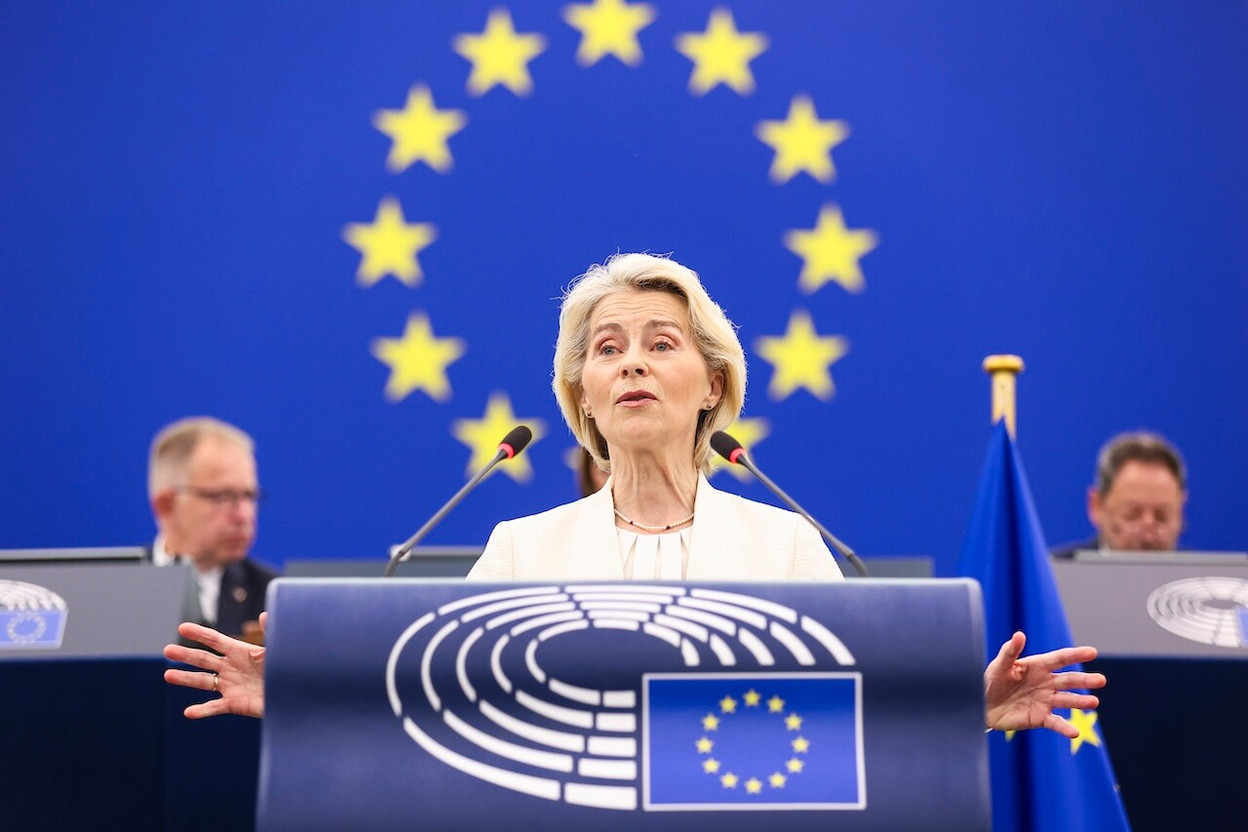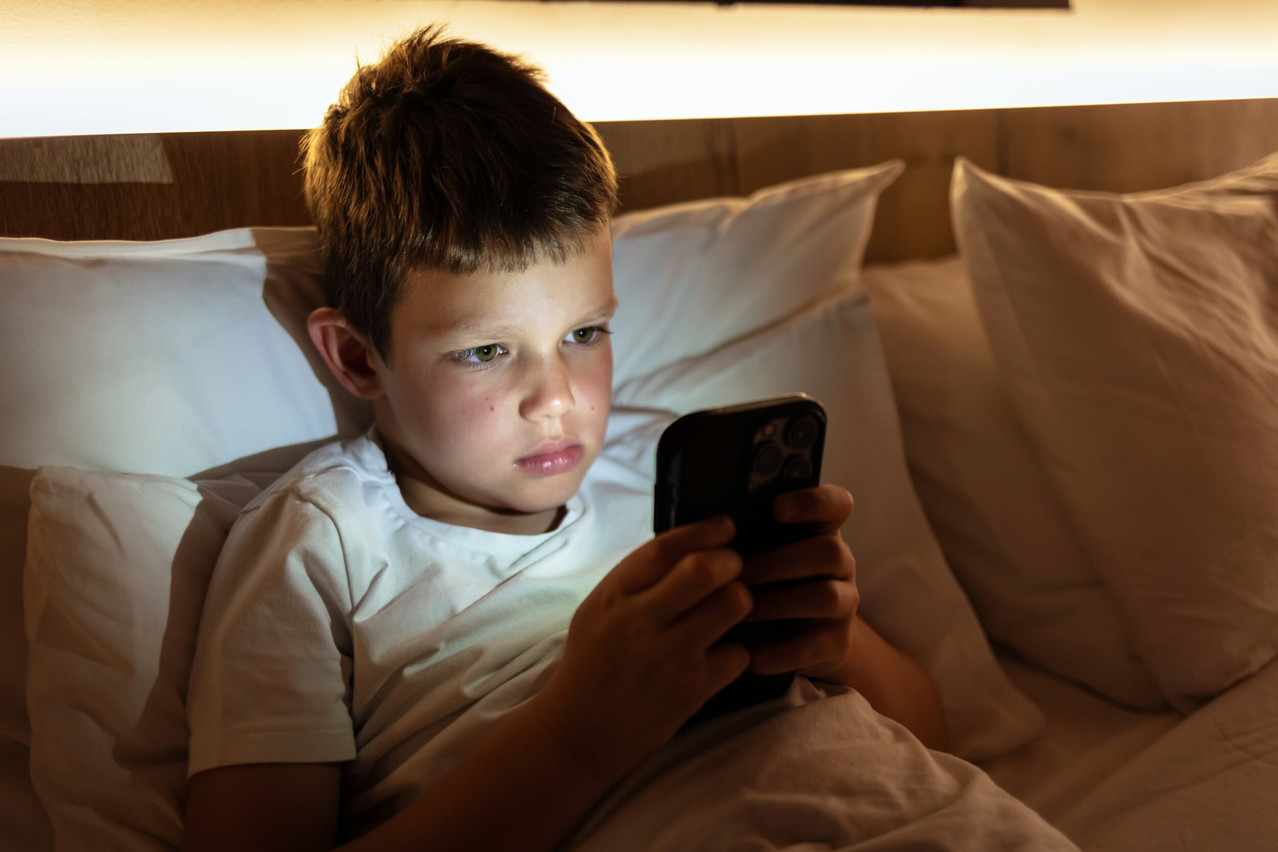
At what age should a child be allowed to use social media, and under what conditions? With the announcement of the ‘Kids Act’ during the state of the Union address on 16 September, Ursula von der Leyen aims to provide a European response to these questions. The Commission president wants to regulate minors’ access, limit addictive features and place greater responsibility on the companies that design digital services.
This initiative has resonated in the European Parliament, where MEPs are due to vote on 17 September on a motion for a resolution concerning the impact of social media and the digital environment on young people. The two approaches, however, have different scopes. The Commission is announcing a legislative initiative, the provisions of which will need to be clarified; the Parliament is setting out guidelines and requests which, even if adopted, will not in themselves create new obligations.
Their alliance nevertheless points to a common political stance: families cannot be expected to bear sole responsibility for protecting children in spaces where the platforms dictate the rules, guidelines and requests.
Gradual access based on age
The measures announced by Ursula von der Leyen are based on several tiers. Children under the age of 13 would be barred from accessing social media. Between the ages of 13 and 15, teenagers would only be able to use ‘mini-accounts’ supervised by their parents, with limited functionality and a usage limit of one hour per day. For those aged 15 to 18, platforms would be required to provide a safe environment by design, in order to reduce exposure to addictive features and extreme content.
The issue therefore goes beyond simply setting a minimum age. It is a question of organising gradual access to services whose features should evolve in line with the users’ age. The effectiveness of this approach will depend both on age verification and on the safeguards actually built into the platforms.
The benefits of a European response
The difficulties encountered in France highlight the limitations of a national response. In August, Paris saw its proposal for a total ban on social media for under-15s rejected by the Constitutional Council on several grounds. The first of these was a failure to comply with the Digital Service Act (DSA) which regulates online platforms. This is a European competence that the Commission closely monitors, ensuring that national initiatives do not create disproportionate unilateral barriers or obligations that would undermine the digital single market.
In essence, imposing a watertight age verification system at the level of a single country without compromising the security of children’s personal data remains a complex technical and legal challenge. One that Paris has failed to meet. In addition to European regulations, the Constitutional Council struck down the bill on two grounds relating to civil liberties: such a radical measure constituted a disproportionate infringement of minors’ freedom of communication and expression, and the proposed measures would have required all users — including adults — to prove their age, which created a risk of infringing the right to privacy and of widespread surveillance not guaranteed by law.
With French President Emmanuel Macron keen to make this regulation a hallmark of his second term, an alternative proposal was quickly drawn up. It no longer imposes a blanket ban, but instead targets features deemed harmful or addictive – including infinite scrolling, auto-playing videos, night-time notification streams and connections with unknown accounts. Will this proposal be better received?
For his part, the Prime minister of Luxembourg 
A common approach should reduce the fragmentation of national initiatives. However, it would not obviate the need to resolve the central challenge: protecting children whilst safeguarding their rights and users’ privacy. Policy convergence between institutions therefore does not prejudge either the final content of the Kids Act or the speed with which it will be adopted.
Checking age without revealing identity
With regard to the minimum age for access, the parliamentary proposal favours a harmonised approach at European level, without itself setting a specific age limit. References to the ages of 13 to 15 relate to consent to data processing as provided for in the GDPR; they do not, in this proposal, constitute a new general ban on access to social media.
The text focuses primarily on a practical aspect of the scheme: how can age be verified without imposing a blanket requirement for identification? As systems based on a simple self-declaration can be easily circumvented, it advocates mechanisms that allow individuals to prove their age whilst limiting data collection to what is strictly necessary.
In particular, it describes a principle of ‘double anonymity’: the third party carrying out the age verification must not know which service is being accessed, and that service must not be able to identify the user through this verification. The systems should be supervised by the public authorities and meet requirements relating to security, interoperability and non-discrimination.
This approach provides a vital complement to the restrictions announced by Ursula von der Leyen: the protection of minors must not become a further means of collecting sensitive data. Parliament is also calling for European standards and certification for parental control tools, to make them simpler and more effective across different devices.
Influencing the mechanisms that capture attention
Once access has been granted, the environment still needs to be suitable. It is on this point that the parliamentary proposal sets out in the most concrete terms the ‘security by design’ objective underpinning the Kids Act.
It advocates maximum privacy settings by default, disabling auto-play, placing limits on infinite scrolling and restricting notifications. It also wants to allow users to reset their recommendation feed and make safe settings mandatory for systems intended for minors. A ‘youth mode’ would limit addictive features and disable targeted advertising.
The idea is to minimise risks right from the moment an account is opened. A child should not have to figure out on their own which settings are needed to keep them safe, nor should a parent have to search for options scattered across several menus.
However, approaches differ when it comes to screen time. Whilst Ursula von der Leyen mentions a limit of one hour per day for supervised accounts held by 13- to 15-year-olds, the resolution does not include this limit. Instead, it favours customisable breaks, discreet reminders about the duration of use and age-appropriate recommendations based on scientific evidence.
Making algorithms auditable
Young people’s safety also depends on the content that platforms recommend to them. The parliamentary bill calls for greater transparency, robust external audits and access for accredited researchers to aggregated data enabling them to study minors’ exposure to algorithmic systems. It also aims to make the various recommendation methods more accessible, particularly those tailored to children.
These calls build on the aim of making platforms more accountable. Companies have a detailed understanding of how their platforms are used, whilst families and the authorities struggle to gauge the effects of their design choices. Independent monitoring should make it possible to assess the effectiveness of safeguards based on their outcomes.
Supporting victims and addressing new ways of using the service
The Kids Act also targets sexually explicit images generated by artificial intelligence (AI) involving minors. The parliamentary proposal complements this aspect with calls for support measures: child-friendly reporting procedures, legal assistance and psychological support. It calls on platforms to respond swiftly to cyberbullying and to publish information on processing times and the measures taken.
The scope under consideration goes beyond social media alone. For AI-based conversational ‘companions’, the text calls for their artificial nature to be clearly indicated, for safety features to be enabled by default for minors, and for users expressing thoughts of self-harm to be directed towards support services.
It also addresses the transparency of influencers’ commercial content, the protection of children from exploitation in such activities, and the regulation of random purchases or rewards in video games, such as ‘loot boxes’. These calls reflect a common concern: to take into account the vulnerability of minors to commercial incentives and practices that encourage compulsive behaviour.
Enforcement of the rules will be crucial
To give these ambitions practical substance, the motion for a resolution emphasises the means of monitoring: more resources for the authorities, better European coordination and regular evaluation of the measures. It also includes an educational component, comprising teacher training, support for parents and the involvement of young people in designing the measures that affect them.
The minimum age for access and screen time are the most visible aspects of the debate launched by Ursula von der Leyen. Parliamentary proceedings serve as a reminder that child protection also involves business models, technical choices and means of control. The scope of the future Kids Act will be measured by its ability to translate this ambition into practical, verifiable safeguards for everyday use.