Business travel is becoming increasingly important when it comes to trips to Luxembourg. According to Luxembourg for Tourism, 18% of international trips to the country in 2024 were within the business events segment. Other professional trips accounted for an additional 9% of visits to the grand duchy, bringing the total share of travel motivated by work-related reasons to more than a quarter.
While leisure travel remains the main driver (accounting for 59% of international trips) and 15% of visitors come to see relatives, the dynamic of professionally motivated travel is gradually growing stronger. Between 2023 and 2024, its share increased by three percentage points, say the latest available figures.
Faced with this evolution, the question of transport infrastructure is becoming central. For business travellers, passing through these facilities often constitutes their first and last contact with the country. In Luxembourg, this role is notably played by Luxembourg Airport, one of the main gateways to the grand duchy.
This role is reflected in the growth of its activity. “In 2025, 5.3m travellers were recorded, which constitutes a record,” says Lux-Airport CEO 
Passengers coming to Luxembourg for business hold a significant place among these travellers. “On average, between 30% and 40% of our passengers belong to the business traveller category,” explains the CEO. This level is significantly higher than the European average. “It’s a particularly high rate, which pushes us to adapt our products and services to meet the expectations of a demanding audience.”
€1bn to prepare for the future
To meet the needs of this exacting clientele, Lux-Airport is preparing several major projects to improve the passenger experience. The most visible concerns the extension of the terminal, which aims to accommodate a growing volume of travellers while improving comfort. Particular attention will be paid to business travellers.
At the same time, the airport intends to boost its premium services. The Business Aviation Center, dedicated to private aviation and business jets, is set to be completely rebuilt. An expansion of the lounge and an improvement of the VIP offering are also being studied to make the pre-flight experience more comfortable.In total, nearly €1bn will be invested by 2032 to modernise and develop the infrastructure of the airport.
Speed as an advantage
Beyond these investments, the passenger experience also relies on a characteristic specific to Findel: its size. For business travellers, who are often in a hurry, time remains a precious resource. From this point of view, the relatively compact size of the airport – sometimes perceived as a limitation compared to major international hubs–actually constitutes one of its main assets.
“The strength of the airport is precisely its human scale,” emphasises Flassak. “Passengers can go through security checks and reach their gate very quickly. Waiting times are generally very short.”Some time slots, however, remain busier. “If you arrive for the first flights of the day, when the majority of business travellers are moving, delays can be a bit longer,” the CEO notes.
An expanding air network
From Luxembourg, passengers can now reach more than 120 destinations in 33 countries thanks to scheduled flights. Certain connections occupy a significant place in business traffic. Flights to London, Zurich and Frankfurt are among the routes most frequently used by business travellers because of the close links between these financial centres and Luxembourg.
Among the projects regularly mentioned is also the prospect of a direct connection with the United States. “It would be a real added value for the country,” says Flassak. “We receive many requests on this subject. But an airline must be able to operate this route in a profitable manner.”
Opening new routes primarily depends on airlines. “Our role is to provide the infrastructure and ensure the airport operates in the best conditions. We do everything we can to convince airlines that Luxembourg deserves to be served, but in the end, they are the ones who make their decisions,” the executive says. While no concrete announcement has yet been made, he believes that growth in traffic is making this prospect increasingly credible.
Improved accessibility
The efficiency of a business trip is not limited to the flight itself. Access to the airport is also a key element of the traveller experience. The arrival of the tram at Findel has therefore been particularly well received. Today, 51% of passengers use public transport, including 22% who take the tram to or from the airport. “We were surprised, in a positive way, by the number of people using the tram,” notes Flassak. “The direct connection, which brings people to the city centre in just a few minutes, is a real asset.”
Of course, some business travellers continue to prefer other modes of transport , such as taxis or limousine services. But the integration of the airport into the country’s free public transport network considerably strengthens its accessibility.
Skypark, the airport’s new business hub
While the airport’s proximity to the city is an obvious advantage, it also imposes certain constraints. Surrounded by residential areas, the site has limited room for expansion. “Our challenge is to optimise the existing infrastructure as much as possible,” emphasises Flassak.
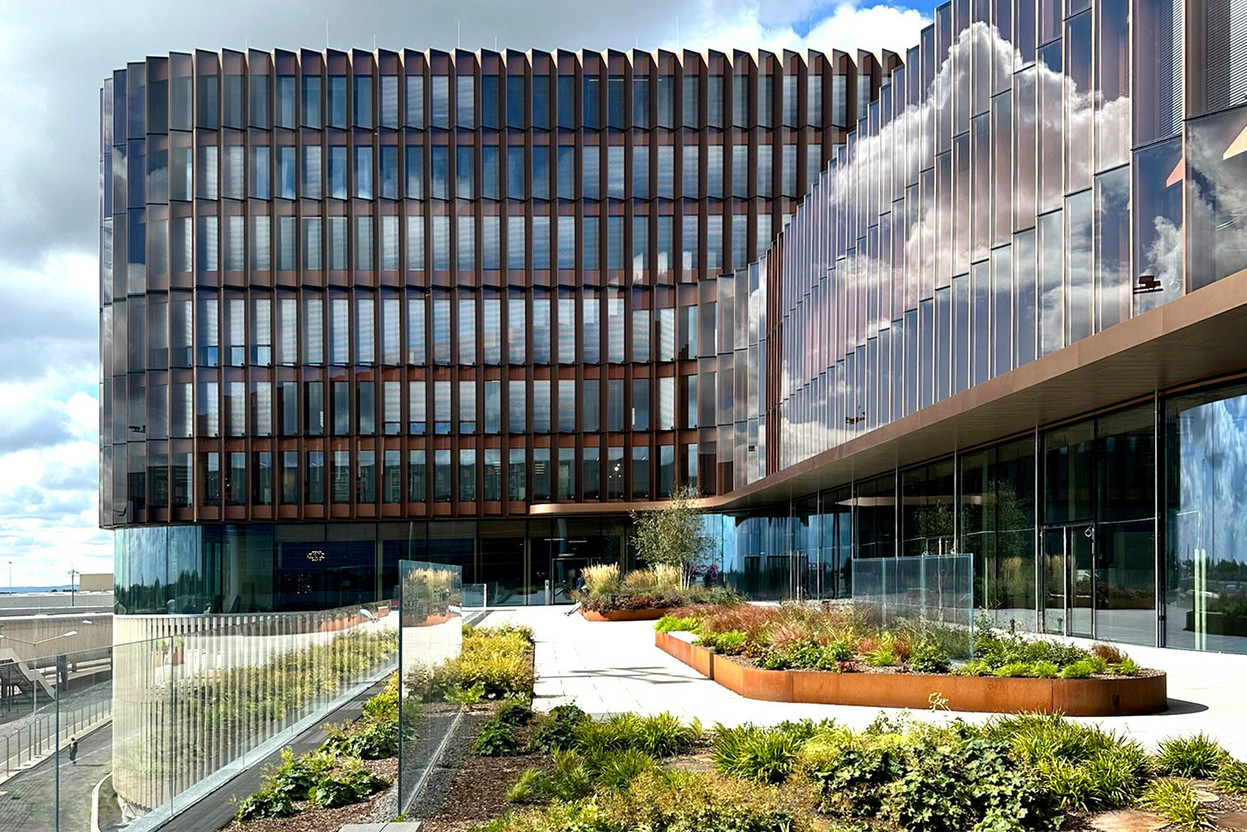
In this context, the development of the Skypark Business Center plays a key role. This complex, which hosts hotels, offices and services, is gradually transforming the airport district into a true business hub. Certain activities previously located in the terminal have been transferred to new spaces in the complex to free up space in the airport and enable new developments, like the expansion of the lounge.
The project also strengthens the offer for business travellers. The ultramodern meeting rooms located in the Moxy Luxembourg Airport Hotel are already regularly fully booked. “It’s already a success, and it will be even more so when the entire project is completed,” concludes Flassak.
This article was written for the Business Events & Teambuilding supplement of Paperjam magazine’s April 2026 issue, published on 25 March. It is published on the site to contribute to the full Paperjam archive.
Click this link to subscribe to the magazine.
Is your company a member of the Paperjam Club? You can request a subscription in your name. Please let us know via club@paperjam.lu