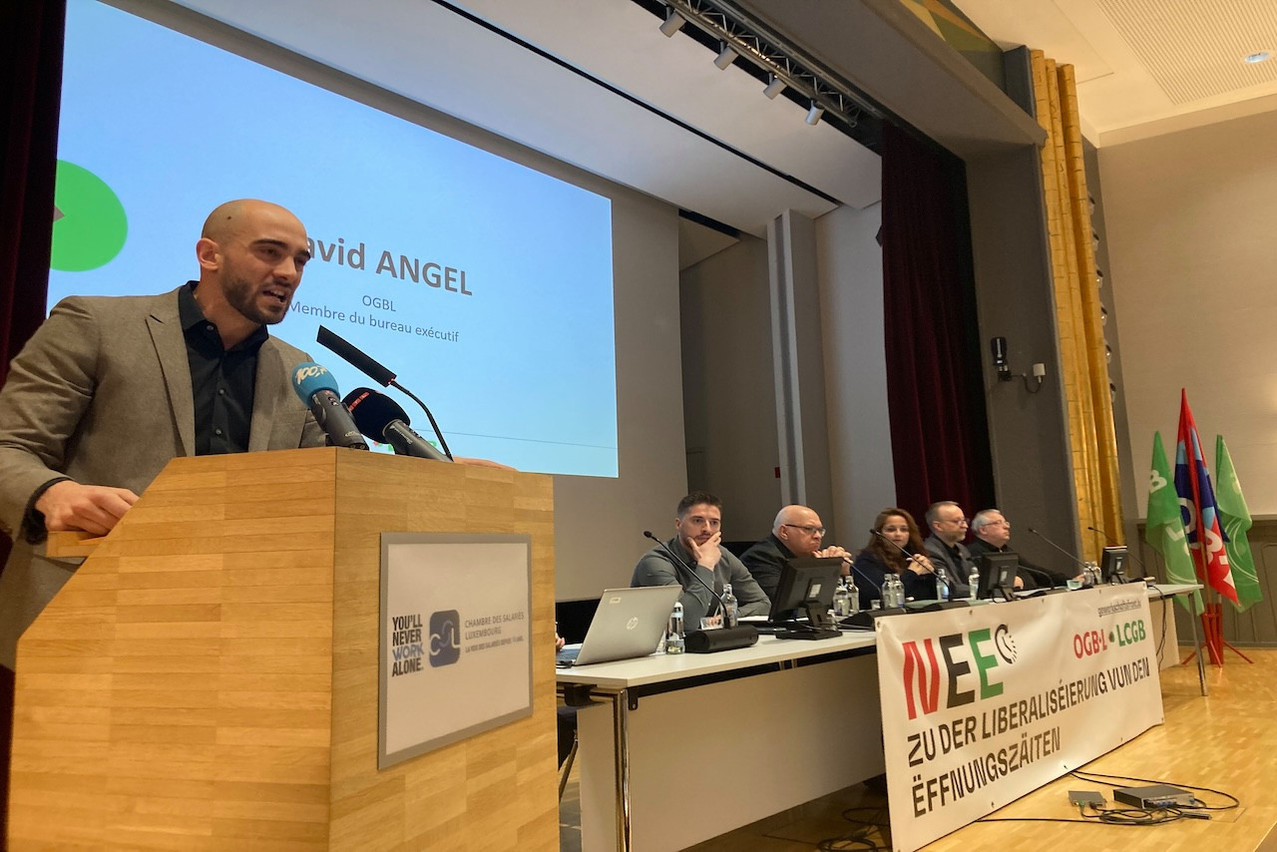
More than 360 people turned out at the Casino syndical de Bonnevoie on Thursday 6 February, in response to a call from the OGBL and LCGB. “We had expected half as many people, but we had invited the trade union delegates from the retail sector. This mobilisation shows that the subject is extremely serious,” commented David Angel, central secretary for the commerce sector of the OGBL. 

As has often been the case in recent months, the unions are united in their opposition to the government and the two bills affecting the commerce sector. Bill 8472, on opening hours in the retail and craft sectors, and bill 8456, on Sunday working hours.
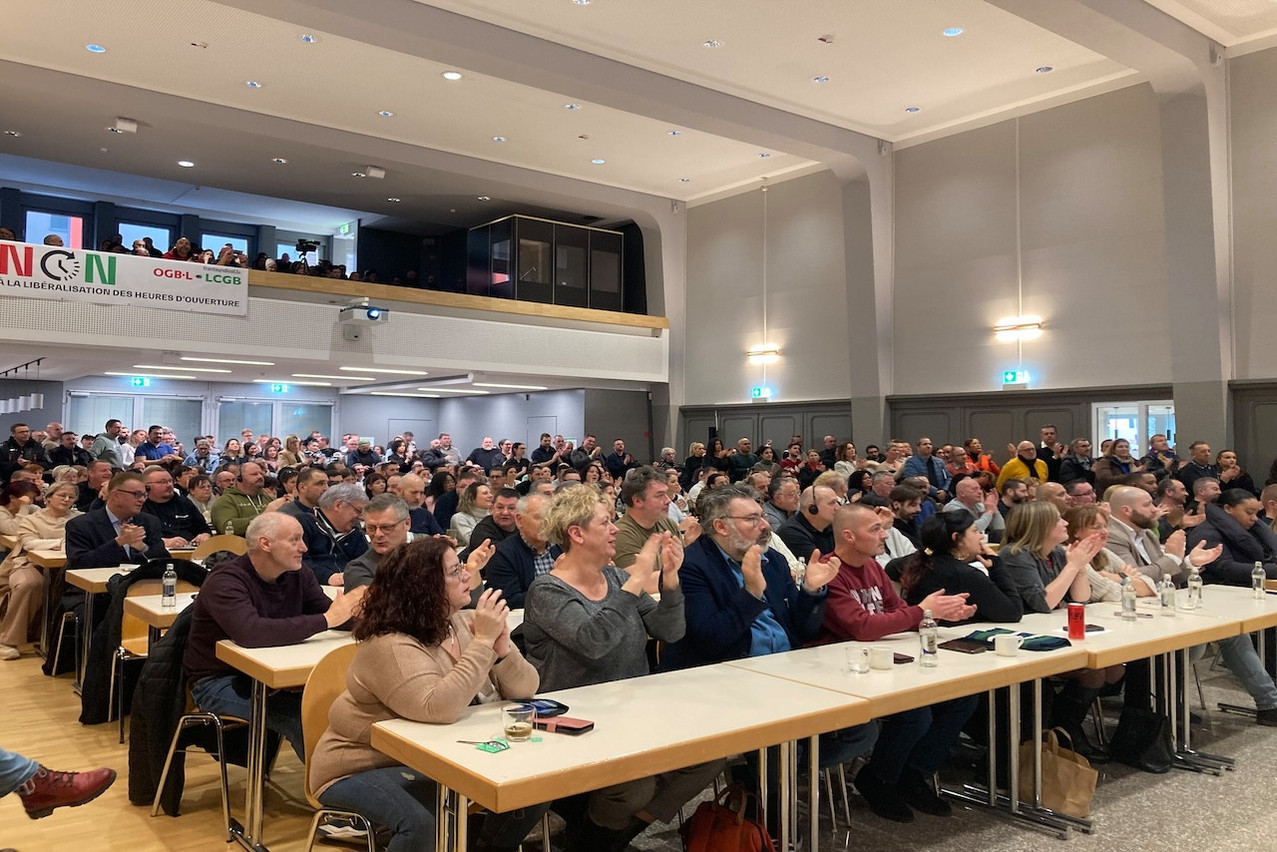
Some 360 people turned out at the Casino syndical de Bonnevoie, at the call of the LCGB and the OGBL. Photo: Ioanna Schimizzi/Maison Moderne
It was a gathering worthy of a meeting, with thunderous applause for every speech by a representative of the OGBL or the LCGB. The main target of the speeches was the economy minister 
50,000 employees in the retail sector
According to the bill, if adopted without amendments, shops would be allowed to be open as follows: from 5am to 10pm Monday to Friday; from 5am to 7pm on Saturdays, Sundays, public holidays and the eves of public holidays; and from 5am to 6pm on 22 June, 24 December and 31 December. Of the 11 public holidays in the year, the obligation to close would only be maintained for three specific days (1 January,1 May and 25 December).
“But when most of the 50,000 employees in the retail sector are women, and some are single-parent families, how will they be able to organise childcare? And what about the harmful effects on health and the work-life balance? This project tramples on both social dialogue and human lives,” insists Angel.
A quid pro quo
One of the arguments put forward by the minister for the economy is that, since 2018, he has granted derogations on numerous occasions and that, on average, 35 municipalities also apply for a derogation each year. The bill must also respond to the conclusions of a ruling by the Constitutional Court, which considered that the system in place until then was discriminatory because of unequal treatment with regard to the sale of certain products.
“But in this case we were talking about a baker and confectioner, so why not create a strict framework specifically for this trade?” asks Tiago Afonso, LCGB trade union secretary. “Why lump the whole sector together when the situations are so different? If a shop opens at 5am and closes at 10pm, employees have to arrive at 4am and leave at 11pm, with no pay in return. The minister compares the situation to hospital or police employees who work 24/7. But who dies if a business is closed?”
Other sectors affected
The unions are therefore calling for “real social dialogue with the government. Either it backtracks on its bill, or we find compromises, but it is not acceptable as written. We would have the most liberal opening of shops in the Greater Region,” continues Afonso. Union representatives also pointed to the other sectors affected by the extension, “such as logistics, catering, transport, cleaning and childcare. The government thinks it’s modernising businesses, but it’s quite the opposite. While we were supposedly essential during covid, this is how the government thanks us.”
And bill 8456 was not to be outdone. With regard to retail shops in the commerce sector, for the years 2022, 2023 and 2024, 80.65% were authorised to open on Sundays under this derogation, representing 82.50% of the country’s total retail surface area. “Minister Delles complains about the derogations, but he is the one who set up this system.” This bill aims to amend the provisions governing Sunday working, and provides for Sunday working to be limited to eight hours in the retail sector, compared with four hours at present. “But once again, what are the benefits for employees?” asks Angel.
As already announced last week, a number of actions are planned over the coming months, culminating in a national demonstration in Luxembourg City on 28 June. A rally was also organised in front of the Chamber of Deputies on Wednesday 5 February.
This article was originally published in French.