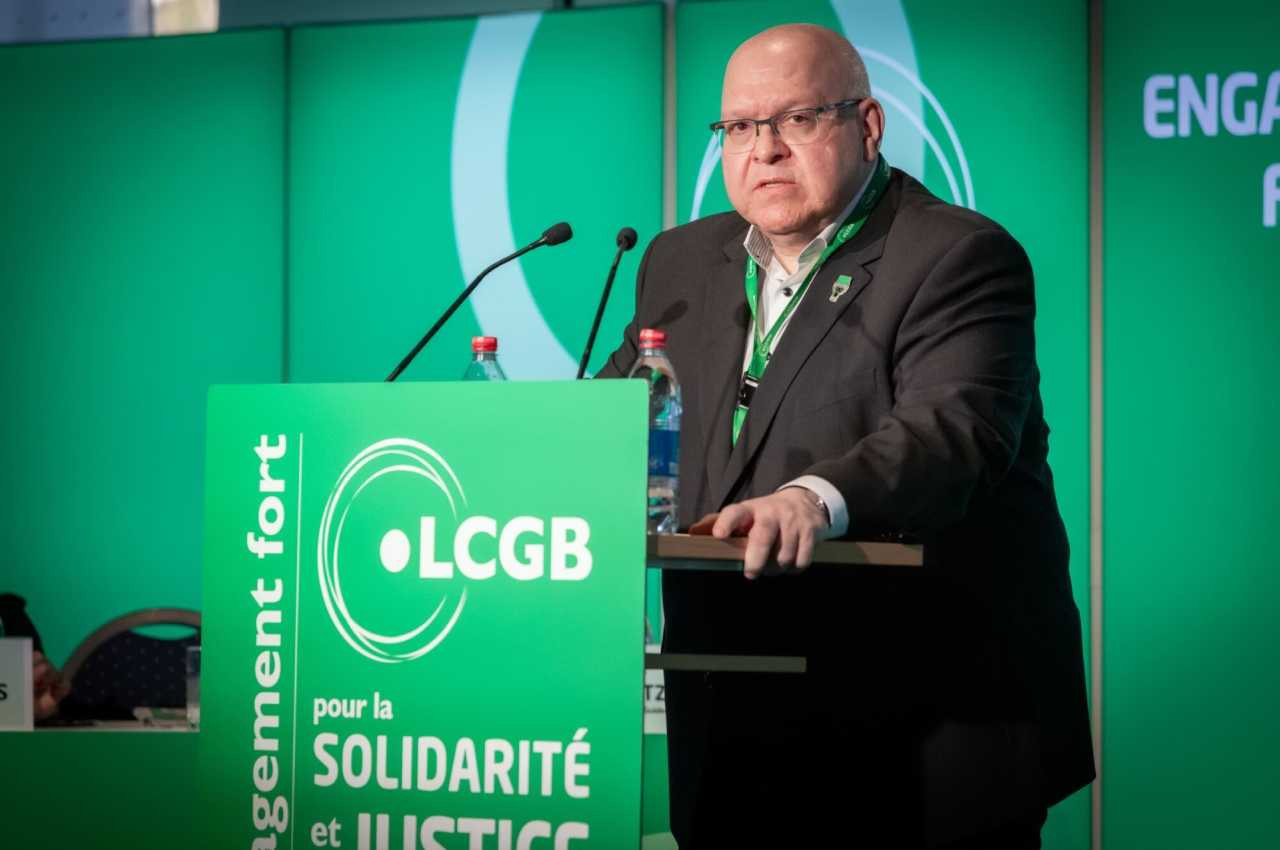
Spring will be hot... but it will have nothing to do with global warming. On Saturday in Dommeldange, at the 61st LCGB congress, 
In his closing speech, Dury spoke not only of the LCGB's development over recent years, but also and above all of the government's current attack on social achievements and workers' rights. "Social apartheid has unfortunately become a reality in our country", he said in his speech, in which he opposed the destruction of social cohesion and social dialogue in Luxembourg.
For more than 100 years, the LCGB has left its mark on working conditions, the social security system, pensions in Luxembourg and much more, and has weathered more than one storm, he stressed. As a modern trade union, the LCGB has proved that it is capable of adapting, supporting and encouraging change, while always remaining true to one thing: its commitment to solidarity and social justice, he recalled in front of high-level international trade union representatives from the CFDT Grand Est, the CSC and the FCG, national trade union representatives from the Luxembourg Chamber of Employees (CSL) including 


LCGB demands
The 280 delegates also adopted a seven-page manifesto of demands. Here are the LCGB's main commitments and demands, grouped by theme:
- Social dialogue: maintaining and strengthening social dialogue at all levels, in particular via the national tripartite (discussions between labour, business and government leaders). Demand for reform of the legal framework for collective bargaining agreements (CCT). The LCGB calls for the role and resources of representative unions at national level to be strengthened through a reform of the law on staff representation. Calls on the government to reform the right to strike.
- Reducing social injustice: promoting a decent work policy, combating discrimination, access to affordable housing, accessibility of basic services, a fair environmental policy, gender equality, strengthening the rights of LGBTQIA+ people, equal treatment between the public and private sectors, and opening up voting rights to foreign residents.
- Strengthening purchasing power: maintaining automatic indexation of wages, automatically adjusting the tax scale to inflation, smoothing out the "middle class hump", maintaining the non-taxable non-qualified minimum social wage, abolishing tax class 1A for single-parent families, increasing the single-parent tax credit, raising the minimum lump sum for expenses, raising family benefits, and increasing the basic grant.
- Safeguarding lives: strengthening social protection for employees against existential risks (sickness, unemployment), improving job retention, strengthening protection against redundancy and rights in the event of redundancy plans or bankruptcy, abolishing the 78-week sickness limit, improving outplacement and re-employment assistance.
- Protection in the face of digitalisation: human and social support for digitalisation, supervision of artificial intelligence, fair distribution of AI-related productivity gains, introduction of a tax on AI applications, regulation of work via platforms, protection of employees' privacy, and combating the digital divide through training, etc.
- Improving continuing vocational training: employees' right to continuing training, extending individual training leave, stimulating in-company apprenticeships, the right to qualifications, simplifying the validation of acquired experience, and promoting linguistic leave.
- Adaptation of working time: reform of the legal framework relating to the organisation of working time, new definition of overtime, right to part-time work with return to full-time work, reduction of working time thanks to AI, strengthening of time savings accounts, improvement of statutory leave, facilitation of teleworking for cross-border workers, and gradual transition to retirement.
- Strengthening health and safety at work: preventing psycho-social risks, improving ergonomics, adapting occupational medicine structures, stepping up social dialogue on health and safety, upgrading the status of safety representatives, and introducing safety procedures.
- Fair and innovative social security and healthcare system: a system based on solidarity, equity, efficiency, accessibility and quality. Active investment in the interests of insured persons, simplification of communication, development of out-of-hospital structures, and a national e-health strategy. Maintaining the tripartite funding system for sickness and maternity insurance, maintaining the contribution rate, removing the ceiling on social security contributions, separating CNS national health insurance and state expenditure, improving reimbursement rates, modernising billing nomenclatures and making direct payment the norm. Opposition to the deterioration of the public pension insurance scheme and proposal to increase revenue for the public scheme.
- Innovative trade union services: expansion of the range of multilingual services, launch of the "TonLCGB" mobile application, specific legal assistance, professional civil liability for the health professions, and administrative assistance.
Read the original French-language version of this news report here / lire en français