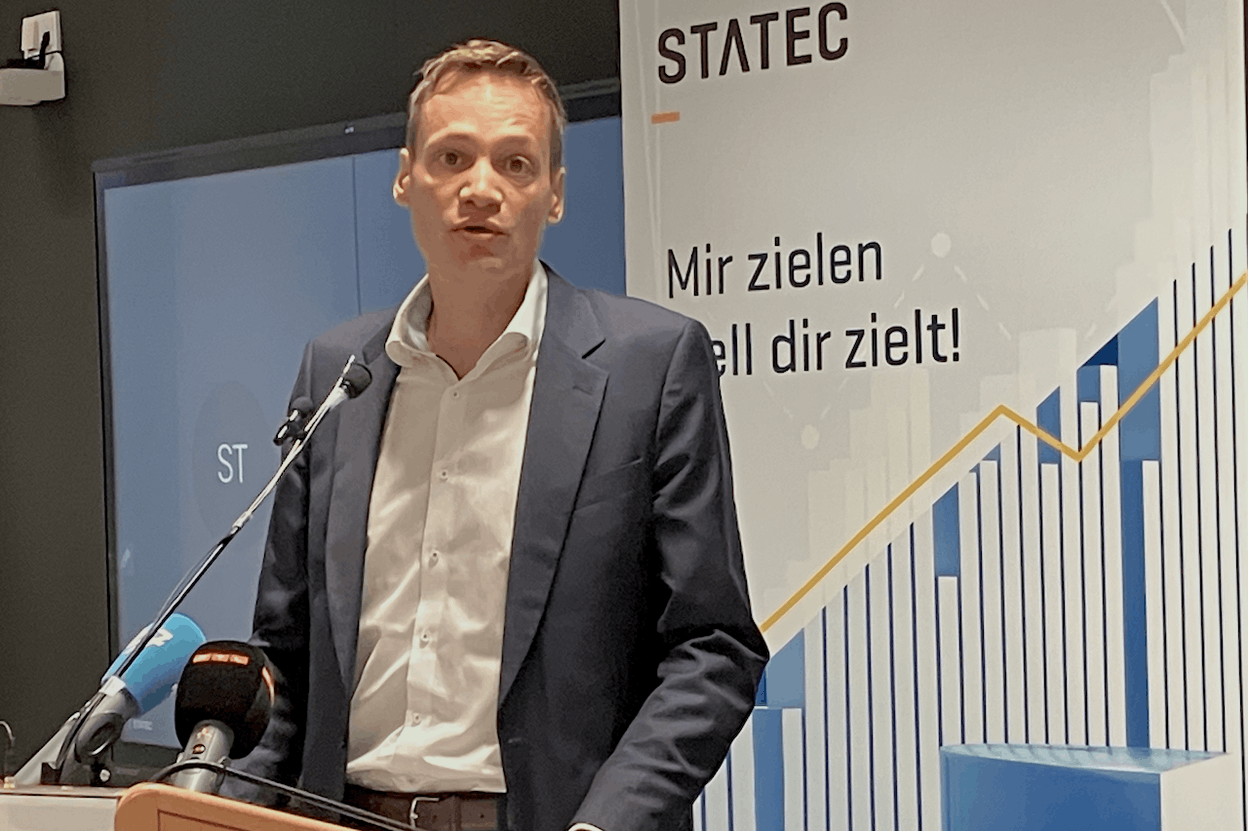
You succeeded Serge Allegrezza, who had held the position for many years. Did you feel any pressure when you arrived?

What was your first priority on taking up your post?
"From day one, I launched an in-depth analysis to build a new work programme. It was a collaborative approach with all the teams and our external partners, in particular the other bodies in the statistical system, in order to identify areas for improvement. This process led to a new long-term vision, focused on overhauling data management: recent technological advances now offer a tremendous opportunity for transformation in this area.
Does this strategy incorporate artificial intelligence?
"Yes. AI and machine learning are already being used to classify certain data. But to exploit their full potential, you first need well-structured, centralised data. That's the whole point of the strategy we're implementing through several projects, in particular with the CTIE.
The aim is to build a data architecture tailored to the needs of official statistics, guaranteeing quality and reliability. By industrialising our processes, we are improving both speed and accuracy. We are also working to make greater use of administrative data, in order to limit the need for surveys and, in so doing, reduce the burden on households and businesses alike.
The added value of our work lies in the ability to understand the links between phenomena, rather than examining them separately.

Your job is still fairly abstract for many people. In concrete terms, how do you go from the idea for a study to its publication?
"There are two strands: pure statistics and economic analysis. Most of our work is based on international standards, defined and validated by the world statistical community and then adapted by Eurostat at European level. These frameworks guarantee the comparability and reliability of the figures. We then analyse the data in the Luxembourg context: the aim is to anticipate the economic and social challenges so as to provide clear and useful information for public debate at the right time. That's what Statec is all about: informing decision-making with solid, accessible data.
If we have to anticipate economic issues, what are the key subjects to be monitored today?
"Demography, particularly through the issues of immigration and attractiveness, remains a central challenge for Luxembourg. But the energy and environmental dimensions are just as important. The last few years have seen a succession of crises: the pandemic has shaken up the economy, value chains, prices, purchasing power, wages... and, by extension, competitiveness. Our role is to analyse these interactions and come up with a clear vision. This is the added value of our work: understanding the links between phenomena, rather than examining them separately.
What are the main challenges you are facing today?
"The issues are constantly evolving, and some data is still incomplete. This is the case for information on income or wealth, which is essential for analysing inequalities or equity between generations. Data on buildings is also lacking, even though it is essential for developing effective strategies for renovating buildings and reducing emissions.
But new sources are emerging, such as smart meters. This big data is making it possible to limit the need for surveys while improving accuracy and responsiveness. More and more private data is also becoming accessible, within a highly regulated framework, particularly at European level, whether it concerns mobile telephony or banking transactions. Another concrete example is scanner data, the data collected from supermarket checkouts. Thanks to them, we have gone from a few thousand to almost 90,000 products tracked in the shopping basket.
The confidentiality rules are the same everywhere, but in Luxembourg, the level of detail published is more limited.

In Luxembourg, the size of the country makes data confidentiality more sensitive. How do you guarantee the anonymity of respondents?
"The confidentiality rules are the same everywhere, but in Luxembourg the level of detail published is more limited. In sectors where there are few players, we simply cannot disseminate the data, even if it exists. Guaranteeing anonymity is a job in itself, and we use advanced technologies to achieve this. Using census data, for example, we have created a synthetic population: an entirely fictitious database that faithfully reproduces the structure and characteristics of the real population. This allows detailed analyses to be carried out without ever exposing personal information.
You recently moved to Belval. Has leaving the capital had an impact on the way you work?
"Above all, it's a great opportunity to get closer to the academic world. At Belval, the presence of a large number of researchers is an asset for our research department: exchanges are facilitated and collaborations strengthened. The move also has a role to play in terms of attractiveness and employer brand. It simplifies access for staff coming from the south of the country and avoids traffic jams towards the capital. However, it remains essential to maintain a strong link with the economic and political players based in the capital, as this proximity is at the heart of our mission and our ability to respond quickly to their needs.
Why do some statistics stop at 2022 or 2023?
"It's a combination of factors. Surveys take time, and certain administrative deadlines, such as the filing of balance sheets or VAT returns, are longer in Luxembourg than elsewhere. As long as this information is not available, we have to work with estimates. This is why we first publish short-term indicators (monthly or quarterly), and then revise the figures when the full data becomes available. It's a balance between speed and reliability: publishing quickly, but without compromising statistical quality.
This is also where our role lies: bringing statistics to life as a player in democracy.

What is the average response rate to Statec surveys?
"It depends on the survey: around 80% for the population census, compared with a third for more targeted surveys. Responding is normally compulsory, but we give priority to education: we explain why this data is essential. Responding to a Statec survey is a civic gesture, just like voting. It provides an accurate picture of society and informs collective decisions.
The Statec website can seem complex. Are you working on making it more user-friendly?
"We have already made progress on popularisation, with more accessible formats: infographics, short videos and Conjoncture Flash, our monthly publication on economic news. Fundamental work is also underway to improve our website and the way we present data. The main challenge is to model data that has so many dimensions. The challenge is therefore to prioritise, select the essential information and make it comprehensible to everyone. This is one of the major areas on which we will continue to work in the coming years.
Who do you think should bear responsibility for making statistics better understood: schools, the media or Statec?
"It's a shared responsibility. Data literacy starts at school, continues in the work of journalists and is part of our mission. We are transparent about our methods, but rather like the terms and conditions of an insurance policy, few people have the time to read them in detail. Our teams regularly visit secondary schools and local authorities to present local statistics and raise public awareness. In a world saturated with information, it is essential to rely on reliable and comparable data. All the more so at a time when certain technologies, such as artificial intelligence, are being trained on data that is sometimes biased. This is also where our role lies: bringing statistics to life as a player in democracy."