According to Statec’s latest flash economic report, after a sharp downturn in the third quarter of 2024, confidence among service companies in Luxembourg is on the rise again. “This trend was confirmed in the last survey in January,” said the statistics institute. “The confidence indicator rose for the fourth consecutive month and reached a level not seen for the past two and a half years.” This rebound is being driven mainly by certain sectors, such as legal and accounting activities, air transport, catering, postal and courier services, leasing, and administrative and business support activities.
However, this improvement is not uniform. Whole swathes of the sector remain outside the recovery. Businesses in land transport, warehousing services, housing, IT programming and consulting, or head office and management consultancy services are still not seeing any improvement. What’s more, although the indicator is improving, the current level of confidence remains below its historical average.
However, there is another positive sign: the perception of employment trends is improving, both in terms of recent trends and the outlook for the coming months. At the same time, the proportion of companies citing financial constraints is falling, which could be a support factor for investment and recruitment.
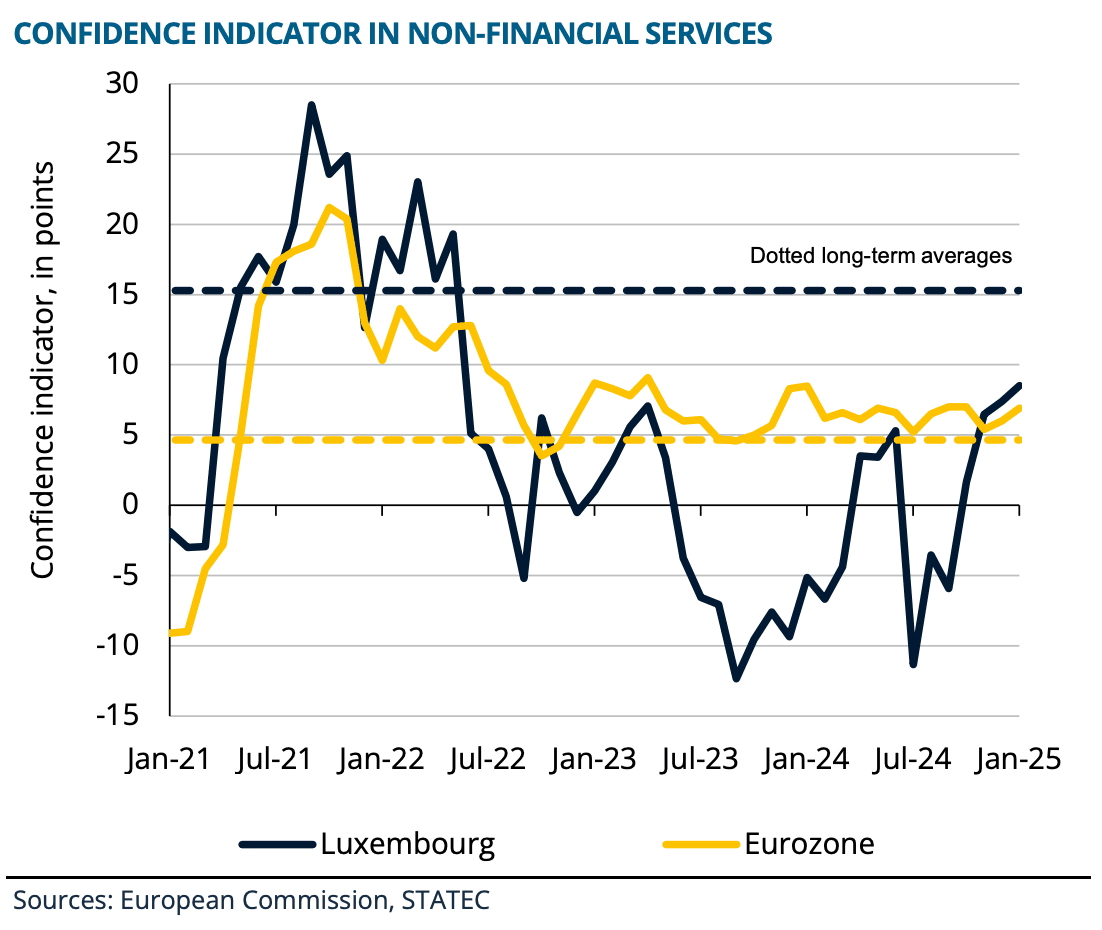
The confidence indicator shows an increase for non-financial services. Image: Statec
At the European level, confidence in services has been fluctuating since the beginning of 2024, hovering slightly above its long-term average, but with no clear trend. Italy is pulling the indicator upwards, while other countries remain more hesitant.
Retail trade, which is the subject of a specific survey, is following a similar dynamic to that of other services in Luxembourg: a fall in retailer confidence in the third quarter of 2024, followed by a rebound. Recent sales trends are positive, as is the short-term outlook, and the reduction in inventories is another encouraging factor. However, unlike the services sector, retailers do not expect any significant improvement in employment in their sector.
Across the eurozone as a whole, retail trade has also been showing signs of recovery since the fourth quarter, but this trend is not being replicated everywhere, particularly in the three countries bordering Luxembourg, where retailers remain cautious.
Industry and construction face structural challenges
Luxembourg industry is following a different trajectory. Although industrial morale has been recovering slightly since mid-2023, it remains subject to wide monthly fluctuations. Unlike the general trend in Europe, which remains downward, Luxembourg manufacturers are showing a degree of resilience. However, the international context is not in their favour: weak demand for investment and capital goods, persistently high energy costs and increased international competition are hampering their recovery.
The construction sector, meanwhile, is in a state of persistent crisis. Confidence among building contractors continues to decline, reaching its lowest level since the 2009 financial crisis in early 2025. Order books are at their lowest, and almost 60% of companies in the sector are reporting insufficient demand, compared with just 10% at the start of 2022. While confidence among manufacturers in the eurozone has already recovered, Luxembourg still seems to be stuck in a negative spiral.
The short-term outlook for these sectors therefore remains uncertain. While services are beginning to show an encouraging rebound, industry and construction continue to suffer from a lacklustre environment, putting the brakes on a more widespread economic recovery.
This article was originally published in French.