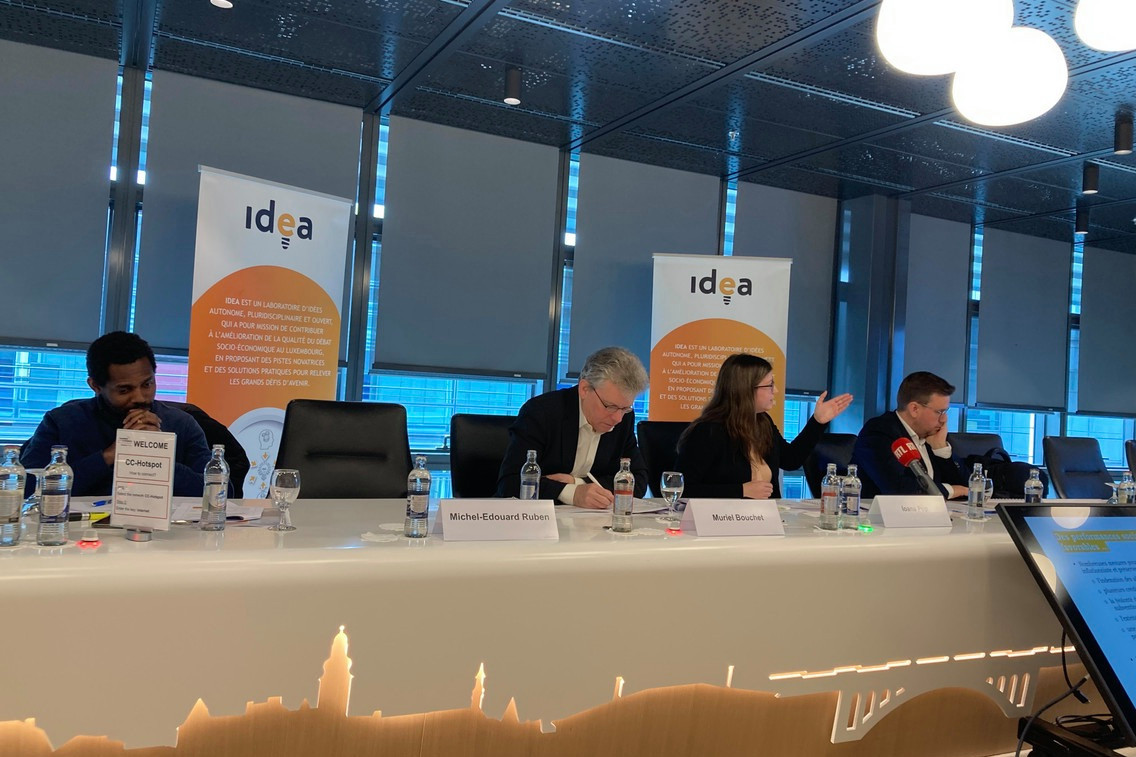
“On the economic front, we have seen a term of office with many surprises: we were vulnerable to shocks that we had not imagined and which arrived, and there was a fairly rapid mobilisation of intermediary bodies and public authorities in Luxembourg to deal with the problems with a certain speed and above all in a pragmatic manner,” said Vincent Hein, economist at the Idea Foundation. On Wednesday 29 March, the thinktank presented its latest working document.
“The economic retrospective of the past five years is largely dominated by the analysis of the effects of a succession of two shocks, first health and then geopolitical, against which the Luxembourg economy seems to have bent (a little), but not broken,” he continued. “The government managed them well, firstly because Luxembourg was lucky enough not to be affected by the pandemic in the same way as other European regions. And secondly, the government had budgetary leeway that not all European countries necessarily had.”
A small miracle in terms of employment
Muriel Bouchet, Vincent Hein, Ioana Pop and Michel-Edouard Ruben’s analysis explained, among other things, that inflation has been contained, that there has still been a slight slowdown in investment, that unemployment is below the 2018 level and that Luxembourg is still attracting people with the notable phenomenon of “atypical neo-frontier workers”--border workers of Luxembourg nationality, who represent almost one job in ten over the period 2017-2022.
“The country is experiencing a small employment miracle: despite the crises, the Luxembourg economy has continued to create many jobs over the last five years with an average annual growth rate of domestic employment of 3.1%, compared to an average of +3% between 2013 and 2018,” said Pop. “In total, the country has 70,000 more jobs than five years ago. The unemployment rate has also started to fall in 2021 and is now lower than at the beginning of the mandate (4.8% compared to 5.5%).”
During this 2018-2022 period, activity was also strongly supported by public spending, with many measures put in place to limit the inflationary push and preserve purchasing power. “These budgetary margins of manoeuvre have been appreciable in the face of shocks, but public spending has risen from 42.3% of GDP in 2018 to 44.9% in 2023. There will inevitably be a time when the state’s budgetary margins for manoeuvre will no longer be as large as they were four years ago. So we may also have to enter into slightly more complicated discussions on the distribution of the efforts to be made in crises,” warned Hein.
“Fewer gifts for everyone”
The 2023 budget predicted a sharp rise in public debt in the years to come. While the consolidated gross debt would already have risen from 20.9% in 2018 to 26.3% in 2023, it would come close to the government's 30% threshold from 2026, with 29.5%.
Will the debt therefore be one of the challenges of the next government? Hein stated: “Yes, Luxembourg is a small country that is very open to headwinds, and must perhaps pay more attention than others to the stability of its public finances, which is also an argument of attractiveness for investors, and the transitions that are ahead of us, especially the ecological transition, will require additional investments. But, in our opinion, this will require that public spending be directed more towards investment than towards non-targeted spending, which has been the case during this term. So, clearly, the next government will probably have to be more courageous and will probably have to give fewer gifts to everyone, target its policies and show that it is preparing for the future more than it is acting as a fireman.”
This article was first published in French on Paperjam and translated for Delano.