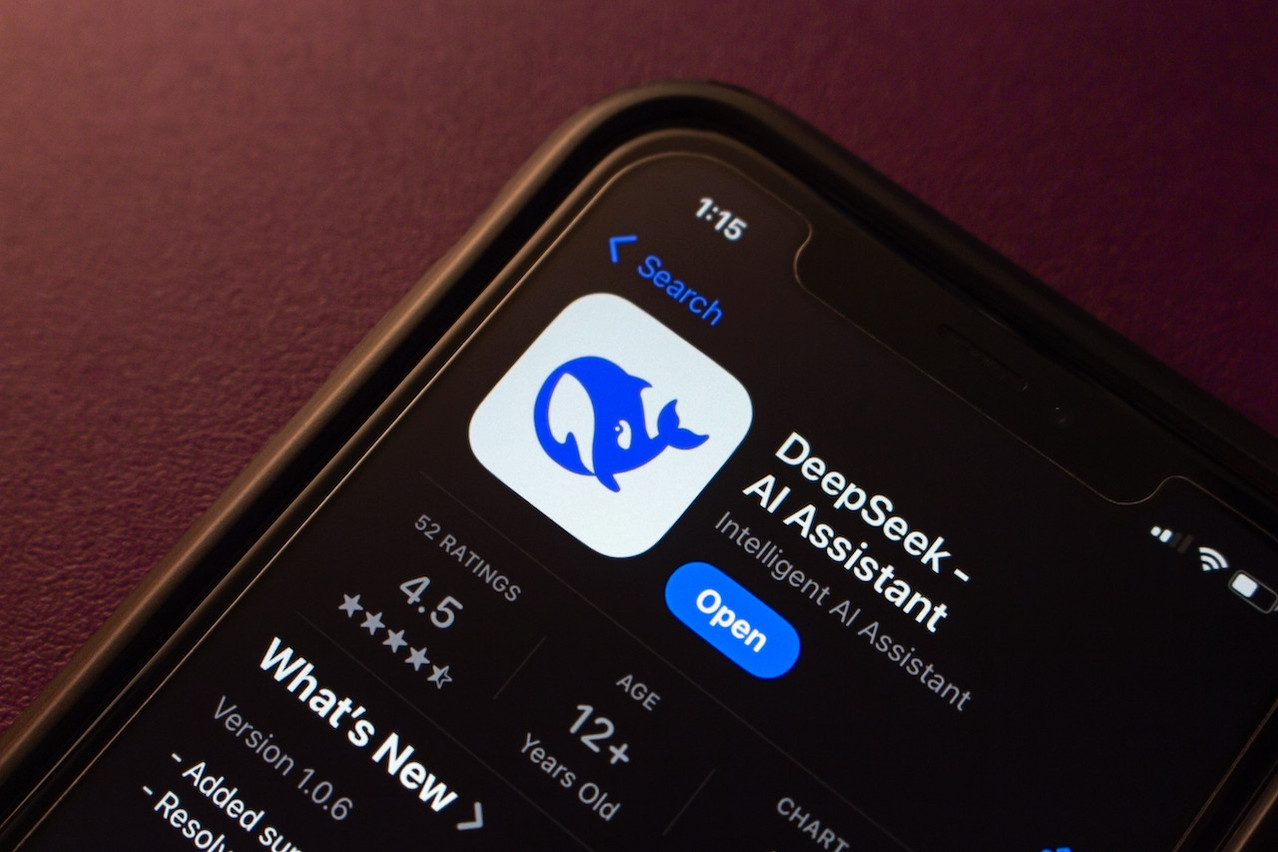
“On 3 February 2025, the National Commission for Data Protection (CNPD) released data protection recommendations to the public in relation to Deepseek. The CNPD drew the public’s attention to the risks and specified that this generative AI model was not designed for European consumers,” says a parliamentary response from three ministers, though signed only by economy minister 
“On 30 January 2025,” the response continues, “the Government Data Protection Commissioner’s Office at the digitalisation ministry sent an email communication to all state employees giving guidance on the use of artificial intelligence tools to employees and issuing recommendations. In particular, it is recommended not to share unpublished professional information with applications, including AI services, that have not been provided by the state.”
"Its use raises significant concerns, particularly in terms of data collection and processing without sufficient safeguards,” the CNDP said in early February. “Data entered by users in ‘prompts’ may be recorded, transferred, stored or analysed without a clear data protection framework. Moreover, this makes it difficult, if not impossible, for data subjects to exercise their rights under the General Data Protection Regulation (GDPR). The absence of a Deepseek representative in the European Union creates legal uncertainty for users in Luxembourg and the EU. This leads to a lack of clear guarantees in terms of compliance with the GDPR, a lack of transparency regarding the governance of this AI, as well as the potential involvement of state or third-party actors in data management, amplifying the risks of violation of personal data and the fundamental right to privacy.”
The CNPD made four recommendations:
—Avoid installing the Deepseek model and its configuration files in any IT environment, in order to limit exposure to the risks of data leakage or misuse.
—When using the online interface, never enter personal or confidential data, as this could be exploited without adequate safeguards.
—Actively raise awareness among employees (professional sphere) and users (personal sphere) of the risks associated with the use of this AI.
—Favour AI tools that comply with the European regulatory framework (GDPR, AI Act), respect data protection principles and offer clear guarantees in terms of security and respect for privacy.
France, Ireland and Belgium, for example, have already launched investigations to understand how this artificial intelligence platform--which made a mockery of OpenAI’s ChatGPT because it cost much less to develop--works.
Italy, Taiwan and Australia, meanwhile, have banned its use on their soil. In the US, although no official federal ban has been put in place, several government agencies including Nasa and the Navy have banned Deepseek from their devices. In addition, lawmakers have proposed legislation to ban the application from government devices, citing national security concerns.
This article was originally published in French.