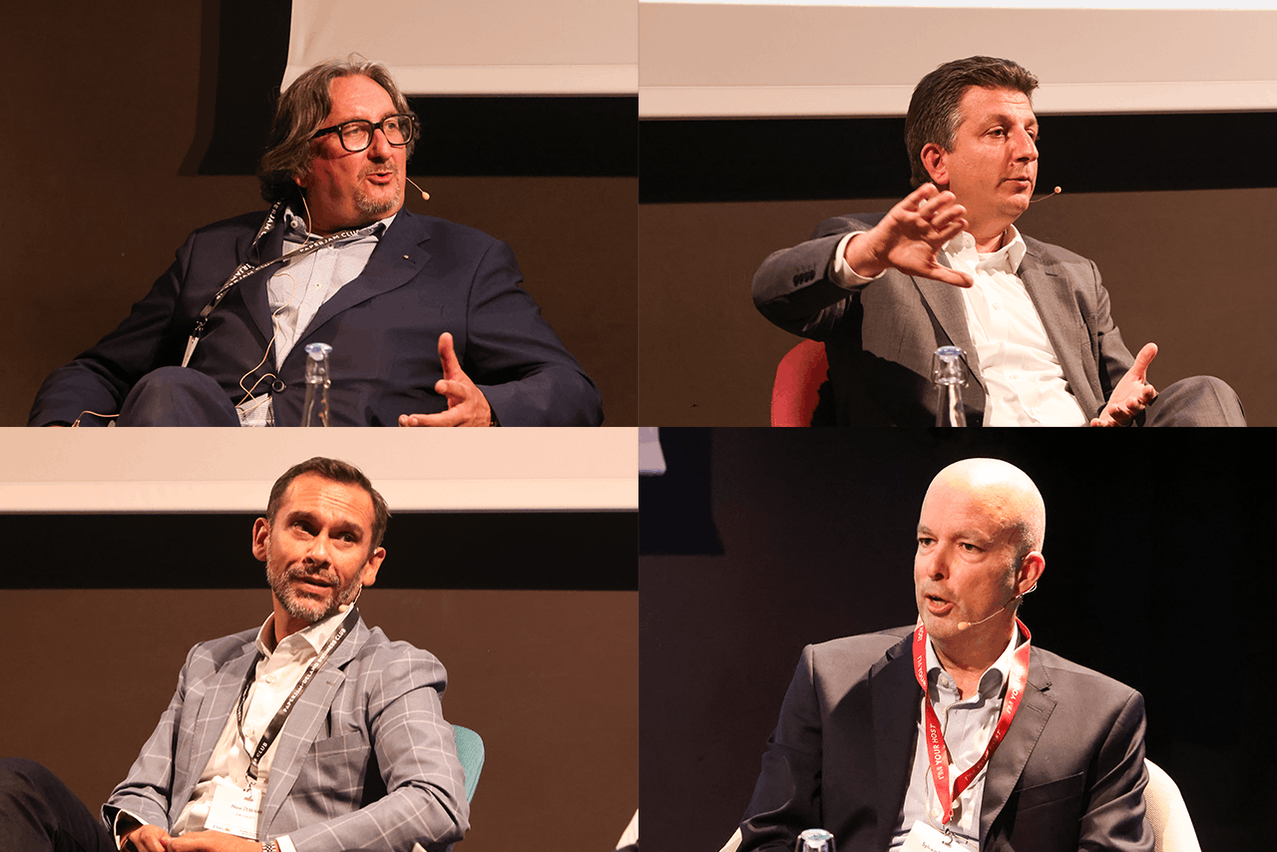
Panellists talked about the impact of various technologies in the private banking sector. The roundtable covered a large array of topic such as the role of mobile phone, digitalisation, (generative) AI, EU regulation, cryptos, fraud, data integrity and Eltifs.
What have been the most transformative pieces of technology for the sector in the last 10 years?
“The mobile phone. As simple as that. The ability for people to essentially look at their portfolios, manage their money, remotely, wherever they are anywhere in the world,” said Luxembourg House of Financial Technology’s CEO, 
Through a live survey with the audience, 
“We did also a study regarding some cliché on [behavioural] differences based on the age of people using the mobile phone. There are none anymore when you remove individuals aged above 80,” stated Martino.
“A new important development relates to open banking because people [have accounts] with many banks, but they try to consolidate, they change banks and they are also moving to neobanks,” said 
He added: “private banking is an extension of the digital retail banking on which you add the special relationship with the relationship manager [which includes] investment advice.”
Which parts of the private banking business exhibits the most reluctance to embrace technologies? Are there solutions to overcome this hesitancy?
“The biggest resistance to change comes from middle management,” claimed Zubairi. “They’re the ones that are the most uncomfortable. They don’t want change and they have resistance to change.” He also suggested that compliance is a case in point, given the amount of manual work plaguing that division. He thinks that the function could gain the most from digitalisation.
On AI tools, Zubairi suggested that “regardless of the explosion that’s occurred over the past year on ChatGPT, those models [for compliance] have been around for a long time. They are able to do a lot of the processing and investigative work, much faster, cheaper and probably more accurately than a human.”
“We run a fintech campus, corporate plus, we get middle management coming in from institutions… we try and open their eyes as to how ultimately these technologies are not there to replace them. Technologies are there to make them more productive, and potentially, and hopefully, get them more fulfilment in their jobs.”
Interestingly, Zubairi noted that “the most prudent about AI are the lawyers and the advisory firms, not the banks.”
What part of the private banking business would benefit the most from digitalisation?
Zubairi commented that using AI tools will make it easier to handle complex estate planning, tax structuring, leveraging life insurance wrappers for inheritance reasons or asset sales for high-net worth through and ultra-high net worth clients. “It can help you to instantly say ‘how best to structure this’,” enabling banks to help clients faster.
“It will be all the different departments in the bank (front, back and the control functions),” said Martino. He added: “Banks will become technology companies doing banking. I think it will be by design everywhere.”
On the competition that may come from Amazon, Google and Apple, Zubairi thinks “these guys will never set up a bank… as it could have repercussions from a compliance and regulatory perspective on their core business and they don’t want to mix.”
Is the private banking sector Luxembourg in a good position to cope with upcoming regulations on technology such as the Digital Operational Resilience Act (Dora), open finance framework or the Markets in Crypto-Assets (also known as Mica) regulation?
Overall, Diederich is not too concerned about Luxembourg banks or subsidiaries and branches from banks based in other EU countries. However, the situation is quite different for banks with HQ outside the EU that have to face the tough reality of paying high-fee consultants and lawyers to comply with EU regulations. On openAPI, he recalled a Swiss bank as saying, “that’s not for us, we will pay lawyers not to do it.”
What technologies (software, AI, trading platforms) help private bankers the most to offer personalised advice to high-net-worth clients?
“Private thinking is about proximity, trust, personalisation and the automation of the production,” said Martino. On proximity and trust, he explained that the regular communication between the relationship manager must now take place in “a secure way.”
On personalisation, he believes that modern systems enable private banks “to know better the clients with more personal records… not only the basics [datapoints].” That also helps to provide more personalised advice.
Zubairi suggested that whatever the generation you belong to, X, Y or Gen Z, there is a trend toward “the cult of me,” which is all about personalisation. He recalled a US company that works with 130 banks to which it provides white label online and mobile applications that learn how the user is engaging. It then personalises the service based upon the user behaviour. “Tools that provide this level of mass customisation and uniqueness to each and every person is going to be incredibly powerful,” argued Zubairi.
“The younger generation wants to party and make business,” said Diederich. He also noted reluctance by private banks to embrace cryptos, arguing “that this is for the kids.” He feels that there a need to inform private banks that “the kids will, at a certain moment, become the owners of the wealth.”
Are you observing a trend toward integrated software or do private banks prefer to rely on a hotchpotch of internally developed systems to which they are attaching external systems?
“I think there is no single model in the market. We see a lot of different legacies. Some people transformed, some did not,” commented Martino. Yet he noted a trend towards investing to be “best in cost.” Whereas there are others who “want to be able to differentiate [in terms of] client experience.”
How can AI help private bankers to offer personalised advice to high-net-worth clients?
“I firmly believe that whatever the technology, AI included will never replace the relationship manager,” said Martino. He rather believes in an “augmented relationship manager or AI powered relationship manager.” He added: “We can talk about real time access to some data, better client profiling, better risk management and potentially automated compliance aspects.”
“The intelligence for me is the RM. Machine learning is with the robot,” said Diederich. “Both together are a winning team.”
“There are negatives. The use of AI in any way shapes or forms within private banking, particularly around investments we’ll need to have complete explainability of transparency because if something goes wrong, you need to kind of be able to explain it,” said Zubairi. “We can’t rely on it too much.” He is particularly concerned about the risk of fraud as AI can do voice mimicking that may be a challenge for personal relationship management.
Diederich suggested the integrity and the volume of data will be key as “AI or machine learning is not capable of making difference between fake and real information.”
“Machines don’t bias, it is the data we put in that is biased,” stated Zubairi.
“From all the information I’ve got on ultra-high net worth, they are asking for the sustainable finance products. But complying with various taxonomies or rule sets, AI can present private bankers potential investment stocks adhering to certain criteria on carbon emissions, for instance. So, it will help assist in that way, but I don’t think personally, that there’s value creation in using an AI in private banking for the stock picking or for investment portfolio advice.”
The head of ETF servicing Europe at State Street bank recently told me in an interview that alternative investments (bank loan/properties) have already sneak in some ETF structures. Could such a vehicle make more sense than the illiquid Eltif structures?
“Yes. There is more flexibility, and I don’t get the hype around Eltifs. Retail investors do want to access maybe to private equity, but you’re still gonna have liquidity issues. I think ETFs provide much more flexibility at a lower cost base,” commented Zubairi.
Read also
Outlook: what will most likely be the most transformative pieces of technology for the sector in the next 10 years?
“I think we’ll be involved to open banking and the API economy,” said Diederich.
“I strongly believe in the next five to 10 years, AI and generative AI will be everywhere… including in our pocket,” stated Martino. He would also gamble on the success of Web 3 and augmented reality. “I believe that this kind of technology could bring even more proximity between the relationship manager and clients.” He also expects ESG and impact financing to slowly reach clients. He wished also to see virtually the projects he is contributing to through his investments.
“Biotech will display some unbelievable impact. The person that will turn 150 is already born... The hype cycle in biotech is still only not even a quarter of the way through the capabilities of being able to manufacture or grow algae that can breathe carbon.” As people will live longer “how does that impact private banking, financial services, pension funds?”