The prospect of a second index-linked pay rise this year is receding. In its latest ‘Conjoncture Flash’, published on Wednesday 24 June, Statec estimates that the measures adopted as part of the ‘Resilienzpak 2026’ sufficiently limit the impact of the energy crisis to keep its baseline scenario unchanged. The next indexation is therefore still expected in the second quarter of 2027, despite the shock caused in recent months by the blockade of the Strait of Hormuz and the surge in oil prices.
The statistics office emphasises that the measures agreed by the tripartite body are expected to keep the rise in energy prices at 2.3% this year, compared with 6.6% if they were not in place. Headline inflation is now forecast at 2.2% in 2026, compared with 2.5% in the initial scenario. Crucially, these measures reduce the risk of accelerating prices, which could bring forward the triggering of an index-linked pay rise in the second half of 2026.
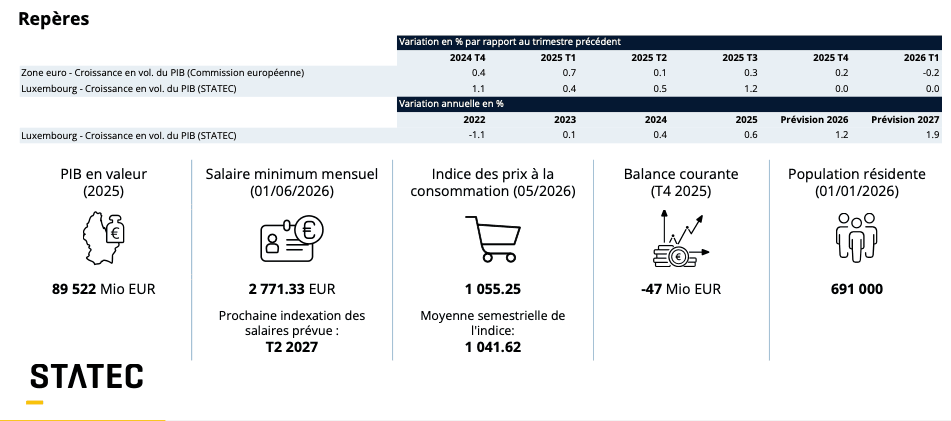
Rising energy prices have reignited inflationary pressures, but Statec is sticking to its forecast of a further index adjustment in the second quarter of 2027. (Photo: screenshot/Statec)
This relative lull in the index does not, however, mean that the Luxembourg economy has returned to normal. Statec describes an economic situation that is holding up, but whose driving forces remain fragile. In the first quarter, GDP remained stable. This result may seem disappointing at first glance, but it masks a more mixed picture.
The US-Iran conflict remains a cause for concern
The industrial sector weighed heavily on economic activity following the decline in capital goods production, whilst the financial sector also contributed to the slowdown. Conversely, several sectors that had been experiencing difficulties regained some momentum, notably construction, retail, transport and property.
The real cause for concern lies more in the months ahead. The consequences of the conflict between the United States and Iran continue to be felt, despite the announcement of a ceasefire and the gradual reopening of the Strait of Hormuz. Since the spring, business surveys have shown a sharp decline in consumer and business confidence. Tensions in global supply chains have also intensified, reaching their highest level since 2022.
This situation has already prompted the European Central Bank to take action. On 11 June, the ECB raised its key interest rates by 25 basis points in order to curb the resurgence of inflation observed in the eurozone. Inflation in the eurozone reached 3.2% in May, driven mainly by rising energy prices. This decision will result in more expensive borrowing costs for households and businesses.
Net assets are rising
Against this backdrop, however, Luxembourg’s financial sector continues to show resilience. Investment funds have returned to their growth trajectory following the stock market turbulence in March. Net assets rose by 15% year-on-year in April. This is a positive sign for Europe’s leading fund domicile, even though Irish competition continues to gain ground and is gradually narrowing the gap with the Grand Duchy.
Insurance also remains a key driver of business. Unit-linked products continue to fuel growth in the sector, although rising interest rates could gradually make guaranteed-return policies more attractive again.
The labour market, meanwhile, is sending more mixed signals. The labour force participation rate continues to rise and has reached its highest level in several years. However, unemployment is also on the rise, standing at 6.2% in May. According to Statec, this increase partly reflects the entry into the labour market of people who were previously economically inactive, rather than a sudden deterioration in the employment situation.