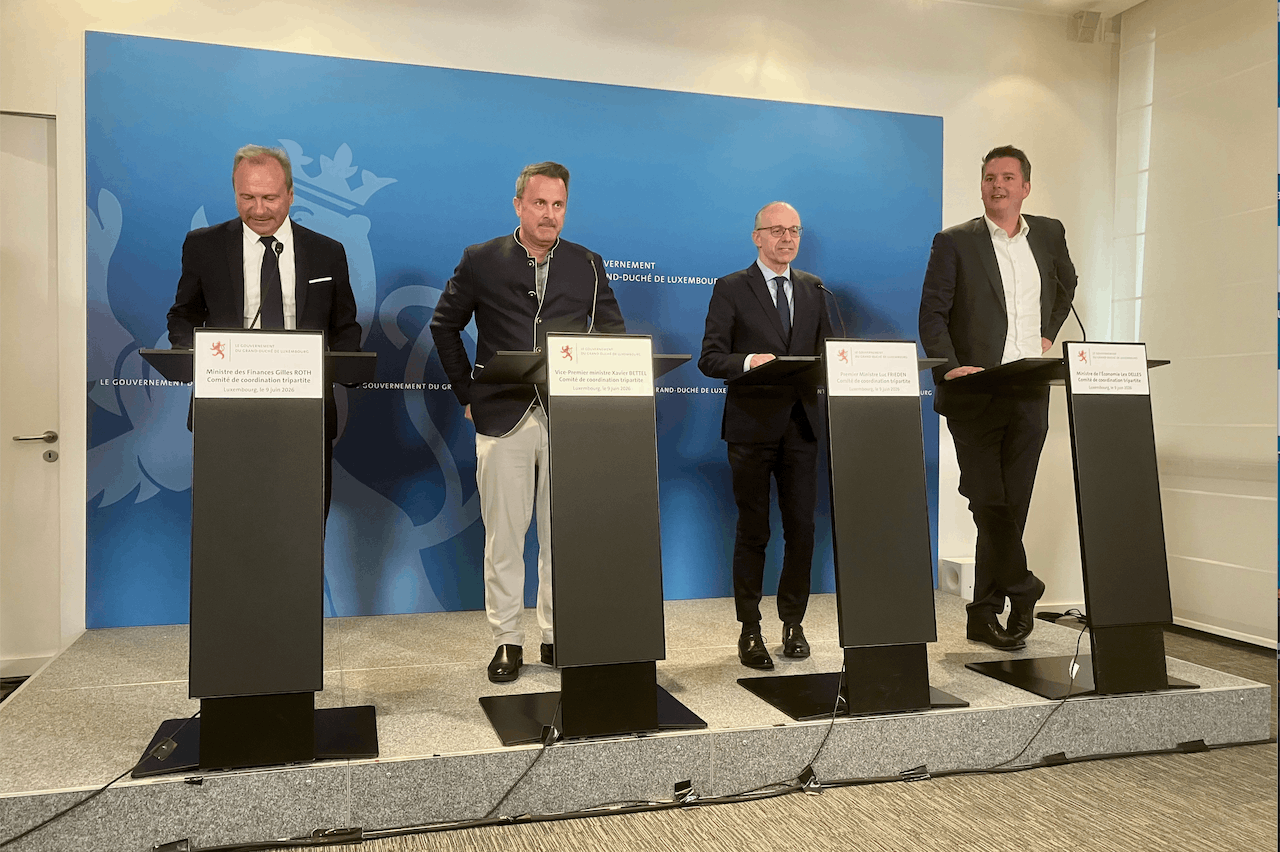
Addressing MPs, the Prime Minister  Luc Frieden defended the agreement reached with the social partners following the tripartite meeting. The agreement is based on three ‘fundamental’ objectives designed to strengthen the country’s resilience: curbing inflation and protecting households’ purchasing power; protecting the economy and safeguarding jobs, preventing businesses from succumbing to energy costs, and accelerating the energy transition “to reduce the country’s vulnerability to future crises”.
An agreement “which has managed to avoid pitting the interests of employees against those of businesses, in order to build sustainable economic and environmental resilience”. Luc Frieden welcomed this outcome and reaffirmed his commitment to social dialogue, a dialogue which, in his view, demonstrates a collective determination to protect citizens and businesses from the harmful effects of inflation whilst ensuring job security in an uncertain geopolitical climate.
So much for the political side of things.
We have the necessary financial resources to fund these measures.
Gilles Roth, Minister of Finance
Beyond that, this agreement will come at a cost. “We have the necessary financial leeway to fund these measures,” the Chancellor of the Exchequer insisted  Gilles Roth. According to him, revenue rose by 7.5% – an increase of €800m – over the first five months of the year compared with 2025. Expenditure, meanwhile, rose by 7.3%, “which makes it possible to fund the agreement”. “We must accept this impact in the interests of social cohesion. This is a request from the social partners. We have found a fair and financially viable compromise. Given a budget of €34bn, this effort is reasonable and in the interests of Luxembourg’s image,” the minister continued.
By 2026, the cost will reach €180m. €60m of this amount is attributable to measures designed to curb rising energy prices. These expenditure items will not be renewed in 2027. The temporary tax credit, which runs from 1 June until 31 December, will cost €70m. This tax credit will be replaced in 2027 by an adjustment to the tax scale equivalent to one index band. Targeted support measures for businesses will cost €40m. Agricultural aid will cost €5m, as will the increase in financial support for the energy transition.
In 2027, the impact on public finances will be €252.5m. €120m of this will be attributable to the increase in the minimum social wage – an increase that will be funded through an adjustment borne by businesses and a special tax credit. Aligning the scale with an index-linked bracket will also cost €120m. Removing the 40-year age limit for the doubling of tax-deductible home savings contributions will cost €10m. Finally, targeted aid for agriculture is estimated at €2.5m. What will be the impact on purchasing power? Gilles Roth estimates that the temporary tax credit will provide relief of up to 154 euros by the end of the year.
On behalf of the Minister for the Economy  Lex Delles, the Resilienzpak 2026 should – provided things do not go awry in the Middle East – keep inflation in check and thus prevent the triggering of further index-linked increases before mid-2027.
Social responsibility and economic rationale
According to the leader of the CSV parliamentary group,  Laurent Zeimet, the coalition has emerged from this process stronger and more dynamic. According to the DP chair and MP
 Carole Hartmann, this agreement is a political – and not merely technical – response to the current uncertainties. “It symbolises the country’s unity and the effectiveness of social dialogue, even in times of geopolitical tensions and trade crises,” said the MP, emphasising the good balance struck between “social responsibility and economic rationale”.
For  Taina Bofferding, chair of the LSAP group, believes this agreement could be improved. She calls for further action, notably through greater social targeting of benefits, a structural increase in the minimum wage, a phased-out of fossil fuels to invest heavily in renewable energy, and a ‘genuine’ tax reform that takes all sources of income into account. In a slight dig at the Prime Minister, the MP emphasised that social dialogue “must not be a mere reaction to situations of conflict or crisis, but a continuous process experienced on a daily basis”. So be it.
Investment for the majority, costs for the opposition
The ADR group leader  Fred Keup is concerned about the cost of this plan – estimated at €420m. Whilst Taina Bofferding sees it as an investment, he is worried about the resulting increase in national debt. “A debt whose burden will fall on future generations.” Without wishing to call them into question, he asserts that short-term aid is not enough. He calls for structural solutions to the country’s major problems, notably the housing crisis and the necessary support for the middle class.
 Sam Tanson (déi Gréng) was critical. Whilst she welcomed the continuation of social dialogue, she criticised the lack of firm action regarding the use of land and the protection of tenants in the face of the housing crisis. It also questioned the relevance of subsidies for fossil fuels, suggesting that a reduction in VAT on basic foodstuffs would be fairer for citizens. It also raised concerns about the funding of these measures and their impact on public debt.
Serious concerns have been raised regarding the funding of the planned tax reform and the rise in national public debt.
 Marc Goergen (den Piraten) welcomes the financial support measures introduced in response to the energy crisis. Above all, however, he regrets the absence of an automatic indexation mechanism for tax scales and criticises the lack of taxes on oil companies’ windfall profits. It expresses qualified satisfaction, emphasising that the state must protect citizens’ purchasing power without creating new structural burdens.
For  Marc Baum (déi Lénk), it is social dialogue that has emerged from these discussions as an essential pillar of national stability. A thorn in the side of neoliberalism. He believes that the measures designed to support the purchasing power of low-wage earners are insufficient and criticises the lack of far-reaching structural reforms.